
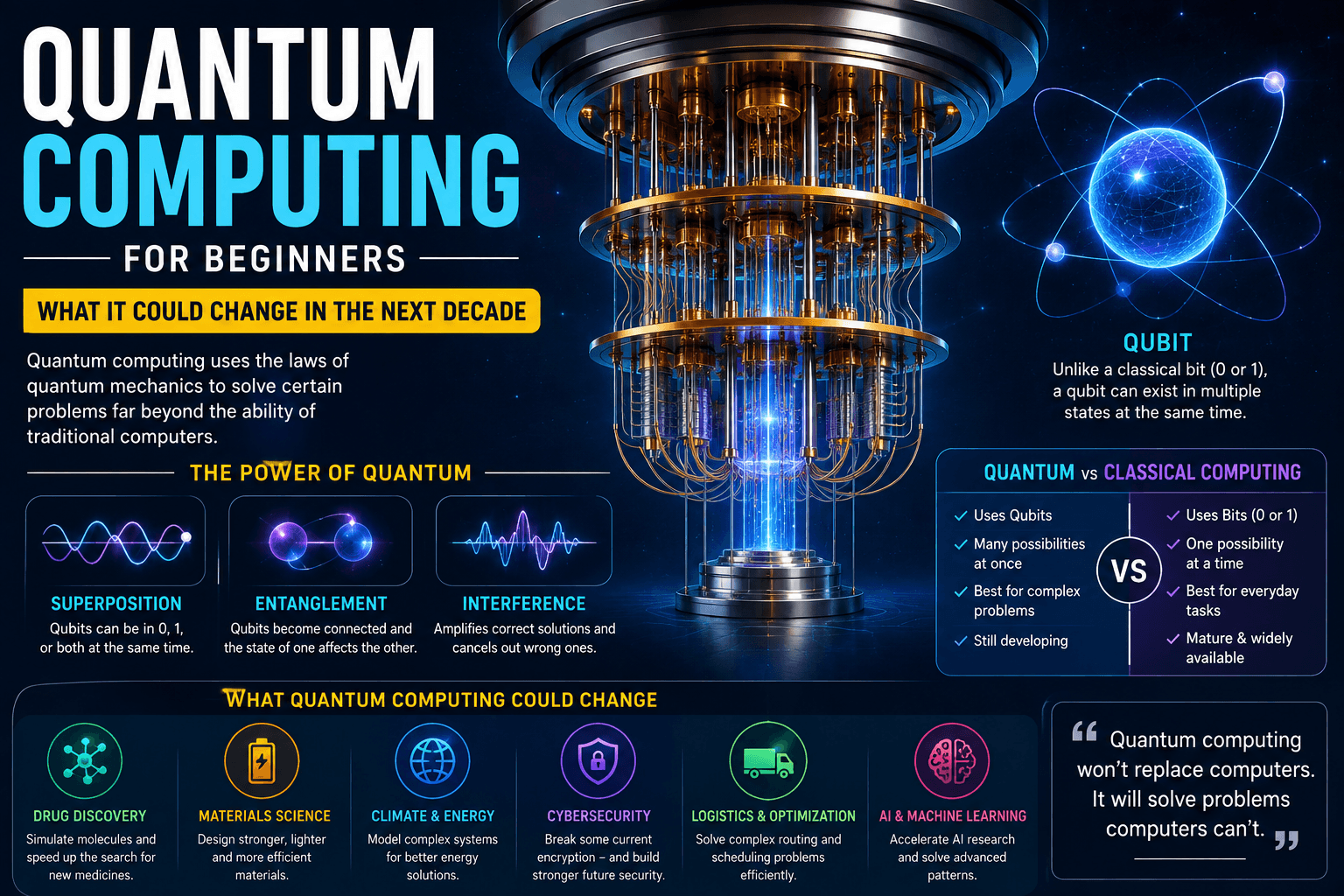

Quantum computing is one of the most fascinating areas of modern technology. Unlike traditional computers, which process information using classical bits, quantum computers use principles from quantum mechanics to process certain types of problems in fundamentally different ways.
Although large-scale, fault-tolerant quantum computing is still an evolving field, researchers and technology companies are making progress. Over the next decade, quantum computing could influence areas such as scientific research, cybersecurity, materials development, logistics, and artificial intelligence.
This beginner's guide explains what quantum computing is, how it works, and what it could change in the future.
What Is Quantum Computing?
Quantum computing is a type of computing that uses quantum-mechanical properties to process information.
Traditional computers use bits. A bit can represent one of two values:
0
1
Quantum computers use quantum bits, or qubits.
A qubit can have quantum properties that allow it to represent information in ways that are different from a classical bit.
This does not mean that a quantum computer is automatically faster than a traditional computer at every task. Quantum computing is expected to be particularly useful for certain specialized problems.
How Is a Qubit Different from a Classical Bit?
A classical bit is generally represented as either 0 or 1.
A qubit can exist in a quantum state involving a combination of possibilities. This concept is commonly explained using superposition.
However, when a qubit is measured, a definite outcome is observed.
Quantum computing also involves another important phenomenon called entanglement, where quantum systems can have correlated states.
These properties allow quantum algorithms to process information differently from classical algorithms.
The Three Basic Concepts of Quantum Computing
1. Superposition
Superposition allows a qubit to exist in a quantum state that can involve multiple possibilities.
This property is one of the reasons quantum computers can use different computational approaches for certain problems.
2. Entanglement
Entanglement is a quantum phenomenon where the states of particles or qubits can become strongly correlated.
In quantum computing, entanglement can be used to create relationships between qubits that support certain types of quantum calculations.
3. Interference
Quantum algorithms use interference to increase the probability of useful outcomes and reduce the probability of unwanted outcomes.
These three concepts form an important foundation for understanding quantum computing.
How Does a Quantum Computer Work?
A quantum computer uses qubits and quantum operations to perform calculations.
The basic process can involve:
Preparing qubits in specific quantum states.
Applying quantum gates.
Creating interference patterns.
Measuring the final quantum states.
Interpreting the results.
Because quantum states are extremely sensitive, quantum computers require specialized environments and error-management techniques.
Some quantum systems operate at extremely low temperatures, while other approaches use different physical technologies.
Types of Quantum Computers
There are several approaches to building quantum computers.
Superconducting Qubits
This approach uses electrical circuits that can behave according to quantum principles under carefully controlled conditions.
Trapped Ions
Trapped-ion systems use electrically charged atoms controlled with electromagnetic fields and lasers.
Photonic Quantum Computing
This approach uses particles of light, known as photons, to process quantum information.
Neutral Atoms
Neutral atoms can be precisely controlled and arranged to create quantum computing systems.
Each approach has advantages and technical challenges.
What Problems Could Quantum Computers Solve?
Quantum computers are not designed to replace laptops or smartphones.
Instead, they may eventually help solve highly specialized problems.
Drug Discovery and Healthcare Research
Quantum computing could help researchers simulate complex molecular interactions.
This may support the development of new medicines and materials.
However, scientific validation and testing would still be required.
Climate and Energy Research
Researchers may use quantum computers to model complex chemical processes related to:
Batteries
Solar energy
Carbon capture
New materials
Cybersecurity
Quantum computing could eventually affect some current cryptographic systems.
This is why governments and organizations are researching post-quantum cryptography—security methods designed to remain secure against future quantum computing capabilities.
Logistics and Optimization
Some quantum algorithms may eventually help with complex optimization problems involving:
Delivery routes
Supply chains
Manufacturing
Financial systems
The practical advantage of quantum computing for specific optimization tasks remains an active area of research.
Artificial Intelligence
Quantum computing may eventually contribute to specialized machine learning and data-processing research.
However, the relationship between quantum computing and AI is still developing.
Why Is Quantum Computing Difficult?
Building a useful quantum computer is extremely challenging.
Qubits Are Sensitive
Quantum states can be disrupted by environmental interference, often called noise.
Error Correction Is Complex
Quantum systems experience errors, and correcting those errors can require significant additional resources.
Hardware Is Difficult to Scale
Creating larger systems with many reliable qubits is a major engineering challenge.
Specialized Infrastructure Is Required
Some quantum computers require complex cooling systems and highly controlled environments.
These challenges explain why practical large-scale quantum computing remains an active area of research and development.
Quantum Computing vs Classical Computing
Classical Computing | Quantum Computing |
|---|---|
Uses bits | Uses qubits |
Best for everyday computing | Designed for specialized problems |
Mature and widely available | Still developing |
Uses classical algorithms | Uses quantum algorithms |
Reliable and scalable | Faces major technical challenges |
The future is likely to involve classical and quantum computers working together.
How Could Quantum Computing Affect Businesses?
Businesses are beginning to explore potential quantum applications.
Possible future areas include:
Financial modeling
Supply chain optimization
Materials research
Drug development
Cybersecurity planning
However, many businesses do not yet need a quantum computer.
A more immediate priority may be understanding how future quantum developments could affect cybersecurity and long-term technology strategy.
The Importance of Post-Quantum Cryptography
One of the most discussed topics related to quantum computing is cybersecurity.
Some widely used encryption methods could become vulnerable if sufficiently powerful quantum computers become available.
This has encouraged the development and adoption planning of post-quantum cryptography.
Organizations that store sensitive information for long periods may need to begin evaluating future cryptographic risks.
A gradual and carefully planned transition can help organizations prepare for future developments.
Will Quantum Computers Replace Traditional Computers?
No, quantum computers are unlikely to replace traditional computers for everyday tasks.
Classical computers are highly efficient for:
Browsing the internet
Writing documents
Watching videos
Running business applications
Everyday software
Quantum computers are designed for specialized computational problems.
The future may involve hybrid computing, where classical and quantum systems work together.
The Future of Quantum Computing
The next decade may bring important advances in quantum hardware, software, and error correction.
Researchers are working to create systems that are:
More reliable
Less sensitive to errors
Larger in scale
Easier to program
Progress is difficult to predict, and the timeline for large-scale practical quantum computing remains uncertain.
However, research investment continues because the potential scientific and technological benefits could be significant.
How to Start Learning About Quantum Computing
Beginners can start by learning:
Basic computer science concepts.
Linear algebra fundamentals.
Probability.
Quantum mechanics basics.
Quantum algorithms.
You do not need to become a physicist to understand the basic concepts.
Many educational platforms and software development kits also provide simulated quantum computing environments.
Common Misconceptions About Quantum Computing
“Quantum Computers Are Faster at Everything”
False. Quantum computers are expected to offer advantages only for certain types of problems.
“Quantum Computers Will Replace Laptops”
Unlikely. They are designed for specialized tasks rather than everyday computing.
“Quantum Computing Is Only Science Fiction”
False. Real quantum computers exist today, although the technology is still developing.
“Quantum Computers Can Instantly Break All Encryption”
This is an oversimplification. The threat depends on the type of cryptography and the capabilities of future quantum computers.
Final Thoughts
Quantum computing is an exciting technology with the potential to transform scientific research and solve certain highly complex problems.
However, it is still developing, and many technical challenges remain.
The most realistic future may involve quantum computers working alongside traditional computers rather than replacing them.
For beginners, the key is to understand that quantum computing is not simply a faster version of today's computers. It is a different approach to computation that may become valuable for specific scientific, industrial, and technological challenges.
Frequently Asked Questions
1. What is quantum computing?
Quantum computing is a type of computing that uses quantum-mechanical principles to process information using qubits.
2. What is a qubit?
A qubit is the basic unit of quantum information used by a quantum computer.
3. Are quantum computers faster than normal computers?
They are not necessarily faster for every task. Their potential advantages apply to specific types of problems.
4. Can I buy a quantum computer?
Quantum computing hardware is highly specialized, but some quantum computing platforms can be accessed through cloud services and simulators.
5. Will quantum computers replace laptops?
No. Quantum computers are designed for specialized tasks and are unlikely to replace everyday computers.
6. What industries could benefit from quantum computing?
Potential industries include healthcare, pharmaceuticals, finance, logistics, energy, materials science, and cybersecurity.
7. Why do quantum computers need special environments?
Quantum states are sensitive to noise and environmental interference, so many quantum systems require carefully controlled conditions.
8. What is quantum entanglement?
Entanglement is a quantum phenomenon where quantum systems can have strongly correlated states.
9. What is post-quantum cryptography?
Post-quantum cryptography refers to cryptographic methods designed to resist potential attacks from future powerful quantum computers.
10. Is quantum computing available today?
Yes. Real quantum computing systems exist, but large-scale fault-tolerant quantum computing remains under development.