
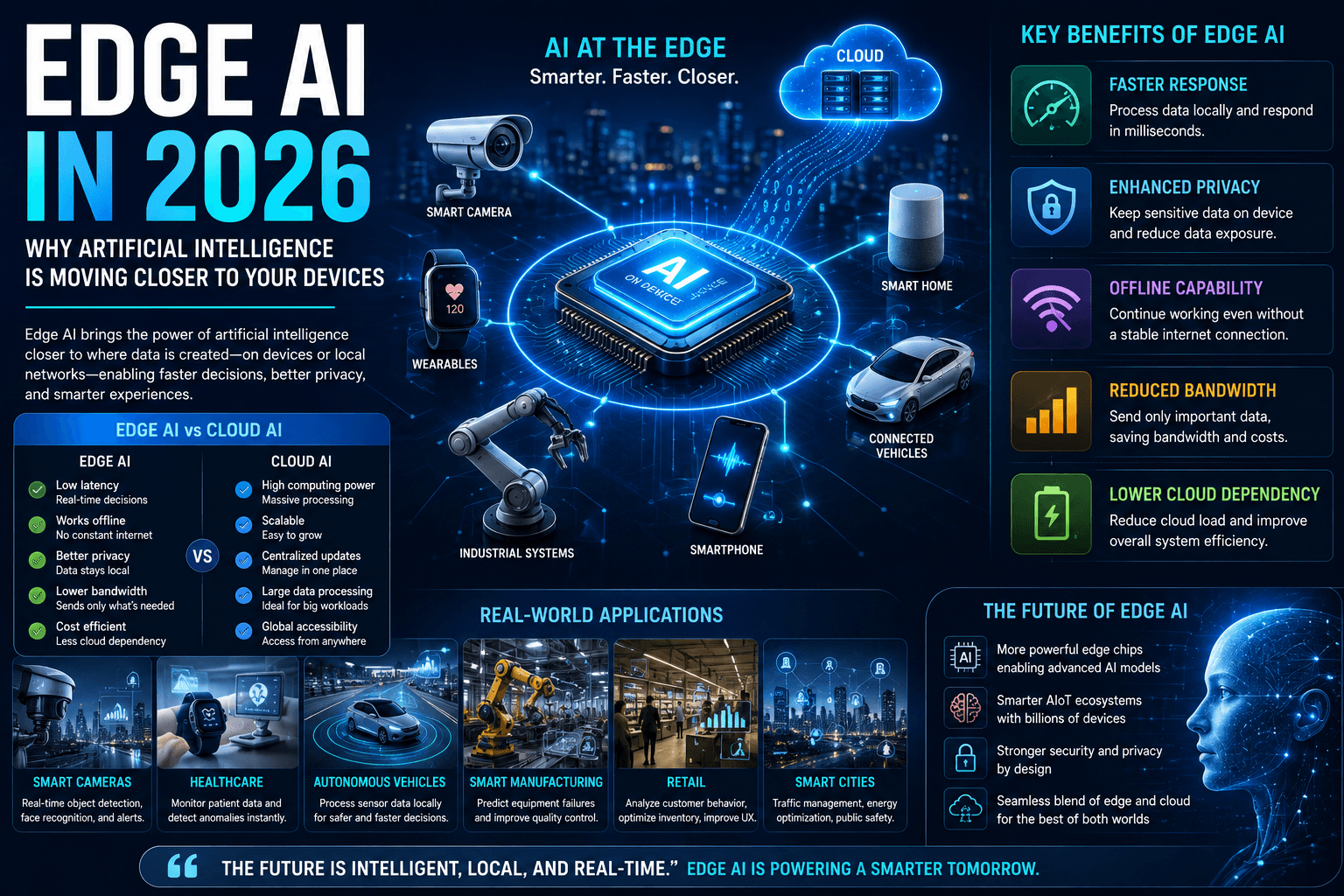

Artificial intelligence is becoming increasingly integrated into everyday technology. Traditionally, many AI systems have relied heavily on cloud computing, where data is sent from a device to remote servers for processing.
However, a growing technology trend is changing this approach: Edge AI.
Edge AI allows certain artificial intelligence tasks to run directly on devices or on nearby computing infrastructure instead of relying entirely on distant cloud servers. In 2026, Edge AI is becoming important for smartphones, smart cameras, vehicles, industrial systems, healthcare devices, and other connected technologies.
This article explains what Edge AI is, how it works, its benefits, challenges, and potential impact on the future of technology.
What Is Edge AI?
Edge AI refers to the use of artificial intelligence on devices located close to where data is created.
Instead of sending all information to a distant cloud server, an Edge AI system can process some data locally.
For example, a smart security camera may use AI directly on the device to detect movement or recognize specific types of objects.
This approach can reduce the need to continuously send all video data to a remote server.
What Does “The Edge” Mean?
In computing, the edge refers to locations near the source of data.
Examples include:
Smartphones
Smart cameras
Wearable devices
Vehicles
Factory equipment
Retail sensors
Local servers
Edge computing moves certain processing tasks closer to these devices.
Edge AI combines this approach with artificial intelligence.
Edge AI vs Cloud AI
Both Edge AI and cloud AI can be useful.
Cloud AI
Cloud-based AI typically processes information using remote data centers.
Advantages may include:
Access to powerful computing resources
Ability to process large datasets
Easier centralized updates
Potential limitations include:
Internet dependence
Network delays
Data transfer requirements
Privacy concerns
Edge AI
Edge AI processes some information locally or near the data source.
Potential advantages include:
Faster response times
Reduced data transmission
Better offline capabilities
Potential privacy benefits
In many real-world systems, Edge AI and cloud AI work together.
How Does Edge AI Work?
An Edge AI system generally follows these steps:
1. Data Is Collected
A device collects information using:
Cameras
Sensors
Microphones
GPS systems
Other connected technologies
2. The AI Model Runs Locally
A trained AI model is deployed to the device or nearby hardware.
The system processes incoming information.
3. A Decision Is Made
The AI model identifies patterns and produces an output.
For example, it may determine whether an object is:
A person
A vehicle
An animal
4. An Action Is Taken
Depending on the system, the device may:
Send an alert
Trigger an automated action
Display information
Store selected data
5. The Cloud May Be Used When Needed
The device may still connect to cloud systems for:
Model updates
Data storage
Advanced analysis
System management
This hybrid approach combines local intelligence with cloud computing.
Why Is Edge AI Important in 2026?
The number of connected devices continues to grow.
Sending every piece of information from every device to distant cloud servers can create challenges involving:
Network bandwidth
Latency
Cost
Privacy
Edge AI can help process information closer to where it is generated.
This can make certain systems faster and more efficient.
Key Benefits of Edge AI
1. Faster Response Times
One of the biggest advantages of Edge AI is reduced latency.
When a device can process information locally, it may not need to wait for information to travel to a distant server and return.
This is especially important for applications such as:
Autonomous systems
Industrial automation
Healthcare monitoring
Smart security
2. Improved Privacy
Processing information locally can reduce the amount of sensitive data that needs to leave a device.
For example, a system may analyze information on-device and transmit only the result rather than the complete raw data.
However, Edge AI does not automatically guarantee privacy. Strong security and responsible data practices are still necessary.
3. Better Offline Functionality
Some Edge AI systems can continue working even when an internet connection is limited or temporarily unavailable.
This can be useful in:
Remote locations
Vehicles
Industrial facilities
Emergency environments
4. Reduced Bandwidth Use
Sending large amounts of data, such as high-resolution video, can consume significant network resources.
Edge AI can filter or analyze data locally before transmitting only the necessary information.
5. Lower Cloud Processing Requirements
Local processing can reduce the amount of information that needs to be processed in cloud data centers.
This may help organizations manage computing resources more efficiently.
Real-World Applications of Edge AI
Smartphones
Modern smartphones increasingly use on-device AI for tasks such as:
Photography improvements
Voice processing
Language features
Image recognition
Personalization
On-device AI can provide faster results and may reduce the need to send certain data to external servers.
Smart Cameras
AI-powered cameras can detect and classify objects directly at the edge.
Applications include:
Security monitoring
Traffic management
Retail analytics
Workplace safety
Healthcare Devices
Wearable devices and medical technologies may use Edge AI to analyze information in real time.
Potential applications include:
Health monitoring
Emergency alerts
Activity tracking
Healthcare systems require strong validation, privacy protections, and appropriate regulatory compliance.
Autonomous Vehicles
Vehicles generate large amounts of sensor data.
Edge AI can help process information from:
Cameras
Radar
Other sensors
Fast local processing is important for systems that need to respond quickly.
Smart Manufacturing
Factories can use Edge AI for:
Equipment monitoring
Quality control
Predictive maintenance
Safety monitoring
Local processing can help organizations identify problems quickly.
Retail
Retail businesses may use Edge AI for:
Inventory monitoring
Customer service systems
Store analytics
Automated checkout technologies
Privacy and transparency should be considered when deploying customer-facing systems.
Edge AI and the Internet of Things
The Internet of Things, or IoT, connects physical devices to digital networks.
As the number of connected devices grows, Edge AI can make these devices more intelligent.
Instead of simply collecting data and sending it elsewhere, devices can analyze information and respond locally.
This combination is sometimes called AIoT, or Artificial Intelligence of Things.
Challenges of Edge AI
Despite its benefits, Edge AI also faces several challenges.
Limited Hardware Resources
Edge devices may have less computing power, memory, and battery capacity than large cloud servers.
AI models often need to be optimized for efficient local operation.
Security Risks
Connected devices can become targets for cyberattacks.
Organizations must protect:
Devices
AI models
Data
Software updates
Model Updates
Keeping AI models updated across large numbers of devices can be challenging.
Accuracy Limitations
Smaller models designed for edge devices may not always perform as well as larger cloud-based models.
Developers need to balance accuracy with speed and resource efficiency.
Device Management
Organizations using thousands of connected devices need effective systems for:
Monitoring
Updating
Securing
Managing devices
Edge AI vs Generative AI
Edge AI and generative AI are different concepts, but they can work together.
Generative AI can create:
Text
Images
Audio
Other content
Edge AI focuses on where AI processing takes place.
Some generative AI models are now being optimized to run partially or entirely on devices.
This could allow users to access certain AI features with greater speed and reduced dependence on internet connectivity.
The Future of Edge AI
Edge AI is likely to become increasingly important as devices become more powerful.
Future developments may include:
More powerful AI chips
Smaller and more efficient AI models
Better on-device generative AI
Improved battery efficiency
Stronger security technologies
More intelligent IoT systems
The future will likely involve a combination of cloud computing and Edge AI.
Different tasks will be processed in different locations depending on factors such as speed, cost, privacy, and computing requirements.
How Businesses Can Prepare for Edge AI
Businesses interested in Edge AI can begin by identifying situations where local processing provides a clear advantage.
Ask:
Does this application require extremely fast responses?
Is internet connectivity unreliable?
Does the system process sensitive information?
Is large-scale data transmission expensive?
Would local processing improve efficiency?
Start with clearly defined use cases and carefully evaluate the results.
Best Practices for Using Edge AI
Organizations should:
Choose the right hardware for the workload.
Optimize AI models for edge devices.
Protect devices and data.
Keep software and models updated.
Test performance in real-world environments.
Consider privacy requirements.
Use human oversight for high-risk applications.
Monitor system accuracy over time.
Final Thoughts
Edge AI represents an important shift in how artificial intelligence is delivered.
Instead of relying entirely on distant cloud servers, devices can increasingly process information closer to where it is created.
This approach can provide faster responses, better offline functionality, reduced bandwidth use, and potential privacy benefits.
From smartphones and smart cameras to factories and vehicles, Edge AI is helping create more responsive and intelligent technology.
As AI hardware and software continue to improve, the combination of Edge AI and cloud computing is likely to shape the next generation of connected devices.
Frequently Asked Questions
1. What is Edge AI?
Edge AI is artificial intelligence that processes data directly on a device or near the location where the data is created.
2. What is the difference between Edge AI and cloud AI?
Cloud AI typically processes data in remote data centers, while Edge AI processes some data locally or closer to the device.
3. What are the benefits of Edge AI?
Benefits may include faster response times, reduced bandwidth use, better offline functionality, and potential privacy advantages.
4. Where is Edge AI used?
Edge AI is used in smartphones, smart cameras, vehicles, healthcare devices, industrial systems, and other connected technologies.
5. Does Edge AI require the internet?
Not always. Some Edge AI systems can perform certain tasks without a continuous internet connection.
6. Is Edge AI more private?
Local processing can reduce the amount of data sent to external servers, but privacy still depends on the overall system design and security practices.
7. What are the challenges of Edge AI?
Challenges include limited hardware resources, security risks, model management, and balancing accuracy with efficiency.
8. What is Edge AIoT?
AIoT combines artificial intelligence with the Internet of Things, allowing connected devices to analyze information and make intelligent decisions.
9. Can generative AI run on Edge devices?
Some generative AI models can be optimized to run partially or entirely on compatible devices.
10. What is the future of Edge AI?
The future may include more powerful AI chips, efficient models, stronger security, and greater integration between Edge AI and cloud computing.