
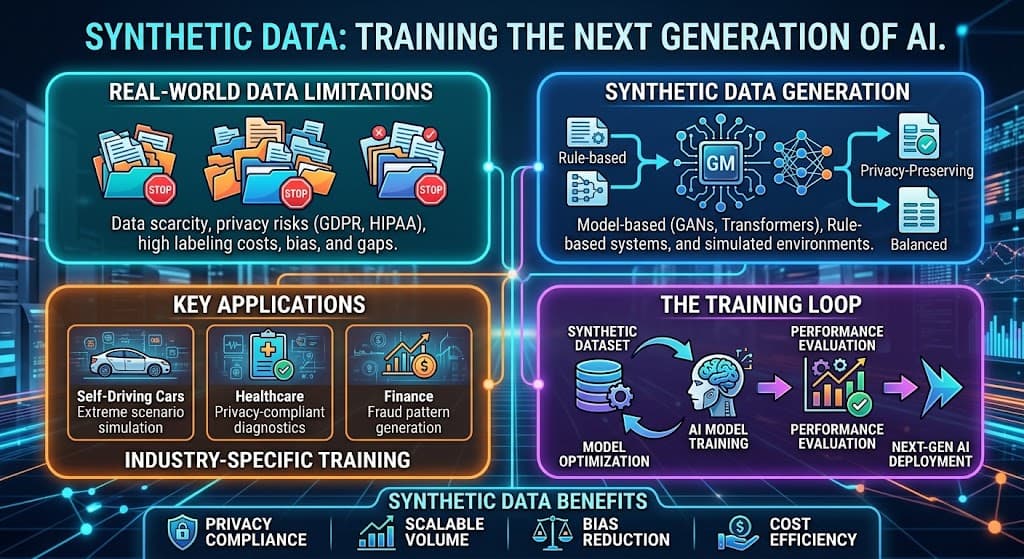

Artificial intelligence depends heavily on data. AI systems need large amounts of information to learn patterns, make predictions, and perform tasks. However, obtaining real-world data can be expensive, difficult, or restricted because of privacy and security concerns.
This is where synthetic data is becoming increasingly important.
Synthetic data is artificially generated information designed to resemble real-world data. It can help researchers and businesses develop and test AI systems without relying entirely on real personal or sensitive information.
What Is Synthetic Data?
Synthetic data is data created artificially using algorithms, simulations, or AI models.
It can take many forms, including:
Images
Videos
Text
Audio
Financial records
Medical data
Customer information
Sensor data
The goal is to create data that represents useful patterns without simply exposing real individuals' information.
How Is Synthetic Data Created?
There are several methods used to create synthetic data.
1. AI Models
Generative AI models can create new examples based on patterns learned from existing data.
For example, an AI system may generate artificial images of objects to help train a computer vision system.
2. Computer Simulations
Simulated environments can generate realistic data.
For example, self-driving vehicle developers can create virtual roads, traffic, weather conditions, and obstacles to test AI systems safely.
3. Mathematical Models
Statistical methods can generate artificial datasets with characteristics similar to real-world information.
Why Is Synthetic Data Important?
The demand for data is increasing as AI systems become more advanced.
However, real-world data can have several problems:
It may contain private information.
It can be expensive to collect.
It may be limited or difficult to access.
It may not include rare situations.
It can contain biases.
Synthetic data may help address some of these challenges.
1. Improving Privacy
Privacy is one of the biggest reasons organizations are interested in synthetic data.
Companies working with sensitive information, such as healthcare or finance, may need ways to develop AI systems without unnecessarily exposing personal data.
However, synthetic data is not automatically anonymous or risk-free. Its privacy properties depend on how it is created and evaluated.
2. Training AI for Rare Events
Some important events are difficult to capture in real-world datasets because they happen rarely.
For example, autonomous vehicles need to recognize unusual situations such as:
Severe weather
Unexpected obstacles
Dangerous road conditions
Unusual traffic situations
Synthetic environments can create many examples of these rare situations for testing and training.
3. Reducing Data Collection Costs
Collecting and labeling large datasets can require significant time and money.
Synthetic data may help organizations generate additional training examples more efficiently.
This can be particularly useful in areas where collecting real data is difficult or expensive.
4. Improving AI Development
Developers can use synthetic datasets to test AI systems under different conditions.
For example, they can adjust:
Lighting
Weather
Backgrounds
Object positions
Environmental conditions
This allows developers to test whether an AI system performs well in a wider range of situations.
Synthetic Data in Healthcare
Healthcare is one area where synthetic data may be especially useful.
Researchers may use artificial datasets to:
Develop AI models
Test medical software
Study patterns
Improve algorithms
However, synthetic data should not replace careful validation with appropriate real-world evidence, especially in high-stakes medical applications.
Synthetic Data in Finance
Financial institutions handle large amounts of sensitive information.
Synthetic financial data can potentially help with:
Fraud detection research
Software testing
Risk modeling
Employee training
System development
Organizations must still ensure that synthetic datasets are properly protected and do not expose sensitive information.
Synthetic Data for Self-Driving Cars
Autonomous vehicle systems require enormous amounts of training data.
Computer simulations can generate virtual driving environments containing:
Cars
Pedestrians
Roads
Traffic signals
Rain
Snow
Fog
These simulations allow developers to test systems in situations that may be difficult or dangerous to reproduce in the real world.
The Problem of Bias
Synthetic data is not automatically fair or unbiased.
If the original data or generation process contains bias, synthetic data may reproduce or even amplify those problems.
Developers need to carefully evaluate datasets for:
Representation
Fairness
Accuracy
Diversity
Quality
Good synthetic data requires careful design and testing.
Synthetic Data and the Future of AI
Synthetic data may play a major role as AI systems require larger and more diverse datasets.
Future applications could include:
Robotics
Healthcare
Cybersecurity
Autonomous vehicles
Virtual reality
Finance
Manufacturing
AI developers may increasingly combine real and synthetic data rather than relying on only one type.
Challenges of Synthetic Data
Despite its advantages, synthetic data has limitations.
Quality Issues
Artificial data may not perfectly represent the complexity of the real world.
Bias
Synthetic data can inherit problems from the data or assumptions used to generate it.
Privacy Risks
Poorly designed synthetic data may still reveal information about real people.
Validation
AI systems trained with synthetic data must be carefully tested to ensure they work reliably in real-world conditions.
Conclusion
Synthetic data is becoming an important part of the future of artificial intelligence. It can help organizations develop AI systems while potentially improving privacy, reducing costs, and creating examples of rare situations.
However, synthetic data is not a perfect replacement for real-world information. Quality, fairness, privacy, and accuracy must all be carefully evaluated.
As AI continues to grow, the combination of real and synthetic data may help create more capable and diverse intelligent systems.
FAQs
1. What is synthetic data?
Synthetic data is artificially generated information designed to resemble or represent patterns found in real-world data.
2. Is synthetic data real?
No. Synthetic data is artificially created, although it may be designed to reflect characteristics of real-world data.
3. How is synthetic data used in AI?
It can provide additional examples for training, testing, and evaluating AI systems.
4. Is synthetic data safe for privacy?
It can improve privacy in some situations, but it is not automatically private or anonymous. Proper generation and privacy testing are essential.
5. What industries use synthetic data?
Healthcare, finance, automotive technology, cybersecurity, robotics, and manufacturing are among the industries exploring its use.
6. Can synthetic data replace real data?
Not always. Synthetic data often works best as a complement to real-world data and careful validation.
7. What are the benefits of synthetic data?
Potential benefits include improved privacy, lower data collection costs, access to rare scenarios, and faster AI development.
8. Can synthetic data contain bias?
Yes. Biases in source data or generation methods can affect synthetic datasets.
9. How is synthetic data generated?
It can be created using AI models, computer simulations, statistical techniques, and other methods.
10. Why is synthetic data important for the future of AI?
As AI systems require more diverse data, synthetic data may help provide additional training and testing information while addressing some data availability challenges.
11. What is the difference between synthetic data and real data?
Real data is collected from actual events or people, while synthetic data is artificially generated to simulate useful patterns.
12. Can synthetic data be used for machine learning?
Yes. Synthetic data can be used to train, test, and evaluate machine learning models.
13. How does synthetic data protect privacy?
It can reduce the need to share original sensitive data, but proper privacy testing is necessary to ensure individuals cannot be identified.
14. What is synthetic image data?
Synthetic image data consists of artificially generated images used for purposes such as training computer vision systems.
15. Can synthetic data improve AI accuracy?
It can potentially improve performance by providing additional and diverse training examples, but results depend on data quality and real-world validation.
16. Is synthetic data expensive to create?
Costs vary depending on the technology and complexity. It can reduce some data collection costs but may require specialized tools and expertise.
17. What is synthetic data generation?
Synthetic data generation is the process of creating artificial datasets using AI, simulations, statistical methods, or other techniques.
18. Can small businesses use synthetic data?
Yes. Depending on their needs and resources, small businesses may use synthetic data for software testing, analytics, and AI development.
19. How is synthetic data used in cybersecurity?
It can help simulate cyberattack scenarios, test security systems, and develop AI-based threat detection tools.
20. Can synthetic data help train robots?
Yes. Simulated environments can generate training data that helps robots learn to recognize objects and perform tasks.
21. What are the limitations of synthetic data?
Synthetic data may fail to capture all the complexity of the real world and can contain bias or unrealistic patterns.
22. Does synthetic data need to be validated?
Yes. It should be evaluated for quality, usefulness, privacy, bias, and how well it represents relevant real-world situations.
23. Can synthetic data be used in healthcare?
It can support research and software development, but high-stakes healthcare applications require careful validation and appropriate safeguards.
24. What is the future of synthetic data?
Synthetic data is likely to become increasingly important as organizations seek more scalable ways to develop, test, and improve AI systems.
25. Can synthetic data be combined with real data?
Yes. Many AI systems can benefit from combining real-world and synthetic data to improve diversity and coverage.