

Introduction
Quantum computing is moving from a largely experimental field toward an increasingly important technology area in 2026. Unlike traditional computers, which process information using bits represented as 0 or 1, quantum computers use qubits that can exploit quantum-mechanical effects to perform certain types of calculations in fundamentally different ways.
Quantum computing is not expected to replace everyday laptops or smartphones. Instead, its potential lies in solving specialized problems that are extremely difficult for conventional computers.
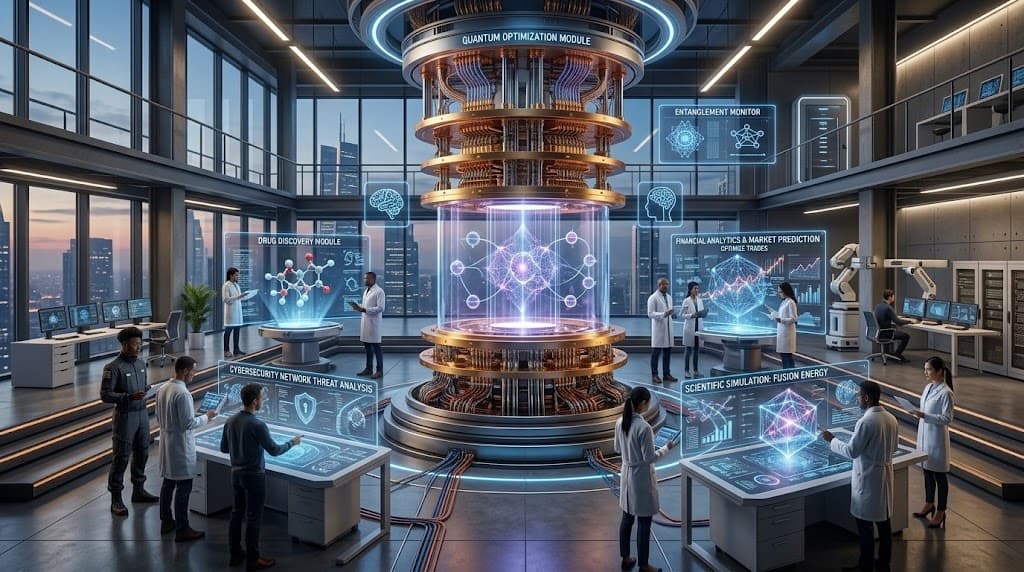
From drug discovery and materials science to optimization, cybersecurity, and artificial intelligence, quantum computing could eventually influence some of the world's most complex industries.
What Is Quantum Computing?
Quantum computing is a form of computing based on principles of quantum mechanics.
Traditional computers use bits, while quantum computers use qubits. A qubit can exist in a quantum state that represents a combination of possibilities, allowing quantum algorithms to approach certain problems differently from classical algorithms.
Two important concepts are superposition and entanglement.
Superposition allows qubits to represent combinations of states, while entanglement creates strong correlations between quantum systems.
These properties can enable quantum algorithms to solve particular mathematical problems more efficiently than known classical approaches.
Why Is Quantum Computing Important in 2026?
Quantum technology is attracting increasing attention because researchers and technology companies are working to build systems with greater numbers of useful, reliable qubits.
One of the biggest challenges is that qubits are extremely sensitive to environmental disturbances. Errors can occur easily, meaning researchers need sophisticated methods for quantum error correction.
The goal isn't simply to create more qubits. It is to create high-quality, controllable, error-resistant qubits that can perform useful computations.
Quantum Computing and Artificial Intelligence
One of the most exciting potential applications is the relationship between quantum computing and AI.
Machine-learning systems often require significant computational resources. Researchers are investigating whether quantum algorithms could eventually accelerate particular optimization, sampling, or machine-learning tasks.
However, quantum AI is still an emerging research area. It would be inaccurate to claim that quantum computers are currently replacing conventional AI infrastructure.
Instead, quantum computing may eventually become a specialized accelerator for certain workloads.
Quantum Computing in Drug Discovery
Drug development can require enormous amounts of computation.
Scientists need to understand how molecules interact, how chemical structures behave, and how potential medicines may affect biological systems.
Quantum computers could eventually help researchers model certain molecular and chemical systems more naturally than conventional approaches.
If scalable quantum systems become practical, this could potentially reduce the time required to investigate some promising compounds.
Quantum Computing and Materials Science
Another promising field is materials research.
Scientists are searching for better batteries, superconducting materials, catalysts, solar materials, and other advanced substances.
Understanding the behavior of atoms and electrons can be computationally difficult. Quantum computers may eventually provide new tools for simulating these systems.
This could support the development of technologies ranging from cleaner energy to more efficient electronics.
Quantum Computing and Cybersecurity
Quantum computing also creates an important cybersecurity challenge.
Some powerful future quantum algorithms could threaten certain cryptographic systems widely used today.
As a result, governments, technology companies, and security researchers are working on post-quantum cryptography—cryptographic methods designed to resist attacks from sufficiently capable quantum computers.
The cybersecurity industry is therefore preparing for the quantum era before large-scale quantum attacks become practical.
Quantum Computing in Finance
Financial institutions deal with complex optimization and modeling problems.
Potential applications of quantum computing include:
Portfolio optimization
Risk analysis
Financial modeling
Fraud detection research
Market simulations
Optimization problems
Most of these applications remain areas of active research, but finance is one of the sectors closely watching developments in quantum technology.
Will Quantum Computers Replace Normal Computers?
No—not in the foreseeable future.
Classical computers are extremely efficient for everyday tasks such as browsing the internet, running applications, watching videos, and managing documents.
Quantum computers are being developed for specialized computational problems.
A likely future is hybrid computing, where classical computers handle ordinary workloads while quantum processors are used for specific calculations where they offer an advantage.
The Biggest Challenges
Quantum computing still faces major technical challenges.
1. Quantum Errors
Qubits can lose their quantum states because of environmental interference.
2. Error Correction
Building reliable quantum error-correction systems requires significant technological advances.
3. Scaling
Increasing the number of useful qubits while maintaining reliability is extremely difficult.
4. Cost and Complexity
Quantum hardware often requires highly specialized environments and sophisticated equipment.
5. Finding Useful Applications
Not every computational problem benefits from quantum computing. Researchers must identify problems where quantum algorithms can provide meaningful advantages.
How Businesses Should Prepare
Businesses don't necessarily need to purchase quantum computers today.
Instead, organizations can begin preparing by:
Monitoring developments in quantum technology.
Understanding their dependence on vulnerable cryptographic systems.
Learning about post-quantum cryptography.
Identifying computational problems that could eventually benefit from quantum methods.
Training technical teams in quantum computing fundamentals.
Following developments from major research institutions and technology companies.
The Future of Quantum Computing
Quantum computing is unlikely to transform every aspect of technology overnight.
Its development will probably be gradual, with progress measured through improvements in hardware quality, error correction, algorithms, and demonstrations of useful computational advantages.
If researchers overcome today's major engineering challenges, quantum computing could become an important component of future scientific and industrial computing.
The most realistic vision is not quantum versus classical computing, but rather quantum and classical systems working together.
Conclusion
Quantum computing is one of the most ambitious areas of technology in 2026. Although practical, large-scale quantum computing remains challenging, progress in hardware, algorithms, and error correction continues to attract significant investment and research.
Its potential applications span AI, medicine, materials science, cybersecurity, finance, and optimization.
For businesses and technology professionals, understanding quantum computing today could provide an advantage as the technology continues developing.
FAQs
1. What is quantum computing?
Quantum computing uses quantum-mechanical principles to process certain types of information using qubits.
2. What is a qubit?
A qubit is the basic unit of quantum information. Unlike a classical bit, its quantum state can represent a combination of possible states.
3. Is quantum computing better than classical computing?
Not for every task. Quantum computers are designed to provide advantages for particular types of computational problems.
4. Will quantum computers replace laptops?
No. Classical computers will remain essential for everyday computing, while quantum systems are expected to handle specialized workloads.
5. Can quantum computing improve AI?
Potentially. Researchers are investigating quantum approaches to optimization, machine learning, and other computational tasks.
6. How could quantum computing affect medicine?
It could eventually help simulate molecular and chemical systems, potentially supporting drug discovery and materials research.
7. Why is quantum computing important for cybersecurity?
Future quantum computers could threaten some existing cryptographic methods, which is why post-quantum cryptography is becoming increasingly important.
8. What is quantum error correction?
It is a collection of techniques designed to protect quantum information from errors and environmental disturbances.
9. Is quantum computing available today?
Yes, quantum computers exist today, but large-scale, fault-tolerant quantum computing remains an active research and engineering challenge.
10. Which industries could benefit from quantum computing?
Potential areas include pharmaceuticals, finance, energy, materials science, logistics, cybersecurity, and artificial intelligence.
11. Is quantum AI already mainstream?
No. Quantum machine learning is still an emerging research area rather than a mainstream replacement for conventional AI.
12. What is post-quantum cryptography?
It refers to cryptographic algorithms designed to remain secure against attacks from sufficiently powerful quantum computers.
13. Why are quantum computers difficult to build?
Qubits are highly sensitive to noise and environmental disturbances, making reliable control and error correction challenging.
14. What is quantum entanglement?
It is a quantum phenomenon in which quantum systems can exhibit strong correlations that cannot be explained by classical physics.
15. What is the future of quantum computing?
The most likely future involves quantum processors working alongside classical computers for specialized and computationally demanding tasks.
