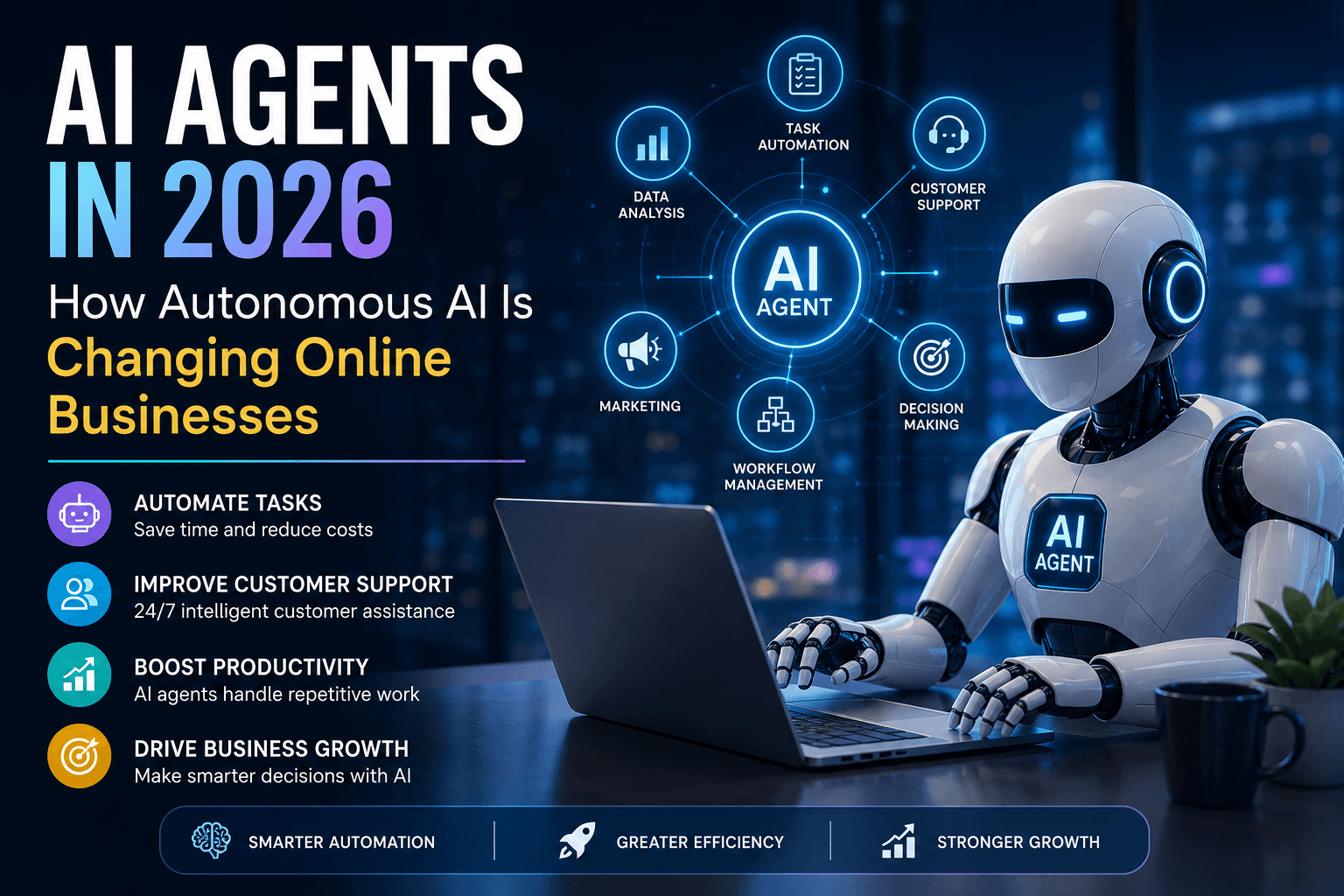

Artificial intelligence has moved far beyond simple chatbots. In 2026, one of the biggest technology trends is the rise of AI agents—intelligent systems that can perform tasks, make decisions, use digital tools, and complete complex workflows with minimal human supervision.
For online businesses, AI agents are creating new opportunities to save time, reduce costs, improve customer experiences, and increase productivity. From managing emails and customer support to analyzing data and assisting with marketing campaigns, AI agents are becoming an important part of the digital business world.
What Are AI Agents?
AI agents are advanced artificial intelligence systems designed to work toward specific goals. Unlike traditional AI tools that only respond to individual prompts, AI agents can often perform multiple steps to complete a task.
For example, an AI agent may be able to:
Receive a business goal
Analyze the information required
Create a plan
Use connected tools or software
Complete different steps automatically
Review the results
Suggest improvements
This makes AI agents more useful for complex and repetitive business tasks.
How AI Agents Are Changing Online Businesses
1. Automating Repetitive Tasks
Online businesses spend a significant amount of time on repetitive work. AI agents can help automate tasks such as organizing information, responding to routine customer questions, managing schedules, and processing data.
This allows business owners and employees to spend more time on strategy, creativity, and business growth.
2. Improving Customer Support
AI-powered customer support is becoming more advanced. AI agents can help businesses provide faster responses to customers and handle common questions at any time.
For example, an AI agent may assist customers with:
Product information
Order updates
Frequently asked questions
Basic troubleshooting
Appointment scheduling
Human support teams can then focus on more complex customer issues.
3. Helping With Digital Marketing
Marketing requires constant planning and content creation. AI agents can help businesses organize and improve their marketing workflows.
They may assist with:
Content research
Keyword research
Social media planning
Email marketing
Advertising analysis
Competitor research
Performance reporting
Businesses can use AI to speed up these processes while keeping human oversight for strategy and quality.
4. Supporting Data Analysis
Businesses collect large amounts of information, but understanding that data can take time.
AI agents can help analyze information from different sources and identify patterns, trends, and potential opportunities. This can help business owners make faster and more informed decisions.
For example, AI can help identify:
Popular products
Customer behavior
Sales trends
Marketing performance
Areas where costs can be reduced
5. Making Ecommerce More Efficient
Ecommerce businesses are also benefiting from AI agents. These systems can assist with product descriptions, customer inquiries, inventory-related workflows, and personalized shopping experiences.
AI can potentially help online stores deliver more relevant recommendations based on customer interests and behavior.
Benefits of Using AI Agents for Business
AI agents offer several potential benefits for online businesses.
Save Time
Automation can reduce the amount of time spent on routine tasks.
Increase Productivity
Teams can complete certain workflows faster with AI assistance.
Reduce Operational Costs
Automating suitable tasks may help businesses use their resources more efficiently.
Improve Customer Experience
Faster responses and personalized support can improve customer satisfaction.
Support Business Growth
AI can help businesses manage increasing workloads without expanding every process at the same rate.
Industries Being Transformed by AI Agents
AI agents are being used across many industries.
Ecommerce
Online stores use AI for customer support, product recommendations, marketing, and operational workflows.
Digital Marketing
Marketers use AI agents to help research, plan campaigns, analyze results, and organize content.
Healthcare Technology
AI systems can assist with administrative workflows, data organization, and information management, subject to appropriate privacy and regulatory requirements.
Finance
AI can support data analysis, customer service, fraud detection, and operational processes.
Education
AI-powered systems can help with personalized learning, administrative tasks, and educational content.
Challenges Businesses Should Consider
Although AI agents offer exciting possibilities, businesses should not rely on them without proper oversight.
Important challenges include:
Data privacy
Security risks
Incorrect information
Integration with existing systems
Quality control
Human oversight
Businesses should carefully review what tasks are appropriate for automation and ensure that sensitive information is properly protected.
How Small Businesses Can Start Using AI Agents
Small businesses do not need to automate everything immediately. A better approach is to start with one useful workflow.
For example:
Identify a repetitive task.
Measure how much time the task requires.
Explore AI tools that may help automate parts of the workflow.
Test the system with human supervision.
Review the results.
Improve the workflow gradually.
Starting small can help businesses understand where AI provides the most value.
The Future of AI Agents
The future of AI agents is likely to involve greater automation and improved integration with business software.
Instead of using separate tools for every task, businesses may increasingly use AI systems that can coordinate multiple parts of a workflow.
However, humans will continue to play an important role. Business strategy, creativity, relationship building, ethical decision-making, and quality control still require human judgment.
The most successful businesses may be those that learn how to combine human expertise with AI capabilities.
Final Thoughts
AI agents are becoming an important technology trend in 2026. They have the potential to transform how online businesses operate by automating repetitive work, supporting customer service, improving marketing workflows, and helping analyze information.
Businesses should approach AI agents strategically. The goal should not simply be to replace people with automation. Instead, businesses can use AI to help people work more efficiently and focus on higher-value tasks.
As AI technology continues to develop, understanding how to use AI agents responsibly could become a major advantage for businesses of all sizes.
FAQs
1. What is an AI agent?
An AI agent is an artificial intelligence system designed to perform tasks and work toward specific goals, often through multiple steps.
2. How are AI agents different from chatbots?
Traditional chatbots mainly respond to questions, while AI agents can potentially perform more complex workflows and interact with connected tools.
3. Can small businesses use AI agents?
Yes. Small businesses can start by using AI to assist with simple and repetitive tasks.
4. Can AI agents help with customer service?
Yes. AI agents can help answer common questions and provide faster customer support.
5. Can AI agents replace employees?
AI is more likely to automate specific tasks than completely replace every human role. Human oversight and expertise remain important.
6. Are AI agents useful for ecommerce?
Yes. They can help with customer support, marketing, product information, and operational workflows.
7. Can AI agents help with marketing?
AI agents can assist with research, content planning, data analysis, and campaign organization.
8. What are the risks of AI agents?
Potential risks include incorrect information, privacy concerns, security issues, and poor decision-making without human oversight.
9. How can a business start using AI agents?
Start by identifying one repetitive task and testing an AI solution with appropriate human supervision.
10. Will AI agents become more popular in the future?
AI agents are expected to become increasingly important as businesses look for ways to automate workflows and improve productivity.