
Starting an online business no longer necessarily requires a large team, expensive office, or huge budget. In 2026, artificial intelligence is helping individuals manage tasks that once required multiple employees.
A one-person online business uses technology, automation, and digital tools to allow a single entrepreneur to create, market, sell, and support products or services.
AI can help you work faster—but success still depends on choosing the right problem to solve and delivering genuine value.
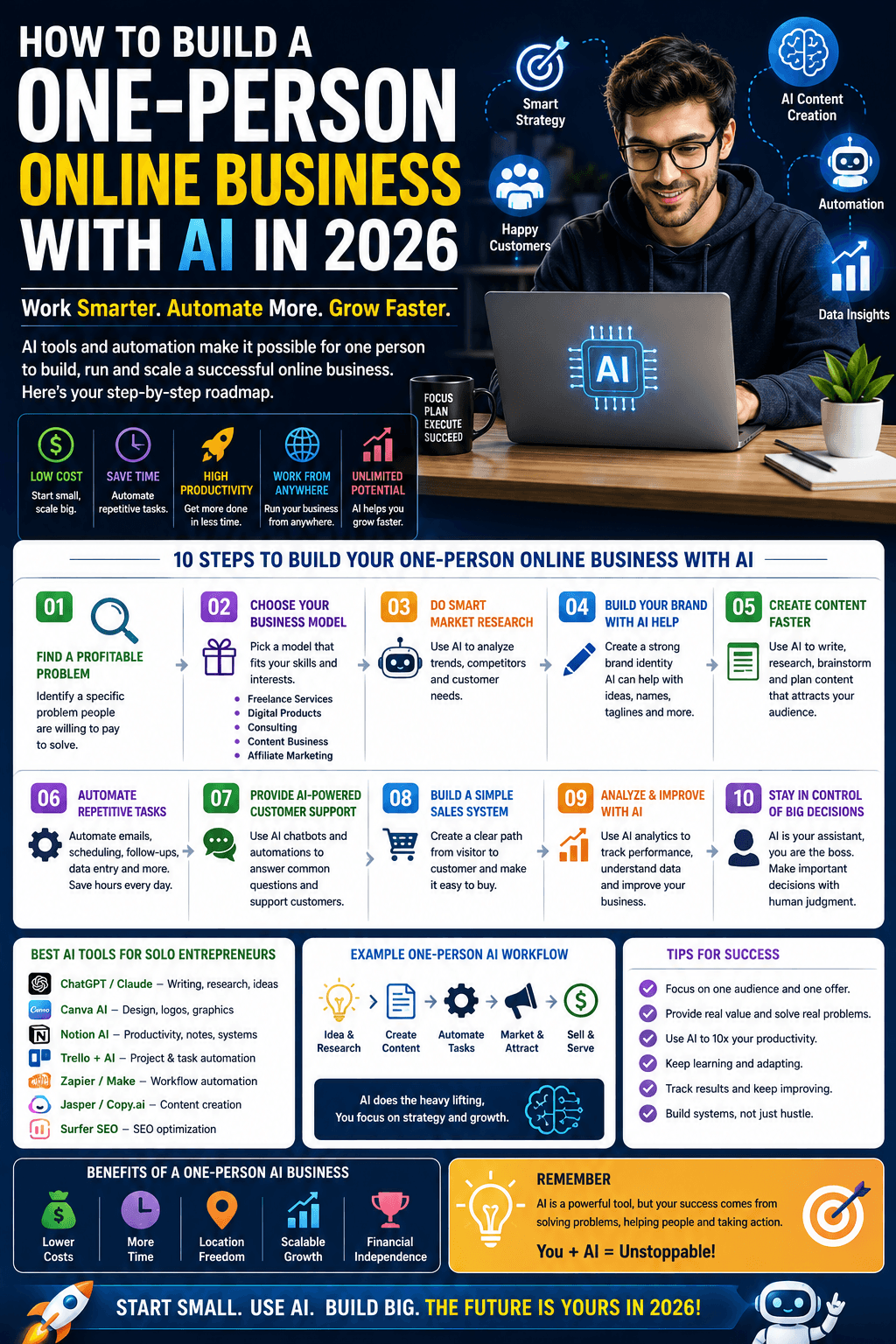
Here is how you can build a one-person online business with AI in 2026.
1. Choose a Profitable Problem to Solve
The first step is not choosing an AI tool.
It is identifying a problem that people are willing to pay to solve.
Ask yourself:
What problems do businesses regularly face?
What tasks do people struggle with?
What skills do I already have?
Which audience do I understand?
Can I provide a faster or better solution?
For example, instead of starting a general “AI business,” you could focus on:
AI content services for small businesses
AI automation for real estate agents
Digital marketing for local businesses
AI-powered productivity templates
Online training for entrepreneurs
A specific problem and audience can make your business easier to market.
2. Choose the Right One-Person Business Model
Several business models can work well for solo entrepreneurs.
Freelance Services
Offer skills such as:
Writing
Graphic design
Video editing
SEO
Social media management
AI automation
Digital Products
Create products that can be sold repeatedly, such as:
E-books
Templates
Courses
Checklists
Notion systems
Digital guides
Consulting
Help businesses solve problems using your expertise.
Content Business
Build an audience through a blog, YouTube channel, newsletter, or social media platform.
Affiliate Marketing
Recommend useful products and earn commissions through legitimate affiliate programs.
You do not need to choose every model. Start with one and build from there.
3. Use AI for Market Research
Before launching, research your market.
AI can help organize information about:
Customer problems
Competitors
Industry trends
Product ideas
Content opportunities
Frequently asked questions
However, do not rely entirely on AI-generated information.
Check:
Customer reviews
Industry reports
Search results
Online communities
Competitor websites
Real customer feedback can reveal opportunities that AI alone may miss.
4. Build Your Brand With AI Assistance
A strong brand helps customers remember and trust your business.
AI can assist with brainstorming:
Business names
Brand messages
Taglines
Content ideas
Website copy
Visual concepts
But your final brand should have a clear personality and purpose.
Avoid creating a generic business that looks exactly like thousands of other AI-powered brands.
5. Create Content Faster
Content marketing can help a one-person business attract customers.
AI can assist with:
Article outlines
Social media ideas
Video scripts
Email drafts
Content calendars
Research summaries
You can then add your own expertise, examples, and personality.
A useful workflow might look like:
AI brainstorms → You select ideas → AI creates a draft → You improve it → Publish and promote
This can save time while maintaining quality.
6. Automate Repetitive Business Tasks
Automation is one of the biggest advantages for solo entrepreneurs.
You may be able to automate tasks such as:
Email responses
Appointment reminders
Lead organization
Social media scheduling
Customer follow-ups
Data entry
Invoice reminders
For example:
New customer submits form → Information enters CRM → Welcome email is prepared → Follow-up task is created
This allows one person to manage more work without manually completing every step.
7. Use AI for Customer Support
Customer support can consume a lot of time.
AI chat systems can help answer common questions about:
Products
Pricing
Business hours
Services
Orders
Policies
For complicated problems, customers should have a clear way to contact a human.
AI should improve customer service—not make customers feel trapped in an endless automated system.
8. Build a Simple Online Sales System
Your business needs a clear way to turn visitors into customers.
A simple system could include:
Content → Website → Useful Offer → Payment → Follow-Up
Your website does not need to be complicated.
Focus on clearly explaining:
Who you help
What problem you solve
What you offer
Why customers should choose you
How customers can buy or contact you
AI can assist with writing and optimization, but the final customer experience should be simple and trustworthy.
9. Use AI to Analyze Your Business
Data can help you understand what is working.
AI tools can help summarize information about:
Website traffic
Customer behavior
Marketing performance
Sales
Content engagement
Important metrics for a solo business might include:
Revenue
Profit
Number of customers
Conversion rate
Customer acquisition cost
Returning customers
Do not track numbers just because they are available. Focus on metrics connected to your actual business goals.
10. Keep Human Control Over Important Decisions
AI is powerful, but it should not make every business decision automatically.
You should personally review:
Important financial decisions
Legal documents
Customer complaints
Major business strategies
Sensitive communications
AI can provide assistance, but accountability remains with the business owner.
A Simple AI-Powered One-Person Business Workflow
Here is an example:
Step 1: Find a Problem
Research a specific audience and identify a problem.
Step 2: Create an Offer
Develop a service or product that solves that problem.
Step 3: Build a Simple Online Presence
Create a website, landing page, or professional profile.
Step 4: Create Useful Content
Use AI to speed up research and drafting.
Step 5: Attract an Audience
Use SEO, social media, email, partnerships, or other channels.
Step 6: Automate Repetitive Work
Connect your tools and reduce manual tasks.
Step 7: Improve Your Offer
Use customer feedback and business data to improve.
Best AI Tools for Solo Entrepreneurs
Different tools can support different areas of a business.
AI Writing Tools
Useful for brainstorming, drafting, and organizing content.
AI Design Tools
Useful for creating visual concepts and marketing materials.
AI Automation Tools
Useful for connecting workflows and reducing repetitive tasks.
AI Research Tools
Useful for organizing and exploring information.
AI Customer Support Tools
Useful for answering routine customer questions.
AI Analytics Tools
Useful for understanding business and marketing data.
The best approach is not to use the maximum number of tools.
Use the fewest tools necessary to solve your biggest problems effectively.
Benefits of a One-Person AI Business
Lower Operating Costs
You may be able to start without hiring a large team.
Faster Workflows
AI can reduce time spent on repetitive activities.
Greater Flexibility
Solo entrepreneurs can make decisions and adapt quickly.
Global Reach
An online business can potentially serve customers in different locations.
Scalability
Digital products and automated systems can help a business handle more activity.
Challenges to Consider
Running a business alone also has challenges.
Too Many Responsibilities
One person is responsible for many areas.
Over-Automation
Customers may still want human communication.
AI Errors
AI-generated information can be incorrect.
Competition
AI makes it easier for more people to create businesses and content.
Burnout
Working alone can make it difficult to separate business and personal time.
Build sustainable systems rather than trying to automate everything overnight.
How Much Does It Cost to Start?
The cost depends on your business model.
Potential expenses include:
Domain name
Website hosting
AI tools
Software subscriptions
Marketing
Payment processing
Professional services
Many solo businesses can start small and reinvest revenue as they grow.
Avoid spending heavily before you have validated that customers want your offer.
The Future of One-Person Businesses
AI may allow more individuals to operate businesses that previously required larger teams.
A solo entrepreneur could increasingly use AI to support:
Marketing
Customer service
Research
Content creation
Sales
Administration
Automation
However, AI does not automatically create a successful business.
The strongest one-person businesses will combine technology with:
Human expertise + customer understanding + a valuable offer + consistent execution.
Conclusion
Building a one-person online business with AI in 2026 is more accessible than ever.
AI can help entrepreneurs research markets, create content, automate workflows, support customers, and analyze business performance.
But technology alone is not enough.
Start by identifying a real problem. Choose a specific audience. Create a valuable solution. Then use AI strategically to save time and improve efficiency.
The future of entrepreneurship may not be about building the biggest team—it may be about building the smartest systems.
FAQs
1. Can one person really run an online business with AI?
Yes. AI and automation can help a solo entrepreneur manage many tasks, although the amount of work depends on the complexity of the business.
2. What is the best one-person business to start in 2026?
The best option depends on your skills and market demand. Freelancing, digital products, consulting, content businesses, and AI automation services are possible options.
3. How can AI help a solo entrepreneur?
AI can assist with research, content creation, marketing, customer support, automation, and data analysis.
4. Do I need technical skills to start an AI-powered business?
Not always. Many AI tools are designed for beginners, although learning basic technology and business skills can be helpful.
5. Can I start a one-person business with little money?
Some online service businesses and digital product businesses can start with relatively low upfront costs, but expenses vary.
6. What should I automate first?
Start with repetitive, low-risk tasks that consume significant amounts of time.
7. Can AI replace employees in a business?
AI can automate some tasks, but human expertise remains important for judgment, creativity, relationships, and complex decisions.
8. How do I get customers for my online business?
You can attract customers through useful content, SEO, social media, email marketing, networking, partnerships, referrals, and advertising.
9. Is an AI business profitable?
Profitability depends on customer demand, pricing, costs, execution, and the value your business provides.
10. What is the biggest advantage of using AI in a solo business?
One major advantage is improved productivity, allowing an entrepreneur to spend less time on repetitive work and more time on valuable activities.