
Artificial intelligence is transforming digital marketing faster than many businesses expected. From content creation and customer personalization to search optimization and campaign analysis, AI is changing how brands attract, engage, and retain customers.
In 2026, businesses do not necessarily need huge marketing teams to compete online. AI-powered tools can help small teams perform research, create content, analyze data, automate repetitive tasks, and deliver more personalized customer experiences.
However, successful AI marketing is not simply about generating more content. Businesses need to combine AI with human creativity, strategy, expertise, and careful review.
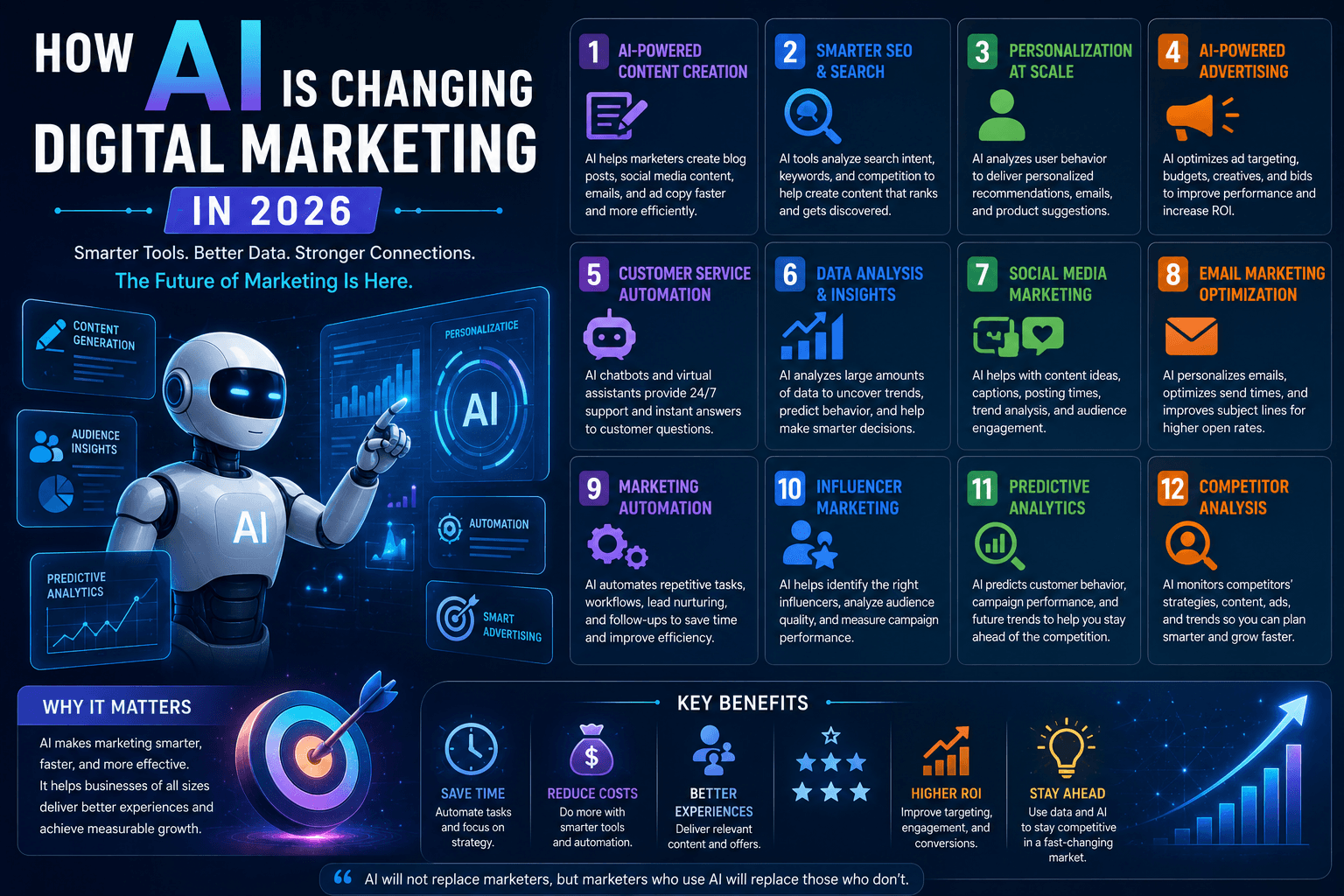
1. AI Is Making Content Creation Faster
Content marketing requires consistent production, but creating high-quality content can take significant time.
AI can help marketers with:
Blog ideas
Content outlines
Social media posts
Email drafts
Video scripts
Product descriptions
Headlines
Content repurposing
For example, one detailed article can be transformed into several social posts, an email newsletter, a video script, and other content formats.
The human marketer still needs to review the material, add expertise, fact-check information, and maintain the brand's voice.
2. AI Is Changing Search Marketing
Search behavior is evolving as users increasingly interact with AI-powered search and answer engines.
Traditional SEO remains important, but businesses also need content that clearly answers questions and demonstrates expertise.
Effective search-focused content should be:
Useful
Accurate
Well organized
Easy to understand
Relevant to search intent
Supported by trustworthy information
Instead of creating content only to target keywords, marketers should focus on solving the user's actual problem.
3. Personalization Is Becoming More Powerful
Customers expect brands to provide relevant experiences.
AI can analyze customer behavior and help businesses personalize:
Product recommendations
Emails
Advertisements
Website content
Offers
Customer communications
For example, an online store can recommend products based on browsing or purchasing behavior.
Personalization can make marketing more relevant, but businesses should use customer data responsibly and follow applicable privacy requirements.
4. AI Is Improving Advertising
Digital advertising platforms increasingly use AI to help marketers optimize campaigns.
AI can assist with:
Audience targeting
Ad variations
Budget allocation
Performance analysis
Conversion prediction
Creative testing
Instead of manually testing every possible combination, marketers can use AI-powered systems to identify promising options more efficiently.
However, businesses should continue monitoring campaigns rather than assuming automation will always make the right decision.
5. Customer Service Is Becoming More Automated
AI-powered chatbots and virtual assistants can answer common customer questions around the clock.
They can help with:
Frequently asked questions
Order information
Basic troubleshooting
Appointment scheduling
Product information
Initial lead qualification
More complicated issues can be transferred to human representatives.
This combination of AI and human support can help businesses respond faster while keeping human assistance available when customers need it.
6. AI Is Helping Marketers Understand Data
Digital marketing generates huge amounts of data.
AI can help marketers identify patterns in:
Website traffic
Customer behavior
Advertising performance
Email engagement
Sales
Conversion rates
Customer retention
Instead of manually examining large datasets, marketers can use AI-assisted analytics to identify trends and potential problems more quickly.
The quality of the conclusions still depends on the quality of the underlying data.
7. Social Media Marketing Is Becoming Smarter
AI is helping marketers plan and manage social media campaigns.
It can assist with:
Content ideas
Captions
Posting schedules
Audience analysis
Trend research
Video scripts
Content repurposing
However, social media success still depends heavily on authenticity and audience connection.
AI-generated posts should not make every brand sound identical.
8. Email Marketing Is Becoming More Personalized
AI can help marketers create more relevant email campaigns.
Businesses can use customer information to develop different messages for different audience segments.
AI can assist with:
Subject lines
Email drafts
Product recommendations
Customer segmentation
Send-time optimization
Campaign analysis
For example, a new customer might receive educational content, while an existing customer receives recommendations based on previous purchases.
9. AI Is Making Marketing Automation Easier
Automation allows marketers to reduce repetitive work.
Businesses can automate workflows such as:
New lead → Welcome email → Follow-up → Sales notification → Customer onboarding
AI can add intelligence to these workflows by helping determine what information should be shown to different customers.
This allows marketing teams to spend more time on strategy and creative work.
10. AI Is Changing Influencer Marketing
AI can also help businesses identify and evaluate potential creators.
Marketers can analyze audience characteristics, engagement patterns, content topics, and campaign performance.
The goal is not simply to choose influencers with the largest follower counts.
A smaller creator with a highly relevant audience may sometimes be more valuable than a much larger but less relevant account.
11. AI Helps Small Businesses Compete
One of the biggest advantages of AI is accessibility.
Small businesses can use AI tools to perform tasks that previously required larger teams.
A small company can potentially use AI for:
Content marketing
Customer support
Market research
Email marketing
Social media
Advertising analysis
SEO assistance
Workflow automation
This can reduce the amount of manual work required to maintain a digital marketing operation.
12. Human Creativity Still Matters
AI can generate content quickly, but speed does not automatically equal quality.
Human marketers remain important for:
Strategy
Brand positioning
Storytelling
Creative direction
Fact-checking
Customer understanding
Ethical decisions
The strongest marketing teams are likely to use AI as a powerful assistant rather than treating it as a complete replacement for human expertise.
Challenges of AI in Digital Marketing
AI also introduces new challenges.
Accuracy
AI can produce incorrect or misleading information. Important content should be reviewed before publication.
Privacy
Businesses need to handle customer data responsibly and follow relevant privacy regulations.
Brand Voice
Overusing generic AI-generated content can make a brand sound similar to everyone else.
Copyright
Marketers need to understand the rights and licensing rules associated with the tools and content they use.
Over-Automation
Not every customer interaction should be automated. Some situations require empathy and human judgment.
How Businesses Can Start Using AI in Marketing
Businesses do not need to automate their entire marketing department immediately.
A practical approach is to:
Identify repetitive marketing tasks.
Choose one AI tool for a specific problem.
Test it on a small scale.
Review the results carefully.
Measure whether it saves time or improves performance.
Expand successful workflows gradually.
The goal should be measurable improvement rather than using AI simply because it is trending.
The Future of AI and Digital Marketing
AI will likely become increasingly integrated into search, advertising, content, analytics, customer service, and marketing automation.
As AI tools become more common, simply having access to AI may no longer provide a major competitive advantage.
The bigger advantage will come from knowing how to apply AI strategically.
Businesses that combine technology with strong customer understanding, original ideas, trustworthy information, and human creativity can build more effective marketing systems.
Conclusion
AI is changing digital marketing in 2026 by making many tasks faster, more automated, and more personalized.
From SEO and content creation to advertising, customer service, email marketing, and analytics, AI can help businesses improve efficiency and make better-informed decisions.
But AI is not a substitute for strategy or human judgment.
The most successful approach is to use AI where it provides genuine value while keeping humans responsible for creativity, accuracy, relationships, and important decisions.
AI can make marketing faster—but smart strategy makes it effective.
Frequently Asked Questions
1. How is AI changing digital marketing in 2026?
AI is helping marketers automate repetitive tasks, personalize customer experiences, analyze data, create content, optimize advertising, and improve customer support.
2. Will AI replace digital marketers?
AI can automate certain marketing tasks, but human skills such as strategy, creativity, storytelling, communication, and decision-making remain important.
3. How can AI help with SEO?
AI can assist with topic research, content planning, search-intent analysis, optimization ideas, and content organization. Marketers should still prioritize useful, accurate, original content.
4. Can AI create marketing content?
Yes. AI can help create drafts, social posts, emails, scripts, product descriptions, and other content. Human review and editing are important for quality and accuracy.
5. Is AI useful for small businesses?
Yes. AI can help small businesses with content creation, customer support, marketing automation, research, social media, and data analysis.
6. How does AI improve personalization?
AI can analyze customer behavior and help businesses deliver more relevant recommendations, emails, offers, advertisements, and website experiences.
7. Can AI improve digital advertising?
Yes. AI-powered advertising systems can assist with targeting, creative testing, campaign optimization, budget allocation, and performance analysis.
8. Can AI help with social media marketing?
Yes. AI can assist with content ideas, captions, scheduling, trend research, audience analysis, and content repurposing.
9. How can AI help email marketing?
AI can help marketers create subject lines, draft emails, segment audiences, personalize messages, recommend products, and analyze campaign performance.
10. Is AI-generated content good for SEO?
AI-generated content can be useful when it provides genuine value and is carefully reviewed. Simply producing large amounts of generic content does not guarantee strong search performance.
11. What are the biggest risks of using AI in marketing?
Major concerns include inaccurate information, privacy issues, copyright questions, generic content, security risks, and excessive automation.
12. Should businesses automate customer service completely?
Not necessarily. AI can handle routine questions, while human representatives should remain available for complex, sensitive, or unusual situations.
13. How can a business start using AI marketing tools?
Start with one specific problem, such as content creation or customer-support automation. Test the tool, measure the results, and expand gradually.
14. What skills should digital marketers learn in the AI era?
Important skills include AI tool usage, data analysis, content strategy, SEO, creative thinking, customer research, automation, communication, and critical evaluation of AI outputs.
15. What is the future of AI in digital marketing?
AI is likely to become more deeply integrated into search, advertising, personalization, analytics, content workflows, and customer experiences. Human strategy and creativity will remain essential.