
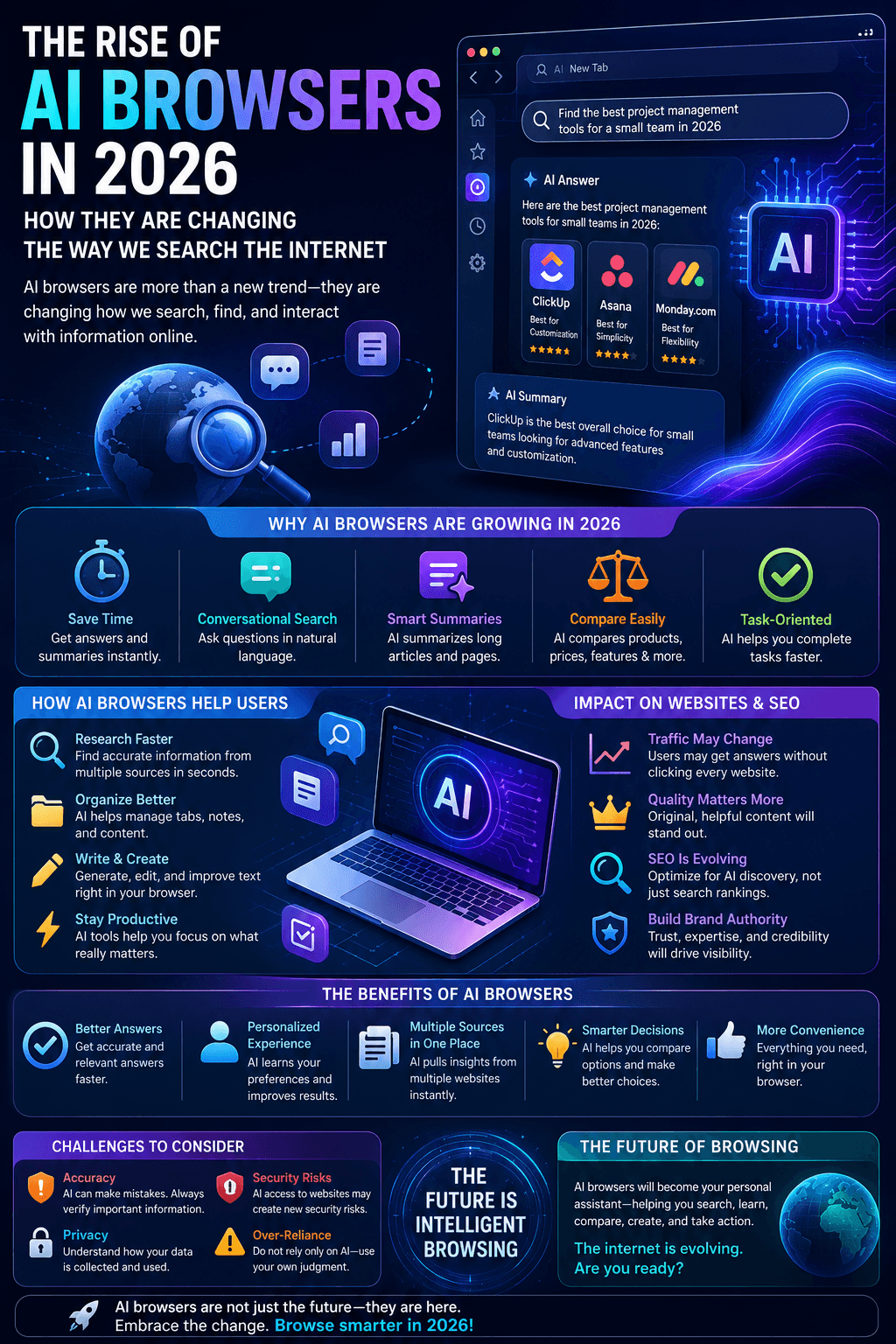

The way people browse and search the internet is changing rapidly. In 2026, artificial intelligence is becoming more deeply integrated into web browsers, creating a new generation of AI browsers that can help users search, summarize, compare, write, research, and complete tasks.
Traditional browsers were mainly designed to help people open websites and navigate the web. AI-powered browsers are beginning to act more like intelligent assistants that can help users understand and interact with online information.
This shift could significantly change how people search for information—and how businesses attract website visitors.
What Is an AI Browser?
An AI browser is a web browser with artificial intelligence features integrated directly into the browsing experience.
Depending on the browser and available features, AI can help users:
Summarize web pages
Answer questions about content
Compare information
Research topics
Organize browser tabs
Write and edit text
Search using natural language
Complete certain online tasks
Instead of opening multiple tabs and manually comparing information, users may increasingly ask their browser for assistance.
For example, a user could ask:
“Compare the prices and features of these three products and recommend the best option for a small business.”
An AI-powered browser could potentially analyze the available information and provide a summary.
Why AI Browsers Are Growing
The internet contains an enormous amount of information.
Finding the right answer can require searching multiple websites, opening several tabs, reading long articles, and comparing different sources.
AI browsers aim to reduce this effort.
They can potentially help users:
Save time
Understand complex information
Research faster
Manage multiple tabs
Find relevant content
Complete repetitive tasks
As AI technology improves, browsing may become more conversational and task-oriented.
1. Search Is Becoming More Conversational
Traditional search often involves short keyword phrases.
For example:
“best laptops 2026”
AI-powered browsing allows users to ask more detailed questions:
“What is the best laptop for a small business owner who needs strong battery life and AI features?”
This shift means search is becoming more similar to having a conversation with an assistant.
Users can provide context, ask follow-up questions, and refine their requests.
2. AI Browsers Can Summarize Information
One of the most useful features of AI-powered browsing is the ability to summarize long pages.
Instead of reading a 5,000-word article, a user might ask:
“Give me the five most important points from this page.”
This can save time, particularly when researching complicated topics.
However, summaries should not completely replace reading important original information, especially when accuracy and context matter.
3. AI Can Help Compare Multiple Sources
Comparing information across websites can take time.
AI browsers may help users analyze:
Product prices
Features
Reviews
Services
Articles
Travel options
Business information
For example, instead of manually comparing five different software products, a user could ask the AI browser to organize key differences.
This can make online research faster and more efficient.
4. Browsing Is Becoming More Task-Oriented
Traditional browsing requires users to perform each step manually.
AI-powered browsers may increasingly help users complete multi-step tasks.
For example:
Research destinations → Compare prices → Organize options → Create a travel plan
The user provides the goal, while AI assists with parts of the process.
This could eventually change browsers from simple navigation tools into more active digital assistants.
5. AI Browsers Could Change Website Traffic
One of the biggest questions is how AI browsing will affect websites.
If users receive summaries and answers directly inside the browser, they may not click through to every original website.
This could reduce traffic for some informational searches.
However, websites that offer:
Original research
Expert insights
Unique tools
Products
Services
Strong brands
Detailed resources
may continue to attract valuable visitors.
The focus may shift from simply generating large amounts of traffic to attracting highly interested users.
6. SEO Is Adapting to AI Browsing
Businesses may need to think beyond traditional search rankings.
Important factors could include:
Clear Information
Content should explain topics clearly and answer real questions.
Original Value
Generic information is easier for AI systems to summarize. Original research and unique insights can provide stronger reasons for users to visit a website.
Brand Authority
A recognizable and trusted brand may become increasingly valuable as AI systems present information from different sources.
Structured Content
Clear headings, lists, and logical organization can improve the user experience.
Strong Technical Foundations
Websites should remain fast, accessible, and easy for search engines to understand.
7. AI Browsers Can Improve Productivity
AI browsing tools can help professionals work more efficiently.
For example, they can potentially assist with:
Research
Writing
Data analysis
Document summaries
Meeting preparation
Information organization
A researcher may spend less time opening and reading dozens of pages.
A marketer may use an AI browser to analyze competitor websites.
A business owner may quickly research market trends.
8. Privacy and Security Will Become More Important
AI browsers may process large amounts of information, potentially including browsing activity and page content.
This creates important questions about:
Data collection
User privacy
Permissions
Security
Third-party access
Users should understand what information an AI browser collects and how that information is handled.
Businesses developing AI-powered browsing technologies will also need to build strong privacy and security protections.
9. AI Browsers May Create New Business Opportunities
The growth of AI browsing could create opportunities for:
AI software developers
Browser extensions
AI security companies
Content publishers
SEO specialists
Digital marketers
Productivity platforms
Businesses may develop new tools designed specifically for AI-powered browsing experiences.
10. The Browser Could Become Your Personal AI Assistant
The long-term vision of AI browsing is simple: make the internet easier to use.
Instead of users manually searching for every piece of information, browsers could become increasingly capable of understanding goals and providing assistance.
Imagine saying:
“Research the best project management software for my five-person business, compare the top options, and create a summary with prices and key features.”
The browser could assist with the research process and organize the results.
Human judgment would still be necessary, especially when making important decisions.
AI Browsers vs. Traditional Browsers
Traditional Browsers | AI Browsers |
|---|---|
Open websites | Understand content |
Manual searching | Conversational searching |
Multiple tabs | AI-assisted research |
Manual comparisons | Automated comparisons |
Basic navigation | Task assistance |
Keyword searches | Natural-language questions |
AI browsers are not necessarily replacing traditional browsing. Instead, AI capabilities are being added to familiar browser experiences.
Challenges Facing AI Browsers
Despite their potential, AI browsers also face challenges.
Accuracy
AI-generated summaries can contain mistakes or omit important context.
Users should verify important information using original sources.
Privacy
Users need transparency about how browsing information is processed and stored.
Website Traffic
Publishers may face challenges if users receive answers without visiting original websites.
Security
AI agents that can interact with websites may create new security risks if they are given too much access.
Over-Reliance
Users should continue developing research and critical-thinking skills instead of automatically trusting every AI-generated answer.
What Businesses Should Do Now
Businesses do not need to completely change their websites overnight.
Instead, they should focus on strong fundamentals.
Create Useful Content
Answer real customer questions and provide valuable information.
Build a Recognizable Brand
Brand awareness can become increasingly important in AI-driven discovery.
Add Original Insights
Publish information that offers more than generic summaries.
Improve Website Quality
Focus on speed, usability, mobile experience, and technical SEO.
Monitor Search Trends
Stay informed as AI browsers and search technologies continue to evolve.
The Future of Web Browsing
AI is likely to make browsing more interactive, conversational, and personalized.
The future browser may not simply display websites.
It may help users understand information, organize tasks, compare options, and take action.
However, websites will remain essential.
The internet still needs original creators, businesses, experts, journalists, developers, and publishers to produce valuable information and services.
AI browsers may change how people access the web—but they do not eliminate the need for high-quality websites.
Conclusion
The rise of AI browsers in 2026 represents another major shift in how people interact with the internet.
Search is becoming more conversational. Research is becoming faster. Browsers are evolving from simple navigation tools into intelligent assistants.
For users, this could mean greater productivity and convenience.
For businesses and website owners, it means adapting to a future where visibility may come from multiple AI-powered discovery channels.
The most important strategy remains the same:
Create valuable, original, trustworthy content and build a brand that people want to find—whether they discover it through traditional search, an AI assistant, or an intelligent browser.
FAQs
1. What is an AI browser?
An AI browser is a web browser that integrates artificial intelligence to help users search, understand information, summarize pages, and perform certain tasks.
2. How are AI browsers different from traditional browsers?
Traditional browsers primarily help users navigate websites, while AI browsers can provide additional assistance with research, summaries, comparisons, and natural-language interactions.
3. Will AI browsers replace Google Search?
AI browsers may change how people search for information, but traditional search engines and websites are likely to remain important.
4. Can AI browsers reduce website traffic?
They could reduce clicks for some informational searches if users receive answers directly. However, valuable and unique websites can continue attracting visitors.
5. How should businesses prepare for AI browsers?
Businesses should focus on useful content, original information, technical website quality, brand authority, and a strong overall user experience.
6. Are AI browsers safe?
Safety depends on the specific browser and its privacy and security practices. Users should review permissions and understand how their data is handled.
7. Can AI browsers help with research?
Yes. They can potentially summarize information, compare sources, answer questions, and organize research.
8. What is conversational search?
Conversational search allows users to ask detailed questions using natural language and follow up with additional questions.
9. Will SEO disappear because of AI browsers?
SEO is evolving, but the need for websites to be discoverable, useful, and technically accessible is unlikely to disappear.
10. What is the future of AI browsing?
AI browsing is expected to become more interactive and task-oriented, helping users search, research, compare information, and complete online activities more efficiently.