
Search is changing rapidly in 2026. For years, businesses relied heavily on traditional search engines to drive website traffic. The basic strategy was simple: create content, optimize it for keywords, rank on search results pages, and attract clicks.
Today, artificial intelligence is changing that model.
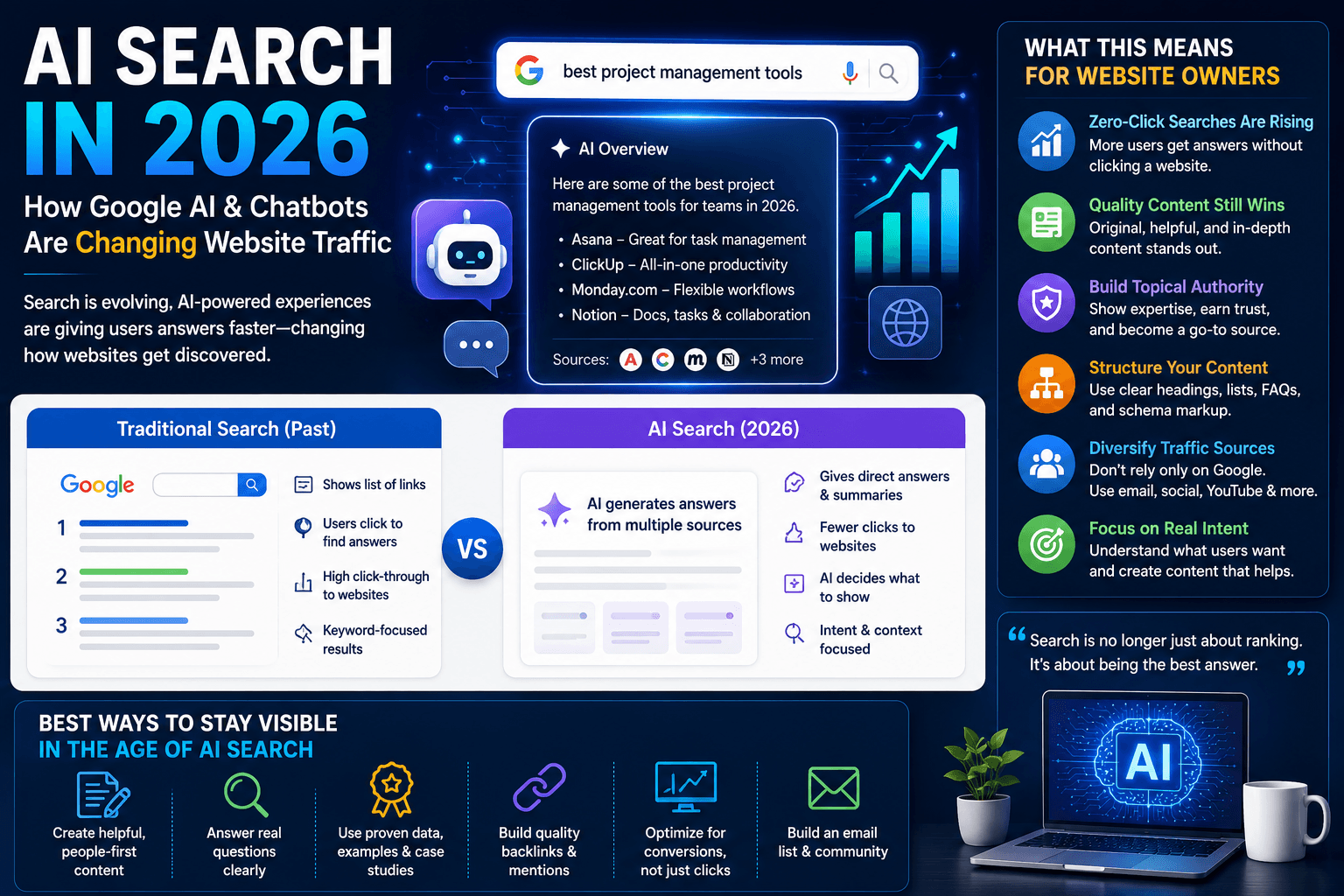
AI-powered search engines, AI-generated summaries, chatbots, and answer engines are giving users information directly instead of always requiring them to click through to a website. This shift is creating both challenges and opportunities for businesses, publishers, marketers, and website owners.
Understanding how AI search works is becoming increasingly important for anyone who depends on organic traffic.
What Is AI Search?
AI search uses artificial intelligence to understand a user's question and provide a more direct, conversational answer.
Instead of showing only a list of blue links, AI-powered search systems may:
Summarize information from multiple sources
Answer complex questions directly
Compare products or services
Provide recommendations
Ask follow-up questions
Generate personalized responses
Help users complete multi-step research
AI search is designed to understand the meaning and intent behind a query rather than relying only on exact keywords.
This is changing how people discover information online.
1. More Searches Are Becoming Zero-Click Searches
One of the biggest changes is the growth of searches where users receive the information they need without clicking a website.
For simple questions, definitions, comparisons, and informational queries, an AI-generated answer may appear directly in the search experience.
This can reduce clicks for websites that previously received traffic from basic informational searches.
However, users may still visit websites when they need:
Detailed information
Original research
Product pages
Expert opinions
In-depth tutorials
Tools and calculators
Unique data
First-hand experiences
The challenge for website owners is to create content that provides value beyond a short AI-generated summary.
2. Traditional SEO Is Evolving
Search engine optimization is not disappearing, but it is evolving.
Keywords, technical SEO, website speed, internal linking, and high-quality backlinks can still matter. However, businesses also need to think about how their content can be understood, evaluated, and referenced by AI-powered search systems.
This has led to growing interest in strategies sometimes described as Generative Engine Optimization (GEO) or AI search optimization.
The goal is to make content useful not only for traditional search rankings but also for AI-generated answers.
3. Helpful and Original Content Is Becoming More Valuable
AI can generate large amounts of content quickly. As a result, generic information is becoming easier to produce.
This means original content can become more valuable.
Businesses can differentiate their websites by publishing:
Original research
Industry insights
Case studies
Expert analysis
Real examples
Customer stories
First-hand experience
Proprietary data
If a website simply repeats information already available everywhere else, there may be little reason for users—or AI systems—to prioritize it.
Originality and usefulness can help content stand out.
4. Brand Authority Matters More
AI-powered search systems need to evaluate which sources are useful and trustworthy.
While the exact methods vary by platform, businesses can strengthen their online presence by building a recognizable and credible brand.
This can include publishing expert content, earning mentions from reputable sources, maintaining accurate business information, and developing a consistent online presence.
Trust is especially important in topics involving finance, health, law, security, and other high-impact decisions.
Website owners should focus on demonstrating expertise rather than simply publishing more pages.
5. Content Structure Is Becoming Increasingly Important
Well-structured content can be easier for both users and systems to understand.
Businesses should consider using:
Clear headings
Direct answers
Short explanatory sections
Frequently asked questions
Lists and tables where appropriate
Descriptive titles
Internal links
Relevant schema markup where applicable
Good structure does not guarantee visibility in AI search, but it can improve clarity and make information easier to navigate.
The focus should always remain on helping users find answers quickly.
6. Chatbots Are Becoming a Discovery Channel
People are increasingly using AI chatbots to research products, learn new skills, compare services, and find solutions to problems.
Instead of typing several separate searches into a search engine, a user can ask a chatbot a detailed question and continue the conversation.
For example, someone might ask:
“What are the best AI tools for a small business with a limited budget?”
The chatbot may analyze the question, provide options, compare features, and answer follow-up questions.
This means businesses need to think beyond traditional search rankings. Their content should clearly explain what they offer, who it is for, and why it is useful.
7. Website Traffic Quality May Become More Important Than Traffic Volume
AI search may reduce clicks for certain informational queries. However, the visitors who do click through may have stronger intent.
For example, a user who has already received a basic overview from an AI system may visit a website because they want more detailed information, pricing, a demonstration, or a solution.
This could mean businesses focus more on:
Conversion rates
Qualified leads
Email sign-ups
Product sales
Engagement
Returning visitors
In other words, fewer visitors do not always mean less business value.
8. Businesses Need to Diversify Their Traffic Sources
Relying entirely on one search engine has always involved risk.
In 2026, businesses can reduce that risk by developing multiple traffic channels, including:
Search engines
AI discovery platforms
Email newsletters
Social media
Video platforms
Online communities
Referral traffic
Direct traffic
Partnerships
A strong audience strategy should not depend on a single platform or algorithm.
Building an email list and developing a recognizable brand can help businesses maintain direct relationships with their audiences.
9. Human Expertise Can Become a Competitive Advantage
As AI-generated content becomes more common, people may increasingly look for genuine expertise and human perspectives.
Content created from real-world experience can offer something that generic AI-generated material often lacks.
Examples include:
Personal experience
Original testing
Interviews
Case studies
Professional insights
Unique opinions
Behind-the-scenes knowledge
Businesses should use AI as a tool to improve productivity while ensuring that their content includes genuine expertise and useful insights.
10. The Future of Search Will Be More Conversational
The traditional search experience is likely to become more interactive.
Users may increasingly ask longer questions, provide context, and continue conversations with AI systems.
Instead of searching:
“best project management software”
A user may ask:
“I run a five-person marketing agency with remote employees. Which affordable project management software would be best for us and why?”
This creates an opportunity for businesses to develop content that answers specific problems and user needs.
The future of search is likely to involve a combination of traditional search, AI answers, conversational interfaces, and direct brand discovery.
How Businesses Can Adapt to AI Search
Businesses do not need to abandon traditional SEO. Instead, they should improve their content strategy.
Here are several practical steps:
Create Content for Real Questions
Focus on the problems your audience is trying to solve.
Use clear language and answer important questions directly.
Publish Original Information
Add expert opinions, examples, research, case studies, and unique insights.
Build Brand Authority
Develop a consistent and trustworthy presence across your website and other relevant platforms.
Improve Content Structure
Use descriptive headings and organize information logically.
Keep Information Updated
AI and search technologies are evolving quickly. Review important content regularly to ensure it remains accurate and relevant.
Focus on Conversions
Do not measure success only by page views. Track leads, sales, subscriptions, and other meaningful business outcomes.
Build Direct Audience Relationships
Encourage visitors to subscribe to newsletters, follow your brand, or return to your website.
Challenges of AI Search for Publishers and Website Owners
AI search also creates challenges.
Publishers may worry about reduced traffic when AI systems summarize information directly. Content creators also face questions about attribution, source visibility, accuracy, and the long-term economics of producing high-quality content.
Businesses should monitor changes in their analytics and identify which types of pages are gaining or losing traffic.
Instead of making assumptions, use data to understand how search behavior is changing for your specific audience.
The Future of Website Traffic
Website traffic in 2026 is becoming more complex.
Success is no longer only about ranking number one for a keyword. Businesses increasingly need to think about visibility across multiple search and discovery systems.
The strongest strategy is likely to combine:
Traditional SEO
AI search optimization
Original and authoritative content
Strong brand building
Multiple traffic channels
Conversion optimization
Direct audience relationships
Businesses that adapt to these changes can continue to attract valuable audiences even as the search landscape evolves.
Conclusion
AI search is changing how people find information online. Google AI features, chatbots, and other AI-powered systems are making search more conversational and answer-focused.
This may reduce clicks for some types of content, but it also creates opportunities for businesses that publish original, useful, well-structured, and trustworthy information.
The future of SEO is not simply about choosing the right keywords. It is increasingly about becoming a reliable source of information that users and AI-powered systems can recognize as valuable.
Businesses that focus on expertise, originality, brand authority, and real user value will be better prepared for the future of AI search.
Frequently Asked Questions
1. What is AI search?
AI search uses artificial intelligence to understand questions and provide direct, conversational, and context-aware answers.
2. Is AI search replacing traditional search engines?
AI search is changing the search experience, but traditional search engines and websites remain important. The future is likely to include both traditional results and AI-powered answers.
3. Will AI search reduce website traffic?
It may reduce clicks for some simple informational searches. However, websites with unique, detailed, useful, and authoritative content can still attract valuable visitors.
4. What is Generative Engine Optimization (GEO)?
GEO is a term used to describe optimizing content for visibility and usefulness in AI-powered search and answer systems.
5. Is SEO still important in 2026?
Yes. Traditional SEO principles such as helpful content, technical accessibility, relevant keywords, and a strong site structure remain useful, although SEO strategies are evolving alongside AI search.
6. How can I optimize my website for AI search?
Create clear, well-structured content that directly answers user questions. Add original insights, demonstrate expertise, keep information updated, and build a trustworthy brand.
7. What type of content performs well in AI search?
Detailed guides, expert analysis, original research, FAQs, case studies, comparisons, and content based on real experience can provide strong value.
8. Are keywords no longer important?
Keywords are still useful because they help connect content with relevant topics and user queries. However, businesses should focus on search intent and overall topic relevance rather than keyword repetition.
9. How can businesses protect themselves from traffic losses?
Diversify traffic sources by building audiences through email, social media, video, partnerships, direct visits, and other discovery channels.
10. What is the future of search?
Search is expected to become more conversational, personalized, and AI-powered. Users will increasingly ask detailed questions and expect direct, context-aware answers.