
Artificial intelligence has become one of the most useful technologies for small businesses in 2026. AI tools can help entrepreneurs automate repetitive tasks, create marketing content, communicate with customers, analyze information, and manage everyday operations.
The good news is that businesses do not always need large teams or expensive technology to benefit from AI. Many AI-powered tools are designed specifically to help small businesses save time and work more efficiently.
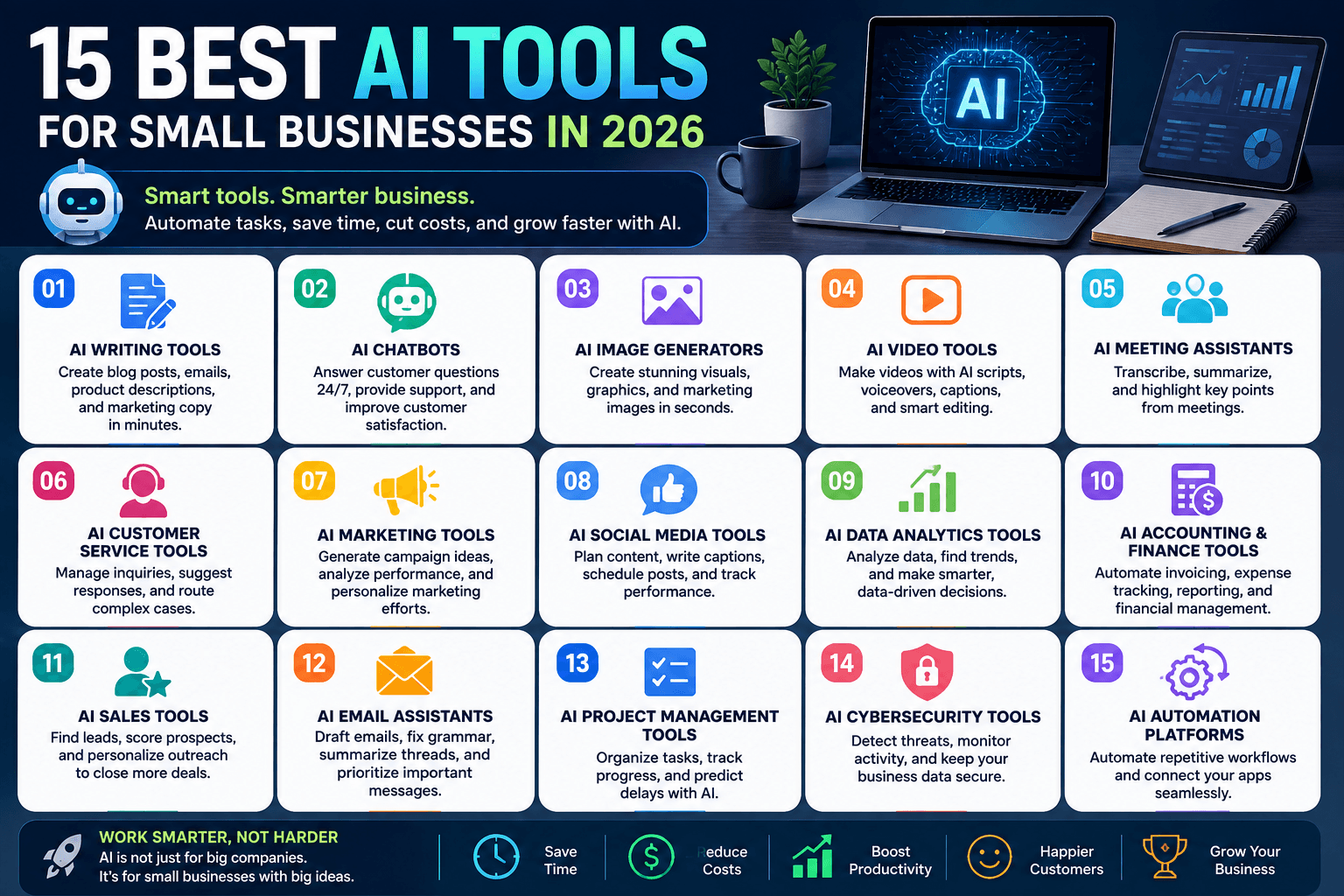
Here are 15 types of AI tools worth considering in 2026.
1. AI Writing Tools
AI writing assistants can help small businesses create blog posts, product descriptions, emails, social media content, and marketing copy.
They can reduce the time required to produce first drafts while allowing business owners to focus on strategy and editing.
2. AI Chatbots
AI chatbots can answer common customer questions at any time of the day.
Businesses can use them to provide information about products, services, pricing, orders, appointments, and frequently asked questions.
This can improve response times without requiring employees to answer every simple inquiry manually.
3. AI Image Generators
Visual content is essential for modern marketing.
AI image-generation tools can help businesses create illustrations, promotional graphics, social media visuals, product concepts, and other creative assets.
They can be especially useful for small companies that do not have an in-house design team.
4. AI Video Tools
Video marketing continues to be important across social media and digital advertising.
AI video tools can assist with scripts, captions, editing, voiceovers, animations, and short-form video production.
Small businesses can use these tools to produce more video content without building a large production team.
5. AI Meeting Assistants
Meetings often generate important information that employees need to remember later.
AI meeting assistants can transcribe conversations, summarize discussions, identify key points, and organize action items.
This can save employees time and make it easier to follow up on decisions.
6. AI Customer Service Tools
AI-powered customer service platforms can help businesses manage inquiries across different channels.
They can classify questions, suggest responses, summarize customer conversations, and route complicated cases to human employees.
This combination of AI and human support can make customer service more efficient.
7. AI Marketing Tools
Marketing requires constant research, planning, and optimization.
AI marketing tools can help businesses generate campaign ideas, analyze audience behavior, create content, and identify opportunities for improvement.
They can also help marketers personalize messages for different customer groups.
8. AI Social Media Tools
Managing multiple social media platforms can be difficult for a small team.
AI-powered social media tools can assist with content ideas, captions, scheduling, trend analysis, and performance reporting.
Instead of spending hours planning every post manually, businesses can use AI to speed up the process while maintaining human control over their brand voice.
9. AI Data Analytics Tools
Small businesses generate valuable data through sales, websites, customer interactions, and marketing campaigns.
AI analytics tools can help identify patterns and trends within this information.
Businesses can use these insights to understand which products perform well, where customers come from, and which marketing activities generate the best results.
10. AI Accounting and Finance Tools
Financial administration can consume a significant amount of time.
AI-powered accounting tools can assist with expense categorization, invoice processing, financial reporting, and other routine tasks.
Automation can reduce manual data entry and help business owners keep financial information organized.
However, important financial decisions should still receive appropriate human review.
11. AI Sales Tools
Sales teams can use AI to research prospects, organize customer information, prioritize leads, and prepare personalized outreach.
AI can also help identify potential customers who are more likely to be interested in a particular product or service.
This allows salespeople to spend more time building relationships and less time performing repetitive research.
12. AI Email Assistants
Email remains an important communication channel for businesses.
AI email assistants can help draft messages, summarize long conversations, improve writing, and prioritize important emails.
For busy entrepreneurs, these capabilities can make daily communication more manageable.
13. AI Project Management Tools
Managing projects involves deadlines, tasks, meetings, and team communication.
AI-powered project management platforms can help organize tasks, summarize updates, identify potential delays, and automate routine workflow activities.
This can be particularly useful for small teams working on multiple projects at once.
14. AI Cybersecurity Tools
Cybersecurity is essential for businesses of every size.
AI security tools can monitor activity, identify unusual behavior, detect potential threats, and assist security teams with faster responses.
Small businesses should consider cybersecurity a priority because a security incident can result in financial losses, operational disruption, and reputational damage.
15. AI Automation Platforms
AI automation platforms connect different business applications and automate repetitive workflows.
For example, a business could automatically send a follow-up email after receiving a new customer inquiry or organize information submitted through an online form.
These automated workflows can save time and reduce repetitive administrative work.
How Small Businesses Can Choose the Right AI Tools
With so many AI products available, choosing the right tool can be challenging.
Instead of adopting every new AI application, businesses should start by identifying their biggest operational problems.
Ask questions such as:
Which tasks take employees the most time?
Which processes are repetitive?
Where are customers experiencing delays?
Which business data is difficult to analyze?
Which marketing activities require the most manual work?
Once these areas are identified, businesses can choose AI tools that directly address specific problems.
Benefits of AI for Small Businesses
The right AI tools can provide several benefits, including:
Time savings: Automating repetitive tasks gives employees more time for valuable work.
Lower operating costs: Automation can reduce the amount of manual effort required for routine processes.
Improved customer service: AI can provide faster responses and support.
Better productivity: Employees can use AI as an assistant for everyday tasks.
Data-driven decisions: AI can help turn business data into useful insights.
Scalable operations: Small teams can handle larger workloads with effective automation.
What Businesses Should Consider Before Using AI
AI tools can be powerful, but businesses should not use them without considering potential risks.
Companies should evaluate data privacy, security, accuracy, pricing, integrations, and ease of use before adopting an AI platform.
Employees should also understand how the technology works and when human review is required.
AI-generated information can sometimes contain errors, so important customer, financial, legal, or business decisions should not automatically be trusted without appropriate verification.
The Future of AI for Small Businesses
AI adoption among small businesses is likely to continue growing throughout 2026.
As AI becomes easier to use, entrepreneurs will increasingly integrate it into everyday operations rather than treating it as an experimental technology.
The most successful businesses will likely be those that use AI strategically—automating repetitive work while preserving human creativity, judgment, and customer relationships.
Conclusion
AI tools are giving small businesses access to capabilities that were once available mainly to larger organizations.
From writing and marketing to customer service, accounting, cybersecurity, and automation, AI can help entrepreneurs save time and operate more efficiently.
However, the goal should not be to use AI simply because it is popular. Businesses should select tools based on clear needs and measurable benefits.
The right AI tools can become powerful digital assistants, helping small businesses work smarter, serve customers better, and compete more effectively in 2026.
FAQs
1. What are the best AI tools for small businesses in 2026?
The best tools depend on the business's needs. Common categories include AI writing, chatbots, marketing, accounting, analytics, sales, cybersecurity, and workflow automation tools.
2. Can AI reduce costs for small businesses?
Yes. AI can automate repetitive tasks and reduce the amount of manual work required for certain business processes.
3. Is AI expensive for small businesses?
Costs vary widely. Many AI tools offer free or low-cost plans, while advanced business platforms can cost more.
4. Can AI replace a small business team?
AI can automate certain tasks, but it does not replace the need for human judgment, creativity, customer relationships, and strategic decision-making.
5. How should a small business start using AI?
Start with one repetitive, low-risk task, measure the results, and gradually expand AI use as employees become comfortable with the technology.
6. Are AI tools safe for business data?
Safety depends on the specific tool and its security practices. Businesses should review privacy policies, data handling, access controls, and security features before using AI with sensitive information.