
Small businesses are increasingly looking for practical ways to do more with limited time, budgets, and staff. In 2026, AI agents are becoming one of the most discussed technologies for improving business productivity.
Unlike basic automation tools that follow fixed rules, AI agents can potentially interpret information, plan multi-step tasks, use connected tools, and assist with more complex workflows.
For small businesses, this can mean less time spent on repetitive work and more time focused on customers, growth, and strategy.
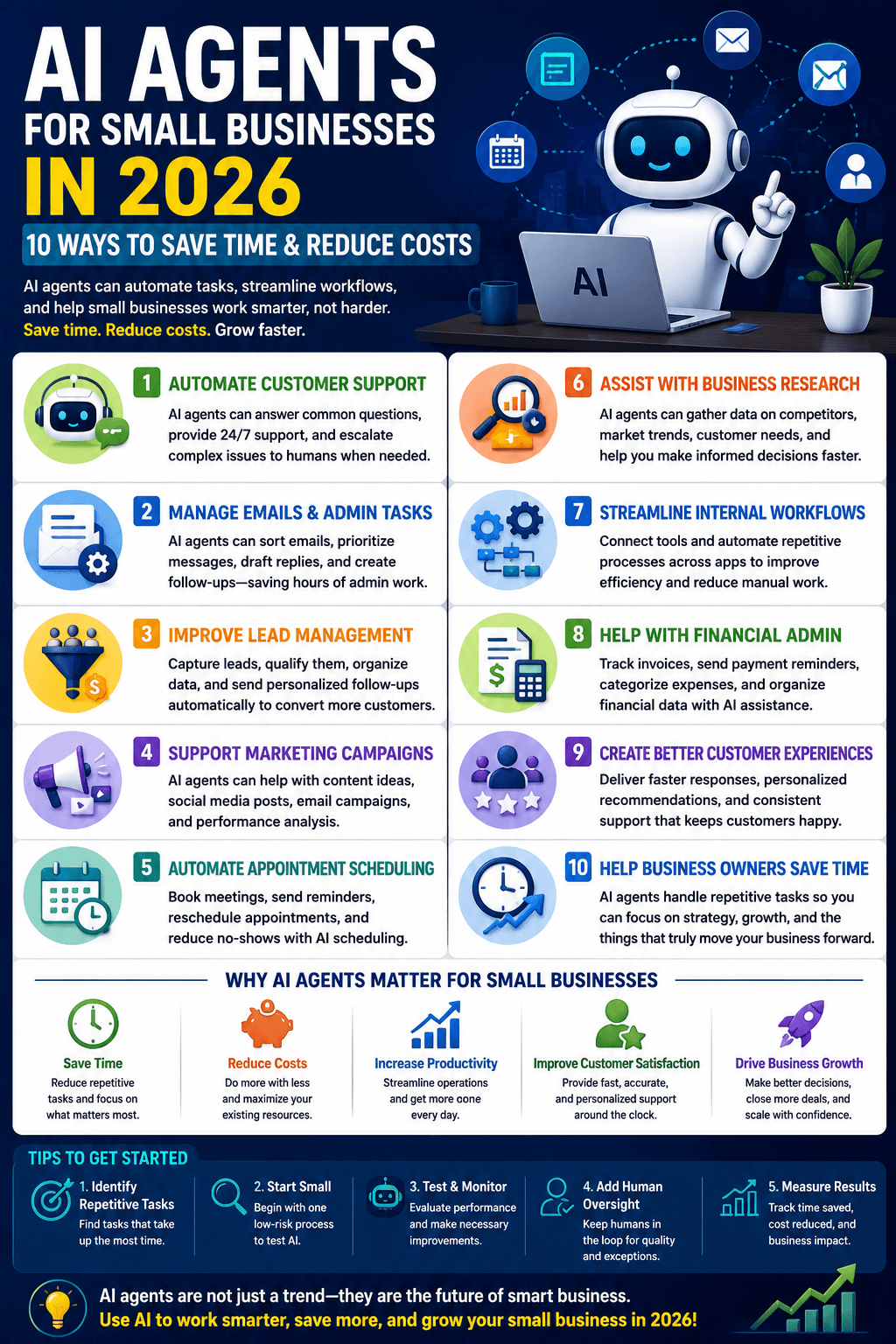
Here are 10 ways AI agents can help small businesses save time and reduce costs in 2026.
1. Automating Customer Support
Responding to customer questions can take a significant amount of time.
AI agents can help handle common requests such as:
Product questions
Business hours
Pricing information
Order updates
Appointment details
Frequently asked questions
For more complex situations, the AI system can direct the customer to a human employee.
This can help small businesses provide faster responses without requiring staff to manually answer every routine question.
2. Managing Emails and Administrative Tasks
Small business owners often spend hours reading and responding to emails.
AI agents can assist with:
Organizing incoming emails
Identifying urgent messages
Drafting responses
Creating follow-up tasks
Summarizing long email threads
Human review remains important, especially for sensitive or important communication.
However, reducing repetitive administrative work can save valuable time.
3. Improving Lead Management
Following up with potential customers is essential, but it can be difficult for small teams to manage every lead.
An AI agent could potentially help:
Collect new leads.
Organize customer information.
Identify high-priority opportunities.
Draft personalized follow-up messages.
Schedule reminders.
This can help businesses respond more quickly and avoid losing potential customers.
4. Supporting Marketing Campaigns
Marketing involves many repetitive activities.
AI agents can assist with:
Researching content ideas
Creating campaign drafts
Organizing marketing calendars
Preparing social media content
Analyzing campaign performance
The best results usually come when businesses combine AI efficiency with human creativity and strategy.
AI can handle repetitive preparation while people make important branding decisions.
5. Automating Appointment Scheduling
Scheduling appointments can involve multiple emails and messages.
AI agents can help manage:
Available time slots
Booking requests
Appointment reminders
Rescheduling
Customer confirmations
This can be particularly useful for consultants, service providers, clinics, agencies, and other appointment-based businesses.
6. Helping With Business Research
Research can be time-consuming.
AI agents can assist with gathering and organizing information about:
Competitors
Industry trends
Customer needs
Products
Market opportunities
Businesses should verify important information before making decisions, but AI can reduce the time required to complete the initial research process.
7. Streamlining Internal Workflows
Many small businesses use several different software tools.
For example:
Email
Customer relationship management systems
Accounting software
Project management platforms
Online stores
AI agents can potentially help coordinate tasks across these systems.
For example:
New customer inquiry → AI analyzes request → Customer information is recorded → Follow-up task is created → Employee receives notification
This can reduce manual data entry and improve workflow efficiency.
8. Assisting With Financial Administration
AI can help organize financial information and administrative tasks such as:
Categorizing documents
Tracking invoices
Sending payment reminders
Summarizing financial information
Organizing expense records
However, AI systems should not replace qualified accountants or financial professionals for important financial, tax, or legal decisions.
Human oversight is essential.
9. Creating Better Customer Experiences
Customers increasingly expect fast and personalized communication.
AI agents can help businesses provide:
Faster responses
Personalized recommendations
Consistent information
24/7 assistance for basic questions
A positive customer experience can improve satisfaction and potentially increase customer loyalty.
However, businesses should always provide customers with a clear way to reach a human when necessary.
10. Helping Business Owners Make Better Use of Time
Perhaps the biggest advantage of AI agents is their potential to reduce time spent on repetitive work.
Instead of manually completing every routine task, business owners can focus more on:
Customer relationships
Business strategy
Product development
Sales
Growth opportunities
For many entrepreneurs, time is one of their most valuable resources.
AI agents can potentially act as digital assistants that support daily operations.
AI Agents vs. Traditional Automation
Traditional automation usually follows specific rules.
For example:
If a customer completes a form → Send an email.
AI agents can potentially handle more flexible tasks.
For example:
Read the customer's message → Understand the request → Check relevant information → Decide the next step → Take an appropriate action.
This additional flexibility can make AI agents useful for workflows involving unstructured information and changing situations.
However, traditional automation is still often the best choice for simple and predictable tasks.
How AI Agents Can Reduce Business Costs
AI agents may help reduce costs by improving efficiency.
Potential benefits include:
Less Time Spent on Repetitive Work
Employees can focus on higher-value tasks.
Faster Customer Responses
Businesses may be able to handle routine inquiries more efficiently.
Improved Workflow Efficiency
AI can help reduce repetitive manual processes.
Better Use of Existing Resources
Small teams may be able to manage a larger workload.
However, businesses should consider implementation, software, training, monitoring, and maintenance costs before adopting AI systems.
How Small Businesses Should Start Using AI Agents
Small businesses should avoid trying to automate everything immediately.
A better approach is to start with one specific problem.
Step 1: Identify Repetitive Tasks
Look for tasks that consume significant time every week.
Step 2: Choose a Low-Risk Workflow
Start with an activity where mistakes will not create serious consequences.
Step 3: Test the AI System
Monitor how accurately and reliably the system performs.
Step 4: Add Human Oversight
Make sure employees can review important actions and handle exceptions.
Step 5: Measure Results
Track:
Time saved
Costs
Customer satisfaction
Error rates
Business results
If the system provides real value, gradually expand its use.
Challenges of Using AI Agents
AI agents can provide benefits, but businesses should also understand the risks.
Accuracy Problems
AI systems can make mistakes or misunderstand information.
Data Privacy
Businesses should carefully consider what data is shared with AI platforms.
Security
Connected AI systems may require access to business tools and information, so permissions should be carefully managed.
Over-Automation
Not every business process should be automated.
Customers and employees may still need human interaction.
Implementation Costs
Advanced AI systems can require investments in software, integration, and training.
The Future of AI Agents for Small Businesses
AI agents are likely to become increasingly integrated into everyday business software.
Instead of operating as separate tools, AI capabilities may increasingly appear inside:
Customer service platforms
Marketing software
CRM systems
Accounting tools
Project management applications
E-commerce platforms
The most successful small businesses will not necessarily be those using the most AI.
They will be the businesses that use AI strategically to solve real problems.
Conclusion
AI agents have the potential to help small businesses save time, reduce repetitive work, improve customer service, and streamline daily operations in 2026.
From managing customer inquiries and leads to supporting marketing and internal workflows, these systems can act as valuable digital assistants.
However, successful adoption requires more than simply installing an AI tool.
Small businesses should start with clear goals, test carefully, protect sensitive information, and maintain appropriate human oversight.
The real value of AI agents is not automation for its own sake—it is giving business owners and employees more time to focus on work that truly matters.
FAQs
1. What is an AI agent?
An AI agent is a software system that can use AI to interpret information, assist with decisions, and perform tasks toward a defined goal.
2. Can small businesses use AI agents?
Yes. Small businesses can use AI agents for customer support, administration, marketing, lead management, research, and workflow automation.
3. How can AI agents save money?
They can potentially reduce the time spent on repetitive tasks and help businesses use employee resources more efficiently.
4. Are AI agents expensive?
Costs vary depending on the platform, integrations, complexity, and usage. Businesses should compare the costs with the expected benefits.
5. Can AI agents replace employees?
AI agents can automate certain tasks, but human employees remain important for judgment, relationships, creativity, oversight, and complex decisions.
6. Are AI agents secure?
Security depends on the specific system and how it is configured. Businesses should carefully manage permissions and sensitive data.
7. What is the difference between AI agents and chatbots?
A basic chatbot primarily responds to conversations, while an AI agent may be able to perform multi-step tasks and interact with connected tools.
8. What should a small business automate first?
Start with repetitive, low-risk tasks that consume significant amounts of time.
9. Do AI agents require coding skills?
Not always. Some platforms offer no-code or low-code options, although advanced implementations may require technical expertise.
10. What is the future of AI agents?
AI agents are expected to become more integrated into everyday business software and automation workflows.