
AAAI Agents in 2026: How Autonomous AI Is Changing Jobs, Business & Everyday Life
Introduction
Robotics is entering a major new phase in 2026. For decades, robots were primarily associated with factories, warehouses, and highly controlled industrial environments. Today, advances in artificial intelligence, computer vision, sensors, batteries, and robotics hardware are helping machines become more capable and adaptable.
One of the most exciting developments is the rise of humanoid robots—machines designed to operate in environments built for humans.
From manufacturing and logistics to healthcare and household assistance, robots could increasingly work alongside people rather than simply performing isolated automated tasks.
What Are Humanoid Robots?
Humanoid robots are machines designed with a human-like body structure, typically including a head, torso, arms, and legs.
Their human-like shape can be useful because homes, offices, factories, and public spaces are already designed around human movement.
Instead of rebuilding an environment for a specialized machine, a humanoid robot could potentially learn to use existing tools and navigate existing spaces.
Why Are Humanoid Robots Growing in 2026?
Several technologies are contributing to the rapid development of modern robotics.
Artificial Intelligence
AI allows robots to understand instructions, recognize objects, interpret their surroundings, and make decisions.
Computer Vision
Cameras and vision systems help robots identify objects, people, obstacles, and environments.
Better Sensors
Modern sensors allow robots to understand movement, distance, force, and physical contact.
Improved Batteries
Better battery technology can help mobile robots operate for longer periods.
Advanced Robotics Hardware
More capable motors, actuators, processors, and control systems are making robots increasingly agile and useful.
Humanoid Robots in Manufacturing
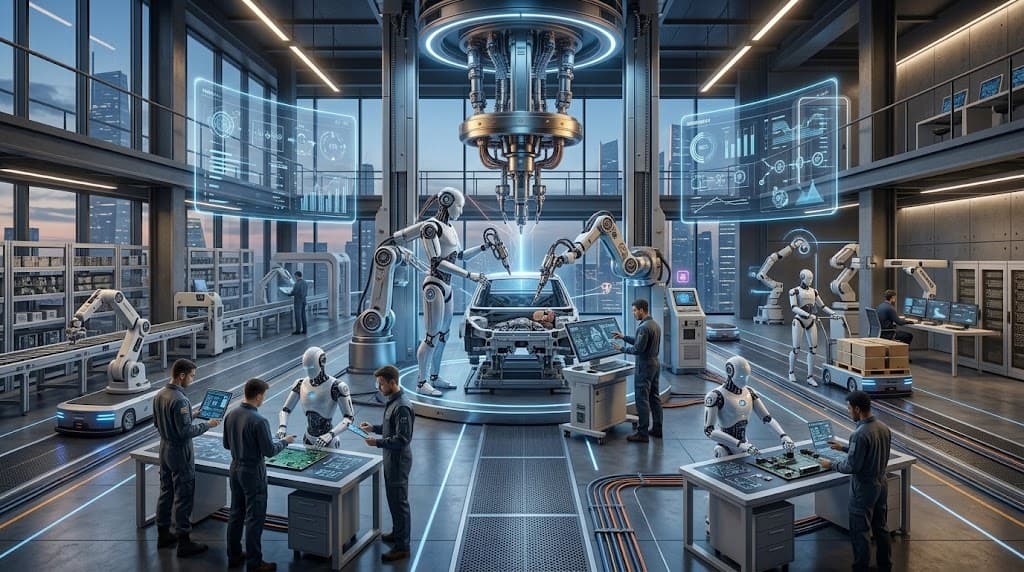
Manufacturing is one of the industries most likely to benefit from advanced robotics.
Humanoid robots could potentially perform repetitive tasks such as:
Moving materials
Sorting components
Handling equipment
Inspecting products
Supporting assembly operations
Working in environments that may be difficult for humans
Unlike traditional industrial robots, humanoid systems could eventually be adapted to multiple tasks instead of being permanently dedicated to one operation.
Robots in Warehouses and Logistics
Warehouses require large amounts of physical movement.
Robots can help transport products, organize inventory, move packages, and perform repetitive operations.
AI-powered robots could potentially navigate changing environments and respond to unexpected obstacles more effectively than earlier automated systems.
This could increase efficiency while reducing the amount of physically demanding work required from human employees.
Robots in Healthcare
Healthcare is another promising area.
Robots could assist with tasks such as transporting supplies, delivering equipment, supporting rehabilitation, and helping with certain routine activities.
However, healthcare robotics requires extremely high standards of safety and reliability.
Robots are more likely to assist healthcare professionals than replace doctors, nurses, and other trained workers.
Humanoid Robots at Home
One of the most ambitious goals is bringing capable robots into people's homes.
A future household robot could potentially help with:
Cleaning
Carrying objects
Organizing items
Basic household tasks
Delivering reminders
Assisting elderly people
Interacting with smart-home devices
But home environments are much less predictable than factories. Every house has different layouts, objects, people, pets, and obstacles.
Teaching robots to safely handle this complexity remains a major challenge.
Will Robots Take Human Jobs?
This is one of the biggest questions surrounding robotics.
Automation can replace certain repetitive tasks, but it can also create new jobs and change existing roles.
Rather than completely eliminating human employment, robotics may shift workers toward responsibilities involving:
Supervision
Maintenance
Programming
Robot management
Customer interaction
Problem-solving
Creative work
The impact will vary significantly by industry and occupation.
Humans and Robots Working Together
The future of robotics is not necessarily about humans competing directly with machines.
A more realistic model is human-robot collaboration.
Robots can handle repetitive, physically demanding, or dangerous tasks, while humans focus on judgment, communication, creativity, and complex decision-making.
This combination could make workplaces more productive while reducing exposure to certain physical risks.
Challenges Facing Humanoid Robots
Despite impressive progress, humanoid robots still face major challenges.
High Costs
Advanced robotic hardware can be expensive to develop, manufacture, and maintain.
Battery Life
Mobile robots require significant energy, especially when performing physically demanding tasks.
Safety
Robots operating around humans must be extremely reliable.
Complex Environments
Homes and public spaces contain countless unpredictable situations.
AI Reliability
A robot must correctly understand instructions and its surroundings before taking physical action.
Public Acceptance
People need to feel comfortable and confident around increasingly autonomous machines.
The Future of Robotics
Robotics is likely to become increasingly connected with artificial intelligence.
Instead of robots simply following fixed instructions, future machines could understand natural language and adapt to changing environments.
For example, instead of programming every individual movement, a person might give a robot a general instruction such as:
“Please organize these items and place them where they belong.”
The AI system could interpret the instruction, identify objects, plan actions, and execute the task.
This combination of AI + robotics could be one of the most important technology trends of the coming decade.
Conclusion
Robotics in 2026 is moving beyond traditional factory automation. Advances in AI, sensors, computer vision, and robotics hardware are creating machines capable of performing increasingly complex tasks.
Humanoid robots could eventually become useful in factories, warehouses, hospitals, homes, and other environments.
However, widespread adoption will depend on improvements in cost, safety, reliability, battery life, AI performance, and public trust.
The future is unlikely to be a world where robots simply replace humans. Instead, the most valuable development may be a world where humans and intelligent machines work together.
❓ FAQs
1. What are humanoid robots?
Humanoid robots are robots designed with a human-like body structure so they can potentially operate in environments built for people.
2. What can robots do in 2026?
Modern robots can perform tasks including manufacturing, warehouse operations, inspection, transportation, and other specialized activities.
3. Can humanoid robots work in factories?
Yes. Manufacturing is one of the major areas being explored for humanoid robotics.
4. Will robots replace human workers?
Robots may automate some tasks and change certain jobs, but many roles will continue to require human judgment, creativity, communication, and expertise.
5. Can robots work in homes?
Home robotics is developing, but household environments remain significantly more challenging than controlled industrial environments.
6. How does AI improve robots?
AI can help robots understand instructions, recognize objects, interpret environments, plan actions, and adapt to changing situations.
7. Are humanoid robots safe?
Safety depends on the robot's hardware, software, environment, and operating procedures. Robots intended to work around people require extensive safety testing.
8. Can robots help elderly people?
Potentially. Robots could assist with certain household tasks, reminders, transportation of objects, and other forms of support.
9. What industries will benefit most from robotics?
Manufacturing, logistics, healthcare, agriculture, construction, and other industries involving repetitive or physically demanding work could benefit significantly.
10. Are humanoid robots expensive?
Advanced humanoid robots currently involve significant development and manufacturing costs, although costs could change as production scales.
11. What is human-robot collaboration?
It means humans and robots working together, with machines handling suitable automated tasks while people provide judgment and oversight.
12. Can robots understand human speech?
AI-powered robots can increasingly process natural-language instructions, although their capabilities vary significantly between systems.
13. What is the biggest challenge for home robots?
Homes are unpredictable environments containing different layouts, objects, people, pets, and unexpected situations.
14. Will robots become more intelligent?
AI advances are expected to make robots increasingly capable of understanding their surroundings and carrying out complex tasks.
15. What is the future of humanoid robots?
Humanoid robots could become valuable tools across industries if developers can improve their reliability, affordability, safety, and ability to operate in real-world environments