TFThe Future of Smart Homes in 2026: AI, Automation & Connected Living
The experimental phase of technology is officially over. As we cross the midpoint of 2026, the global corporate strategy has shifted entirely from "proof of concept" to proof of impact. Driven by the necessity of clear ROI, macroeconomic pressures, and escalating geopolitical dynamics, industries are rewriting their operational DNA.
The defining technological innovations reshaping major sectors—ranging from finance and manufacturing to energy and defense—center on execution, scaling, and true structural transformation.
1. Agentic AI & "Intent-Driven" Software (Enterprise-Wide)
For the past few years, generative AI was largely treated as a highly capable personal productivity tool—a chatbot or a copilot. In 2026, the paradigm has shifted toward Agentic AI and autonomous, goal-driven systems.
Instead of humans writing code or executing individual tasks step-by-step, developers and operators now "express intent," and AI autonomously orchestrates, delivers, and self-heals systems behind the scenes.
Manufacturing & Supply Chain: Autonomous AI agents handle complex, multi-variable logistics—re-routing shipments in real time, negotiating with automated vendor platforms, and adjusting assembly line workflows based on immediate raw material fluctuations.
Software Development: The focus has moved from manual coding to the orchestration and strict governance of self-assembling software pipelines.
2. Cloud 3.0 & "Geopatriation"
The traditional model of running all enterprise applications in a handful of centralized public cloud data centers is no longer tenable for heavy AI operations. High latency, data gravity (the cost and friction of moving massive datasets), and intense data sovereignty laws have given rise to Cloud 3.0.
Geopatriation: The strategic practice of shifting workloads back to regionalized, sovereign, or localized hybrid-cloud environments to mitigate geopolitical risks and protect high-value, proprietary data.
Enterprises are systematically breaking up monolithic architectures into modular, localized cloud clusters. This allows massive AI models to be fine-tuned locally on highly sensitive, industry-specific proprietary data without exposing that data to external legal or security vulnerabilities.
3. Decentralized Energy & Everything-to-Grid (E2G) Technology
The power grid crisis—exacerbated by the monumental electricity demands of AI supercomputing data centers—has forced a revolution in clean energy distribution. Everything-to-Grid (E2G) technology has transitioned from localized pilots to a major industrial backbone.
Instead of relying solely on massive centralized power stations, E2G networks dynamically mobilize millions of idle, distributed energy assets.
When demand peaks—such as late afternoon when residential usage surges just as solar generation drops—E2G software pulls stored electricity back out of electric vehicles, factory backup batteries, and smart homes to balance the grid. This effectively eliminates the need for fossil-fuel-burning "peaker plants".
4. Preemptive Cybersecurity & Post-Quantum Readiness
With hackers deploying the exact same automated, lightning-fast AI tools as enterprise security teams, reactive cybersecurity is obsolete. The standard in 2026 is Preemptive Cybersecurity, which utilizes advanced machine learning models to anticipate and block zero-day vectors before they strike.
Concurrently, a massive wave of industrial innovation is hitting cryptography. Because breakthroughs in quantum computing are threatening traditional encryption methods, forward-looking industries—especially banking, national defense, and telecommunications—are executing massive infrastructure overhauls to deploy quantum-resistant cryptographic algorithms and secure quantum communication networks.
5. Next-Gen Material Science: DLE and Radiative Cooling
Deep industrial innovation isn't confined to digital code. Material science breakthroughs are directly accelerating the global energy transition:
Direct Lithium Extraction (DLE): Traditional lithium harvesting via brine evaporation takes up to two years and consumes massive amounts of water. DLE uses engineered membrane and solvent systems to extract lithium from wastewater and geothermal fluids within hours, returning the water safely underground and radically restructuring the battery supply chain.
Passive Radiative Cooling Materials: New high-tech coatings and paints reflect up to 95% of incoming sunlight, actually dropping a building's surface temperature below that of the surrounding air without using a single watt of electricity. Major retail, grocery, and data facility networks are scaling these coatings globally, cutting commercial air conditioning and HVAC energy consumption by up to 20%.
Key Takeaway for Industry Leaders
Focus Area | 2024–2025 Era | 2026 Reality |
AI Strategy | Fragmented pilots & individual productivity | Process-led, goal-driven autonomous systems |
Data & Cloud | Centralized, public cloud-first migration | Sovereign, localized, and multi-cloud architectures |
Cyber Defense | Patching, detection, and incident response | Preemptive AI blocking & post-quantum migration |
In 2026, technology is no longer an overlay to boost efficiency; it is an active, self-governing architecture running at scale. The competitive divide is no longer between those who adopt tech and those who don't—it is between companies running scattered pilots and those who have built a cohesive, resilient digital backbone.
Would you like to zoom in on a specific sector—such as how private equity and financial engineering are utilizing these AI advancements, or how these technologies are shifting global manufacturing?
Frequently Asked Questions (FAQs)
1. What are the biggest technology innovations changing industries in 2026?
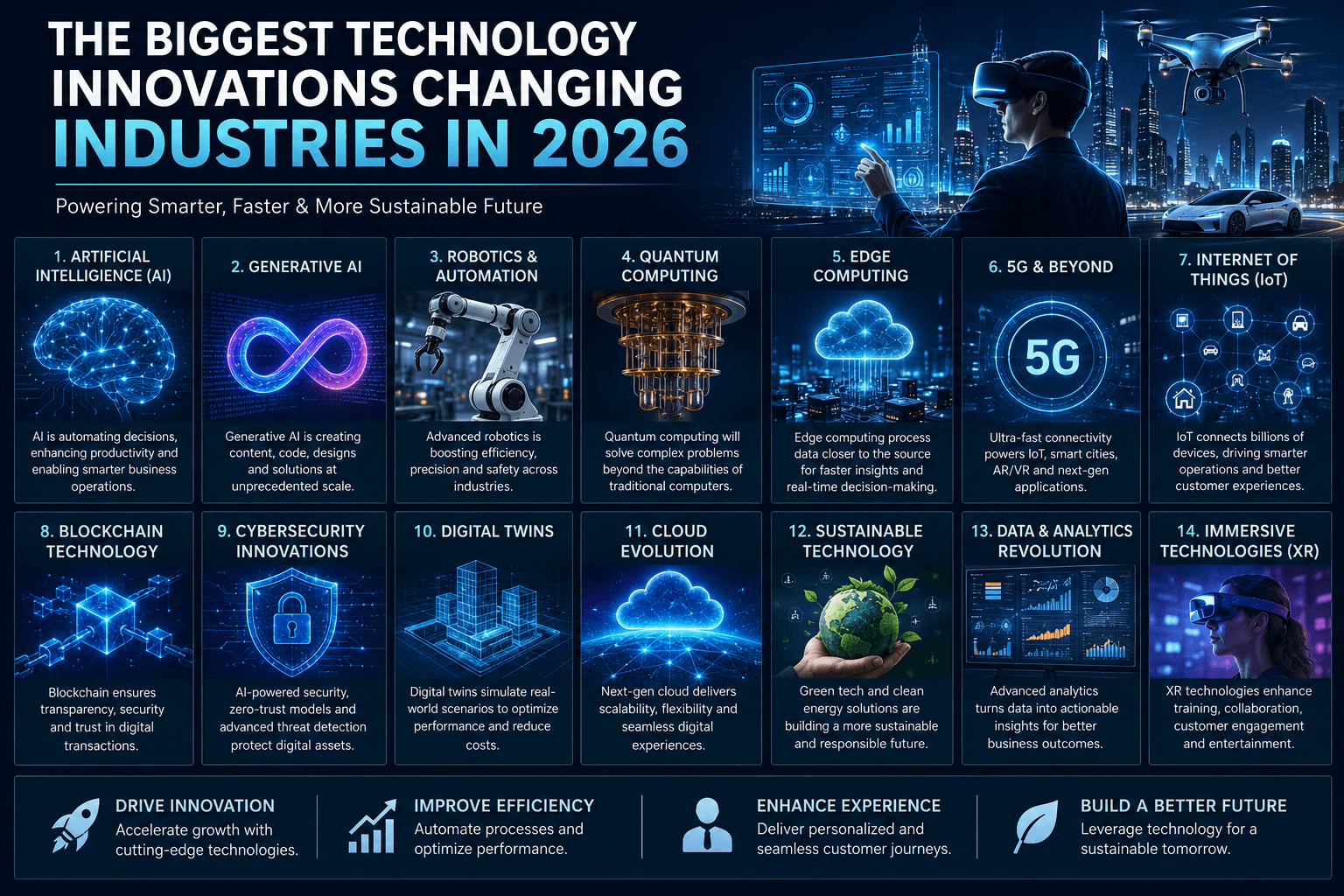
The biggest innovations include artificial intelligence (AI), generative AI, robotics, quantum computing, edge computing, 5G, blockchain, cybersecurity, digital twins, and the Internet of Things (IoT).
2. Why are technology innovations important for businesses?
Technology innovations help businesses improve efficiency, reduce costs, enhance customer experiences, increase productivity, and remain competitive in evolving markets.
3. How is artificial intelligence transforming industries?
AI automates repetitive tasks, analyses large datasets, improves decision-making, personalises customer experiences, and increases operational efficiency across multiple industries.
4. What is generative AI?
Generative AI is a form of artificial intelligence that creates text, images, videos, software code, and other digital content using advanced machine learning models.
5. How does automation improve business operations?
Automation reduces manual work, minimises errors, speeds up workflows, increases productivity, and allows employees to focus on higher-value activities.
6. What industries benefit most from AI?
Healthcare, finance, manufacturing, retail, logistics, education, cybersecurity, agriculture, and customer service are among the industries benefiting the most.
7. What is edge computing?
Edge computing processes data closer to where it is generated, reducing latency, improving speed, and supporting real-time applications.
8. Why is cloud computing still important in 2026?
Cloud computing provides scalable infrastructure, secure data storage, remote collaboration, disaster recovery, and cost-effective digital transformation.
9. How does the Internet of Things (IoT) improve businesses?
IoT connects devices that collect and share data, enabling predictive maintenance, real-time monitoring, operational efficiency, and smarter decision-making.
10. What role does blockchain play in modern industries?
Blockchain improves transparency, security, traceability, digital identity management, and secure transactions across finance, healthcare, and supply chain operations.
11. What is a digital twin?
A digital twin is a virtual representation of a physical asset, process, or system used to monitor performance, simulate scenarios, and optimise operations.
12. How is cybersecurity evolving in 2026?
Cybersecurity now focuses on AI-powered threat detection, Zero Trust security models, identity protection, cloud security, and proactive risk management.
13. What is quantum computing?
Quantum computing uses quantum mechanics to solve highly complex problems much faster than traditional computers in selected applications.
14. Which industries could benefit from quantum computing?
Healthcare, pharmaceuticals, finance, logistics, energy, scientific research, and advanced manufacturing could benefit significantly.
15. How does 5G technology support innovation?
5G enables faster internet speeds, lower latency, reliable connectivity, smart cities, autonomous vehicles, and advanced industrial automation.
16. What is Industry 4.0?
Industry 4.0 refers to the integration of AI, robotics, IoT, cloud computing, automation, and real-time analytics into manufacturing and industrial operations.
17. How are robots changing industries?
Modern robots perform repetitive, dangerous, and precision-based tasks while improving productivity, workplace safety, and manufacturing quality.
18. Why is data analytics important for innovation?
Data analytics helps organisations identify trends, optimise operations, improve customer experiences, and make evidence-based strategic decisions.
19. How does technology improve customer experience?
Technology enables personalised recommendations, faster support, omnichannel communication, AI chatbots, and seamless digital interactions.
20. What is sustainable technology?
Sustainable technology focuses on reducing environmental impact through energy-efficient systems, renewable energy, smart resource management, and environmentally responsible innovation.
21. How does AI support healthcare innovation?
AI assists with disease detection, medical imaging, personalised treatment, hospital management, drug discovery, and remote patient monitoring.
22. What challenges come with adopting new technologies?
Businesses may face implementation costs, cybersecurity risks, employee training requirements, system integration challenges, and regulatory compliance issues.
23. How can businesses prepare for emerging technologies?
Businesses should invest in digital transformation, employee training, cybersecurity, innovation strategies, and scalable technology infrastructure.
24. What role does machine learning play in business?
Machine learning helps predict customer behaviour, automate decision-making, detect fraud, optimise supply chains, and improve operational efficiency.
25. Why is cybersecurity becoming more critical?
As businesses become increasingly digital, stronger cybersecurity is essential to protect sensitive data, maintain customer trust, and prevent cyber threats.
26. Which technology trend offers the greatest business opportunity?
Artificial intelligence remains one of the most impactful technologies because it enhances productivity, automation, innovation, and strategic decision-making across nearly every industry.
27. How can small businesses benefit from emerging technologies?
Small businesses can adopt cloud services, AI tools, automation, digital marketing, cybersecurity solutions, and analytics platforms to improve efficiency and compete effectively.
28. What is the future of technology innovation beyond 2026?
Future innovations are expected to include more advanced AI, widespread quantum computing, autonomous systems, extended reality (XR), intelligent robotics, and increasingly connected digital ecosystems.
29. Why should businesses stay updated with technology innovations?
Keeping up with technology innovations enables businesses to adapt to market changes, improve operational efficiency, enhance customer experiences, reduce risks, foster innovation, and achieve sustainable long-term growth.