TFThe Future of Smart Homes in 2026: AI, Automation & Connected Living
Technology continues to reshape the global business landscape at an unprecedented pace. From Artificial Intelligence and cloud computing to quantum technology and automation, innovation is creating new opportunities for entrepreneurs while redefining how companies operate, compete, and grow.
As businesses prepare for the years ahead, staying informed about emerging technologies is no longer optional—it is essential. Entrepreneurs who understand these trends can make smarter investment decisions, improve operational efficiency, enhance customer experiences, and build sustainable competitive advantages.
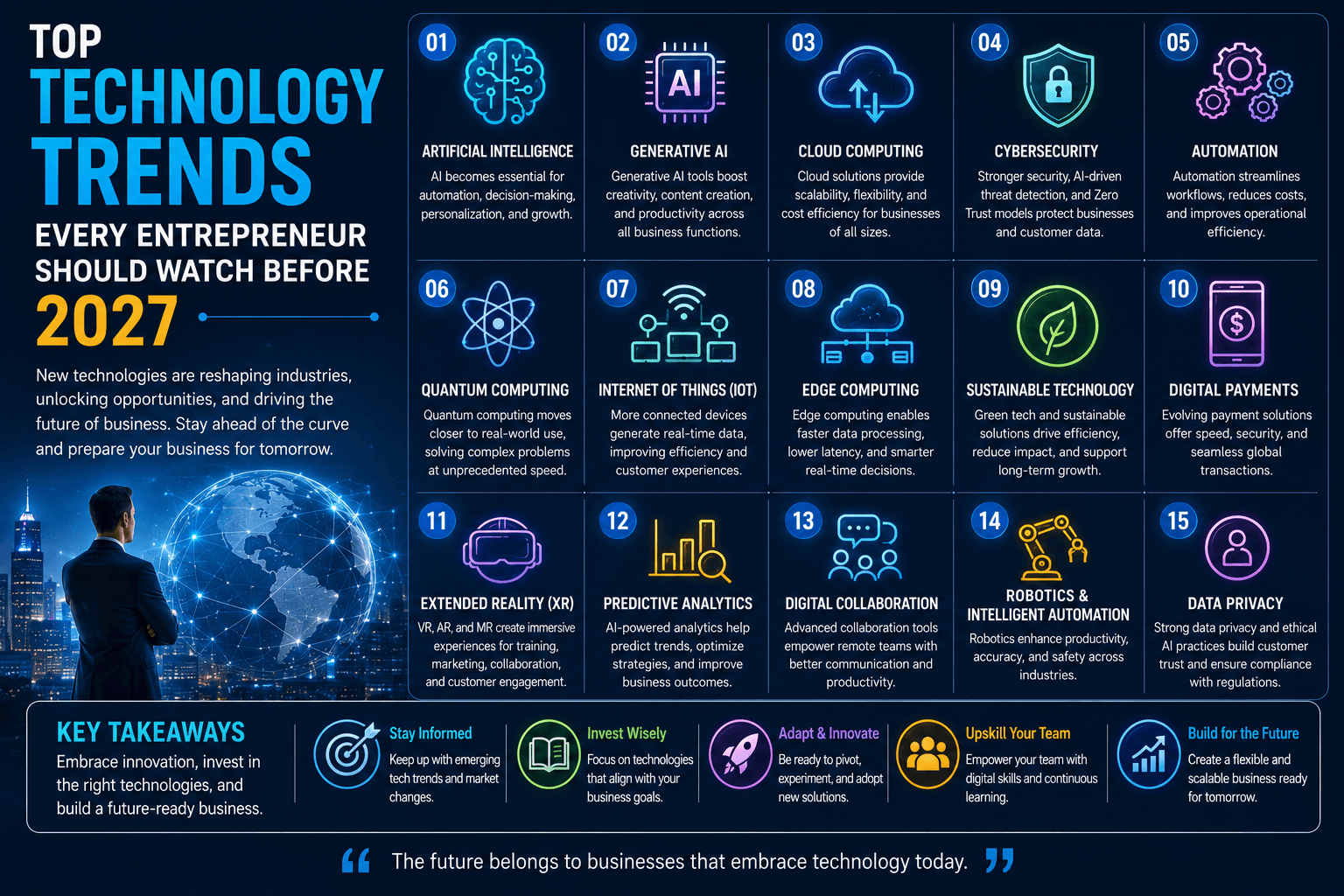
Here are the top technology trends every entrepreneur should watch before 2027.
1. Artificial Intelligence Becomes a Business Standard
Artificial Intelligence (AI) is no longer limited to large technology companies.
Businesses of every size are using AI to:
Automate repetitive tasks
Improve customer service
Analyze business data
Personalize marketing
Forecast demand
Strengthen cybersecurity
Entrepreneurs that successfully integrate AI into daily operations can increase productivity while reducing costs.
2. Generative AI Expands Across Industries
Generative AI is transforming how businesses create content, software, marketing materials, and customer communications.
Applications include:
Content creation
Product design
Customer support
Software development
Business documentation
Research assistance
As AI tools become more advanced, entrepreneurs can accelerate innovation with fewer resources.
3. Cloud Computing Continues to Drive Growth
Cloud technology remains the foundation of digital transformation.
Cloud platforms provide:
Flexible infrastructure
Data storage
Collaboration tools
Business applications
Cybersecurity services
Disaster recovery
Cloud computing enables businesses to scale quickly while minimizing infrastructure costs.
4. Cybersecurity Becomes a Strategic Investment
Cyber threats continue growing in sophistication.
Businesses increasingly invest in:
AI-powered security
Zero Trust security models
Multi-factor authentication
Threat intelligence
Data encryption
Employee cybersecurity training
Strong cybersecurity protects both business operations and customer trust.
5. Automation Improves Business Efficiency
Automation continues eliminating repetitive administrative work.
Businesses automate:
Customer support
Accounting
Inventory management
Marketing
HR processes
Workflow approvals
Automation allows entrepreneurs to focus on innovation and business growth.
6. Quantum Computing Moves Toward Commercial Adoption
Quantum computing continues progressing toward practical enterprise applications.
Potential business benefits include:
Faster optimization
Drug discovery
Financial modeling
Supply chain optimization
Advanced simulations
Scientific research
Although still developing, entrepreneurs should monitor this technology closely.
7. Internet of Things (IoT) Expands
Connected devices continue generating valuable business insights.
IoT supports:
Smart factories
Connected vehicles
Asset tracking
Energy management
Predictive maintenance
Smart logistics
Real-time data helps businesses improve operational efficiency.
8. Edge Computing Accelerates Real-Time Processing
Edge computing processes information closer to where it is generated.
Benefits include:
Lower latency
Faster decision-making
Improved security
Reduced bandwidth usage
Better IoT performance
Industries such as healthcare, manufacturing, and transportation increasingly rely on edge computing.
9. Sustainable Technology Gains Momentum
Businesses are investing in technologies that reduce environmental impact.
Examples include:
Renewable energy
Green data centers
Electric vehicles
Smart energy systems
Sustainable manufacturing
Sustainability increasingly influences customer purchasing decisions and investor confidence.
10. Digital Payments Continue Evolving
Financial technology continues transforming commerce.
Entrepreneurs should monitor:
Mobile payments
Digital wallets
Embedded finance
AI fraud detection
Cross-border payment innovation
Digital payment solutions improve customer convenience while expanding global business opportunities.
11. Extended Reality (XR) Creates New Experiences
Virtual Reality (VR), Augmented Reality (AR), and Mixed Reality (MR) continue expanding beyond gaming.
Businesses use XR for:
Employee training
Product visualization
Remote collaboration
Customer engagement
Virtual events
Immersive technologies create new opportunities across multiple industries.
12. Predictive Analytics Supports Smarter Decisions
Businesses increasingly rely on predictive analytics to anticipate future outcomes.
AI-powered analytics help organizations:
Forecast sales
Predict customer behavior
Optimize inventory
Reduce operational risks
Improve strategic planning
Better forecasting supports more confident decision-making.
13. Digital Collaboration Continues Evolving
Remote and hybrid work remain important business models.
New collaboration technologies provide:
AI meeting assistants
Real-time translation
Intelligent scheduling
Workflow automation
Knowledge management
These innovations improve productivity for distributed teams.
14. Robotics and Intelligent Automation
Advanced robotics continue transforming manufacturing, logistics, healthcare, and warehousing.
Businesses benefit from:
Faster production
Improved quality
Lower operating costs
Better workplace safety
Increased efficiency
Automation continues supporting business growth across multiple industries.
15. Data Privacy Becomes a Competitive Advantage
Consumers increasingly expect businesses to protect personal information.
Organizations investing in:
Privacy compliance
Secure cloud infrastructure
Responsible AI
Transparent data practices
build stronger customer trust while reducing regulatory risk.
Preparing for the Future
Entrepreneurs should focus on:
Continuous learning
Digital transformation
AI adoption
Cybersecurity
Employee upskilling
Innovation culture
Businesses that remain adaptable will be better prepared for future technological changes.
Conclusion
Technology will continue transforming every aspect of business before 2027. Artificial Intelligence, cloud computing, automation, quantum computing, cybersecurity, sustainable innovation, digital payments, and advanced analytics are creating unprecedented opportunities for entrepreneurs worldwide.
Rather than attempting to adopt every emerging technology, successful entrepreneurs should identify the innovations that align with their business goals, customer needs, and long-term strategy.
Organizations that embrace continuous innovation, invest in digital capabilities, and remain adaptable will be best positioned to thrive in the rapidly evolving global economy. By preparing today, entrepreneurs can build resilient businesses ready for the opportunities and challenges of tomorrow.
FAQs
1. What are the biggest technology trends before 2027?
Artificial intelligence, automation, cybersecurity, cloud computing, edge computing, IoT, blockchain, and extended reality are among the leading trends.
2. Why should entrepreneurs follow technology trends?
Keeping up with technology helps entrepreneurs improve efficiency, reduce costs, create better customer experiences, and stay competitive.
3. How is AI changing businesses?
AI automates repetitive tasks, improves customer support, analyzes data, and helps businesses make faster, data-driven decisions.
4. Is cloud computing still important in 2026?
Yes. Cloud computing remains essential for scalability, remote collaboration, data storage, and reducing IT infrastructure costs.
5. What role does cybersecurity play in business growth?
Strong cybersecurity protects sensitive data, prevents cyberattacks, ensures compliance, and builds customer trust.
6. How can automation benefit small businesses?
Automation reduces manual work, minimizes errors, increases productivity, and allows teams to focus on strategic tasks.
7. What is edge computing?
Edge computing processes data closer to its source, reducing latency and improving performance for connected devices.
8. Why is data analytics important for entrepreneurs?
Data analytics helps businesses understand customer behavior, measure performance, and make informed business decisions.
9. Will blockchain be useful beyond cryptocurrency?
Yes. Blockchain is increasingly used for secure transactions, supply chain management, digital identity verification, and smart contracts.
10. What is the Internet of Things (IoT)?
IoT refers to connected devices that collect and exchange data to improve automation and operational efficiency.
11. How will 5G impact businesses?
5G enables faster connectivity, better remote collaboration, smarter IoT applications, and real-time data processing.
12. What are AI agents in business?
AI agents are autonomous software systems that can perform tasks, make decisions, and collaborate with minimal human intervention.
13. Why is digital transformation important?
Digital transformation improves operational efficiency, customer experiences, innovation, and long-term business resilience.
14. How can startups adopt new technologies affordably?
Startups can use cloud-based services, SaaS platforms, open-source tools, and scalable AI solutions to minimize costs.
15. What industries will benefit most from emerging technologies?
Healthcare, finance, manufacturing, retail, logistics, education, and professional services are expected to benefit significantly.
16. What is extended reality (XR)?
Extended reality includes virtual reality (VR), augmented reality (AR), and mixed reality (MR), creating immersive digital experiences.
17. How important is sustainability in technology?
Green technology and energy-efficient solutions help businesses reduce environmental impact while lowering operating costs.
18. How should entrepreneurs prepare for technology changes?
They should invest in employee training, monitor industry trends, strengthen cybersecurity, and adopt scalable digital solutions.
19. Can small businesses compete using advanced technology?
Yes. Affordable cloud services, AI tools, and automation platforms enable small businesses to compete with larger organizations.
20. Which technology trend will have the greatest impact before 2027?
Artificial intelligence is expected to have the biggest impact, transforming decision-making, customer engagement, automation, and overall business operations.