
TFThe Future of Smart Homes in 2026: AI, Automation & Connected Living
Introduction
Innovation has become one of the most important drivers of business success in today's technology-driven economy. Organizations that continuously improve their products, embrace emerging technologies, and build cultures of learning are better equipped to adapt to changing markets and customer expectations.
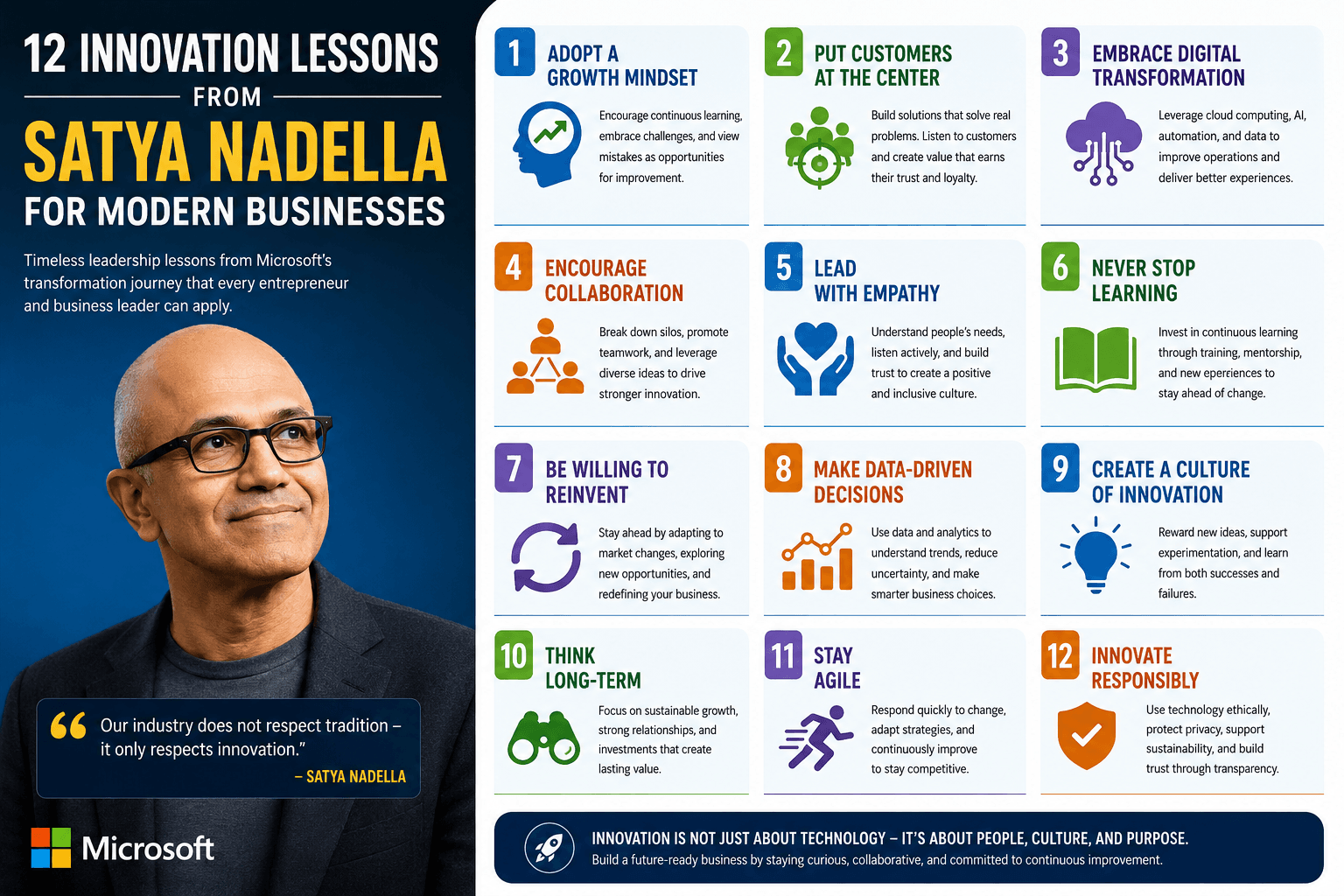
Few business leaders have demonstrated the power of transformation as effectively as Satya Nadella. Since becoming CEO of Microsoft in 2014, he has led one of the world's most significant corporate reinventions by prioritizing cloud computing, artificial intelligence, collaboration, and customer-focused innovation.
At 1st4eBusiness, we believe innovation is not limited to technology companies. Businesses of every size can strengthen their competitive position by adopting modern leadership strategies, investing in continuous improvement, and embracing digital transformation. The following lessons provide practical insights that entrepreneurs, executives, and business owners can apply to build resilient, future-ready organizations.
Why Innovation Is Essential for Business Growth
Innovation enables businesses to remain competitive in rapidly evolving industries. Companies that embrace new technologies, improve operational processes, and respond to changing customer expectations are more likely to achieve sustainable growth.
Modern innovation helps businesses:
Increase operational efficiency
Improve customer experiences
Create new revenue opportunities
Strengthen competitive advantage
Respond quickly to market changes
Organizations that fail to innovate risk losing relevance in increasingly competitive markets.
1. Develop a Growth Mindset
Innovation begins with a willingness to learn. Leaders should encourage employees to develop new skills, embrace challenges, and continuously improve their performance.
Businesses can foster a growth mindset by:
Supporting professional development
Encouraging constructive feedback
Promoting knowledge sharing
Rewarding continuous learning
Viewing mistakes as opportunities for improvement
A learning culture helps organizations adapt to technological and market changes.
2. Keep Customers at the Center of Innovation
Successful innovation solves real customer problems rather than simply introducing new features.
Business leaders should regularly collect customer feedback, analyze user behavior, and improve products based on actual needs.
Customer-focused organizations often experience:
Higher customer satisfaction
Stronger brand loyalty
Increased retention rates
Better product-market fit
Sustainable business growth
3. Accelerate Digital Transformation
Digital transformation is no longer optional. Businesses should leverage modern technologies to improve efficiency, collaboration, and customer service.
Key technologies include:
Cloud computing
Artificial intelligence
Automation
Data analytics
Digital collaboration platforms
Investing in digital capabilities enables organizations to remain competitive in a rapidly changing business environment.
4. Build a Collaborative Workplace
Innovation thrives when employees collaborate across departments and share diverse perspectives.
Organizations can strengthen collaboration by:
Encouraging teamwork
Breaking down communication barriers
Sharing knowledge across teams
Supporting cross-functional projects
Recognizing collaborative achievements
A collaborative culture accelerates problem-solving and drives creative solutions.
5. Lead with Empathy
Effective leadership requires understanding the needs of employees, customers, and business partners.
Empathetic leaders create stronger workplace cultures by:
Listening actively
Supporting employee well-being
Encouraging open communication
Building trust
Understanding customer expectations
Organizations with empathetic leadership often experience higher employee engagement and customer satisfaction.
6. Invest in Continuous Learning
Technology evolves rapidly, making continuous education essential for business success.
Companies should invest in:
Employee training
Industry certifications
Leadership development
Online learning platforms
Mentorship programs
Continuous learning strengthens innovation and prepares organizations for future challenges.
7. Be Ready to Reinvent Your Business
Markets constantly evolve, and successful businesses regularly evaluate their strategies to remain competitive.
Leaders should monitor:
Industry trends
Customer preferences
Emerging technologies
Competitive developments
New market opportunities
Business reinvention creates opportunities for long-term growth and resilience.
8. Make Data-Driven Decisions
Innovation should be guided by reliable data rather than assumptions.
Business leaders should use analytics to:
Monitor performance
Measure customer satisfaction
Improve products
Identify growth opportunities
Support strategic planning
Data-driven decision-making reduces risk and improves business outcomes.
9. Create a Culture That Encourages Innovation
Employees are more likely to develop creative solutions when they feel supported.
Organizations should:
Reward innovation
Encourage experimentation
Accept calculated risks
Learn from unsuccessful initiatives
Promote continuous improvement
An innovation-friendly culture drives long-term competitiveness.
10. Think Beyond Short-Term Success
Sustainable businesses balance immediate performance with long-term strategic goals.
Leaders should prioritize:
Customer relationships
Employee development
Technology investments
Brand reputation
Sustainable growth
Long-term planning helps organizations remain resilient during changing economic conditions.
11. Stay Agile in a Changing Market
Business environments evolve quickly. Agile organizations adapt by responding rapidly to customer feedback, market trends, and technological developments.
Agility enables businesses to:
Launch products faster
Improve operational efficiency
Respond to changing customer needs
Reduce business risks
Maintain competitive advantage
12. Practice Responsible Innovation
Modern businesses must innovate responsibly while maintaining ethical standards.
Responsible innovation includes:
Protecting customer privacy
Strengthening cybersecurity
Using AI responsibly
Supporting sustainability
Maintaining transparency
Ethical innovation builds customer trust and strengthens long-term business success.
Key Takeaways for Business Leaders
Innovation is more than adopting new technology—it is about creating a culture that embraces learning, collaboration, adaptability, and customer-focused thinking.
Business leaders should focus on:
Building a growth mindset
Investing in digital transformation
Empowering employees
Making data-driven decisions
Encouraging responsible innovation
Planning for long-term success
Organizations that consistently improve and adapt are better positioned to succeed in an increasingly competitive marketplace.
Final Thoughts
Innovation is an ongoing journey rather than a one-time initiative. Satya Nadella's leadership demonstrates how businesses can transform by embracing change, investing in people, leveraging technology, and maintaining a customer-first approach.
At 1st4eBusiness, we believe the most successful organizations combine innovation with strategic leadership, ethical decision-making, and continuous improvement. By applying these principles, entrepreneurs and business leaders can build resilient businesses, strengthen their competitive advantage, and create sustainable long-term growth.
Frequently Asked Questions (FAQs)
What are Satya Nadella's key innovation principles?
His approach emphasizes a growth mindset, customer-centric innovation, digital transformation, collaboration, empathy, continuous learning, and responsible leadership.
Why is digital transformation important for businesses?
Digital transformation helps organizations improve efficiency, enhance customer experiences, reduce costs, and stay competitive through technologies such as cloud computing, AI, and automation.
How can businesses build a culture of innovation?
Companies can encourage innovation by rewarding creativity, supporting experimentation, investing in employee development, fostering collaboration, and learning from both successes and failures.
What role does empathy play in leadership?
Empathy helps leaders understand employees and customers, improve communication, strengthen trust, and create a positive workplace culture that supports innovation.
How can small businesses apply these innovation lessons?
Small businesses can start by adopting digital tools, listening to customer feedback, investing in employee learning, making data-driven decisions, encouraging collaboration, and focusing on long-term value rather than short-term gains.
1. Who is Satya Nadella, and why is his leadership important?
Satya Nadella is the Chairman and CEO of Microsoft, recognized for transforming the company through cloud computing, artificial intelligence, and a culture of continuous innovation. His leadership principles are widely studied by entrepreneurs and business executives.
2. What is Satya Nadella's growth mindset?
A growth mindset is the belief that abilities and skills can be developed through learning, effort, and experience. Businesses that embrace this approach encourage employees to continuously improve, adapt to change, and view challenges as opportunities for growth.
3. Why is digital transformation important for modern businesses?
Digital transformation helps organizations improve operational efficiency, automate repetitive tasks, enhance customer experiences, make data-driven decisions, and remain competitive in rapidly changing markets.
4. How does customer-focused innovation drive business success?
Customer-focused innovation ensures that products and services solve real customer problems. By listening to customer feedback and improving offerings based on user needs, businesses can increase satisfaction, loyalty, and long-term revenue.
5. What technologies should businesses invest in for innovation?
Modern businesses should evaluate technologies such as cloud computing, artificial intelligence (AI), automation, data analytics, cybersecurity solutions, and digital collaboration platforms to improve productivity and support long-term growth.
6. How can companies build a culture of innovation?
Organizations can foster innovation by encouraging creative thinking, supporting continuous learning, rewarding new ideas, promoting collaboration across teams, and allowing employees to experiment with calculated risks.
7. Why is empathy an essential leadership skill?
Empathetic leaders understand the needs of employees, customers, and stakeholders. This improves communication, strengthens workplace culture, builds trust, and leads to better decision-making.
8. How does data-driven decision-making improve business performance?
Using reliable data helps leaders identify trends, measure performance, understand customer behavior, optimize operations, and reduce risks. Data-driven organizations often make more informed strategic decisions.
9. What lessons can entrepreneurs learn from Satya Nadella?
Entrepreneurs can learn to embrace change, invest in continuous learning, adopt digital technologies, prioritize customer needs, encourage collaboration, and focus on long-term business growth instead of short-term gains.
10. How can small businesses apply these innovation strategies?
Small businesses can begin by adopting affordable digital tools, collecting customer feedback, training employees, using analytics to guide decisions, improving operational efficiency, and creating a culture that supports innovation and adaptability.
11. Why is continuous learning important in today's business environment?
Rapid advancements in technology and changing customer expectations require leaders and employees to continuously update their skills. Businesses that invest in learning are better equipped to innovate and remain competitive.
12. What is the biggest innovation lesson from Satya Nadella's leadership?
The most important lesson is that innovation is driven by people, culture, and continuous improvement—not just technology. Organizations that combine empathy, collaboration, digital transformation, and long-term thinking are more likely to achieve sustainable success.