GSGlobal Stock Market Outlook 2026: Key Trends, Risks & What Investors Should Watch
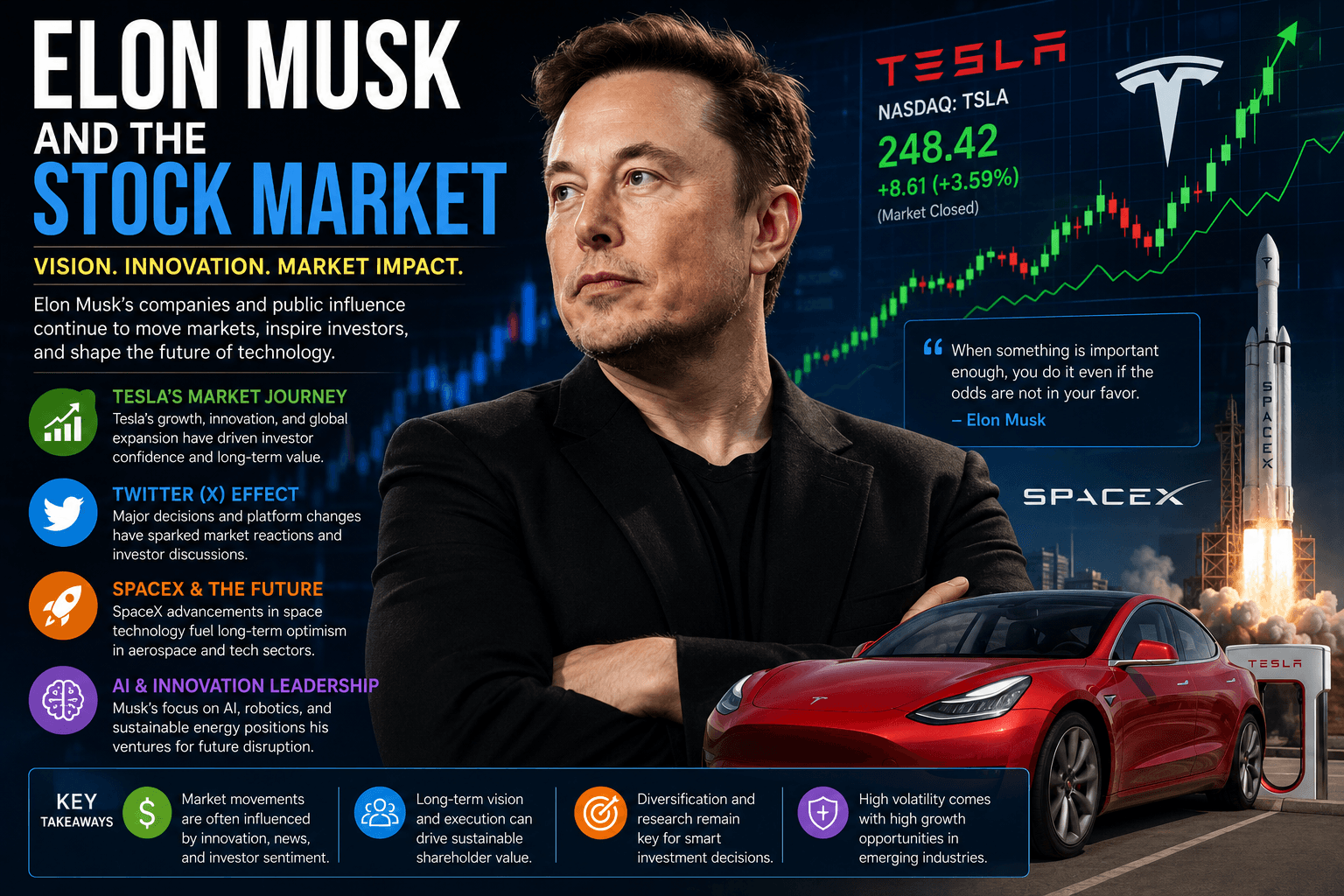
Few business leaders have influenced the global stock market as significantly as Elon Musk. As the CEO of Tesla and SpaceX and a prominent figure in artificial intelligence, social media, and emerging technologies, Musk has become one of the world's most closely watched entrepreneurs. His business decisions, public statements, product launches, and long-term vision often attract widespread attention from investors, analysts, and financial markets.
Over the past decade, Elon Musk has demonstrated how leadership, innovation, and public perception can shape investor confidence. Companies associated with him have attracted significant interest due to their ambitious goals and technological advancements. While market performance is influenced by numerous economic, financial, and industry-specific factors, Musk's public profile has often coincided with increased investor attention and market activity.
One of the most widely discussed examples is Tesla's rise from a niche electric vehicle manufacturer to one of the world's most valuable automotive companies. Investors were drawn not only to Tesla's financial performance but also to its leadership in electric vehicles, battery technology, autonomous driving research, and renewable energy solutions. Many market participants viewed Tesla as a technology company rather than a traditional automaker, contributing to strong investor enthusiasm during periods of rapid growth.
Investor confidence often depends on expectations about future growth rather than current financial results alone. Elon Musk's long-term vision has consistently emphasized innovation, sustainable transportation, artificial intelligence, robotics, and clean energy. These strategic goals have encouraged many long-term investors to focus on future opportunities instead of short-term market fluctuations.
However, companies led by high-profile executives may also experience increased market volatility. Financial markets respond to a wide range of information, including earnings reports, product announcements, regulatory developments, macroeconomic conditions, and executive communications. Because Elon Musk has a substantial public presence, investors frequently pay close attention to his interviews, presentations, and company updates when evaluating market sentiment.
Tesla's expansion into battery manufacturing, energy storage systems, charging infrastructure, and autonomous driving technologies has positioned the company as a leader in several rapidly growing industries. These developments have attracted institutional investors seeking exposure to long-term technological trends, including electrification and artificial intelligence.
Artificial intelligence has become another important area associated with Musk's business activities. Growing global investment in AI has increased investor interest in companies involved in machine learning, robotics, autonomous systems, and advanced computing. While different organizations pursue AI using various approaches, market participants generally view artificial intelligence as one of the most significant drivers of future economic growth.
Innovation often plays a central role in stock market performance. Investors frequently reward companies that successfully develop new technologies, expand into emerging markets, and maintain competitive advantages. Businesses investing heavily in research and development may attract higher valuations if investors believe those investments will generate sustainable long-term growth.
Market sentiment is another powerful factor influencing stock prices. Positive expectations about future earnings, technological breakthroughs, or industry leadership can increase demand for shares. Conversely, concerns about competition, production challenges, supply chain disruptions, changing regulations, or broader economic uncertainty may create downward pressure on stock prices. These dynamics affect many publicly traded companies, particularly those operating in rapidly evolving technology sectors.
Institutional investors, hedge funds, pension funds, and mutual funds increasingly evaluate companies using both financial metrics and long-term strategic positioning. Factors such as revenue growth, profitability, innovation capability, market share, corporate governance, and sustainability initiatives all contribute to investment decisions. Companies operating at the forefront of technological innovation often receive considerable attention from both professional and retail investors.
The rapid growth of retail investing has also changed the relationship between influential business leaders and financial markets. Millions of individual investors now access stock markets through digital investment platforms, enabling faster reactions to company announcements and broader participation in equity markets. Public interest in technology companies has increased significantly as innovation continues reshaping global industries.
Electric vehicles represent one of the fastest-growing sectors influencing investor expectations. Governments worldwide continue introducing policies supporting lower emissions, renewable energy adoption, and sustainable transportation infrastructure. These long-term trends have encouraged investors to monitor companies involved in battery technology, charging networks, autonomous driving software, and electric mobility solutions.
Beyond the automotive industry, Musk's involvement in space exploration has also attracted global attention. Although SpaceX remains privately held, its technological achievements have contributed to growing investor interest in commercial aerospace, satellite communications, reusable rockets, and space-based technologies. Success in private innovation often influences broader confidence in emerging technology sectors.
Financial analysts emphasize that investors should evaluate companies using comprehensive research rather than relying solely on headlines or public commentary. Corporate financial statements, revenue trends, profitability, competitive positioning, industry outlook, and economic conditions remain essential considerations when making investment decisions. Diversification and long-term planning continue to be fundamental principles of sound investing.
The broader technology sector continues benefiting from advances in cloud computing, artificial intelligence, robotics, semiconductor development, cybersecurity, and automation. Companies successfully integrating these technologies may improve operational efficiency while creating new products and services that drive future growth. Investors often monitor these developments closely when assessing long-term market opportunities.
Looking ahead, technological innovation is expected to remain one of the strongest drivers of global economic development. Electric transportation, renewable energy, artificial intelligence, robotics, and digital infrastructure will likely continue attracting substantial investment from governments, businesses, and institutional investors. Leaders capable of advancing innovation while delivering consistent business performance may continue influencing investor confidence across financial markets.
Elon Musk's influence on investor sentiment demonstrates how visionary leadership can shape discussions around technology, innovation, and future economic trends. While individual leaders can attract significant public attention, stock market performance ultimately reflects a combination of company fundamentals, financial results, competitive dynamics, macroeconomic conditions, and investor expectations.
For investors, understanding both the opportunities and risks associated with high-growth technology companies is essential. Conducting thorough research, maintaining diversified portfolios, and focusing on long-term objectives remain prudent approaches regardless of market conditions. As technology continues transforming industries worldwide, innovation will remain a central theme shaping investment decisions for years to come.
Conclusion
Elon Musk remains one of the most influential figures in global business and technology, with his companies often drawing significant attention from investors and financial markets. His emphasis on innovation has contributed to broader discussions about the future of transportation, artificial intelligence, renewable energy, and advanced manufacturing. Although markets can respond strongly to developments involving prominent business leaders, successful investing requires careful analysis of company performance, industry trends, and economic fundamentals. As technological innovation continues accelerating, businesses focused on long-term value creation are likely to remain important participants in the evolving global stock market.