
GSGlobal Stock Market Outlook 2026: Key Trends, Risks & What Investors Should Watch
Artificial intelligence has become one of the most influential forces shaping global financial markets. Over the past few years, AI-related companies have driven impressive gains across major stock indexes, attracting billions of dollars in investments from institutions, hedge funds, and retail investors alike. From semiconductor manufacturers and cloud computing providers to enterprise software developers, businesses connected to AI have experienced significant growth in both revenue and market value.
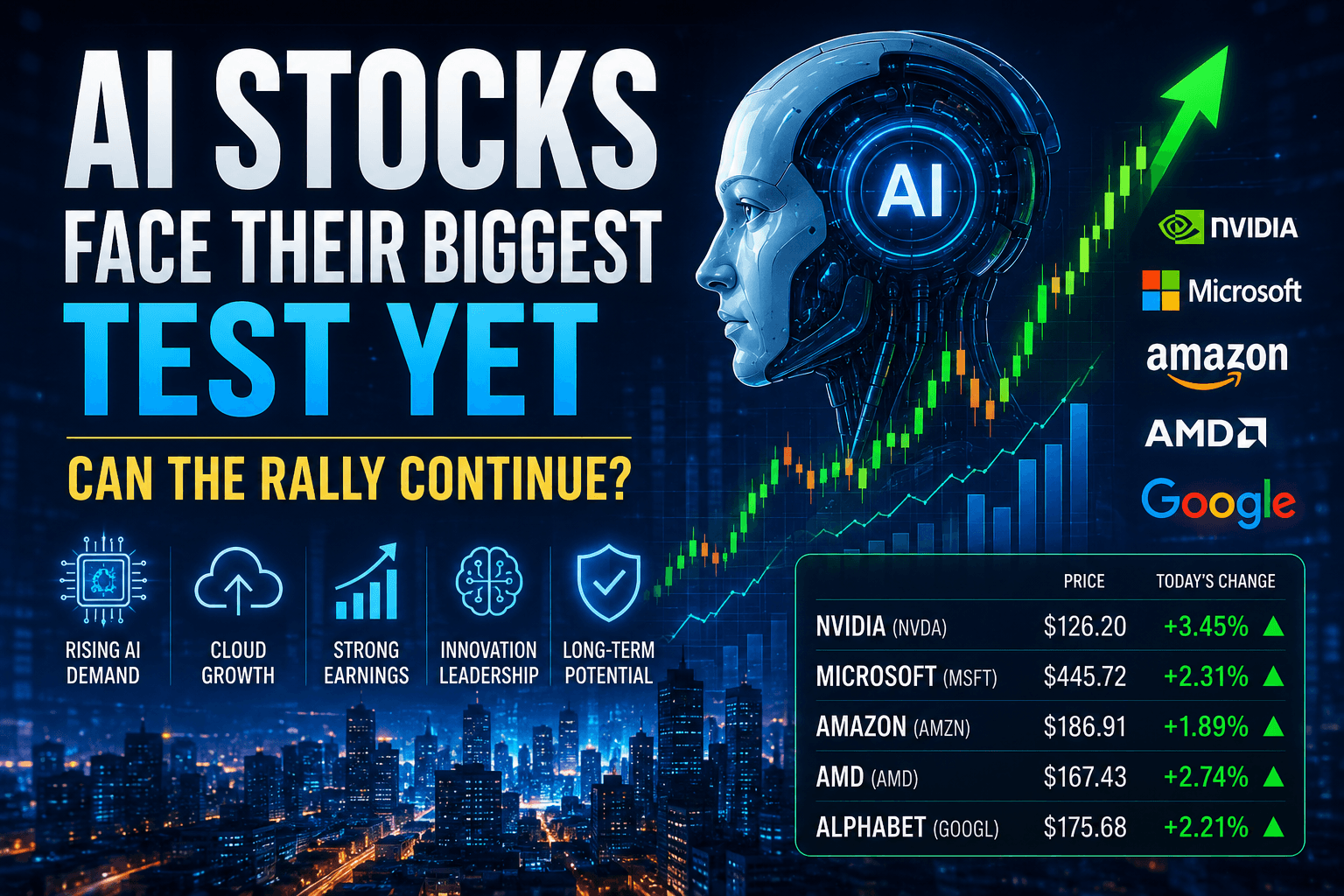
However, as valuations continue to climb, investors are asking an important question: Can the AI stock rally continue, or is the sector entering a period of greater scrutiny? The answer depends on several key factors, including corporate earnings, infrastructure investments, competitive innovation, and broader economic conditions.
AI Investment Boom Continues
Businesses across nearly every industry are increasing spending on artificial intelligence. Companies are integrating AI into customer service, cybersecurity, healthcare, finance, manufacturing, education, and logistics to improve efficiency and reduce costs.
This rapid adoption has created enormous demand for AI hardware, software, cloud infrastructure, and data centers. As organizations continue expanding AI capabilities, companies supplying these technologies are benefiting from rising revenues and long-term growth opportunities.
Semiconductor Companies Remain the Foundation
AI systems require massive computing power, making semiconductor manufacturers essential to the industry's growth.
Advanced graphics processing units (GPUs), AI accelerators, and specialized processors are powering machine learning models, autonomous systems, and generative AI platforms worldwide.
As demand for AI computing increases, chip manufacturers continue investing billions in research, manufacturing capacity, and next-generation technologies.
Cloud Computing Supports AI Expansion
Artificial intelligence relies heavily on cloud infrastructure to process, store, and analyze enormous volumes of data.
Major cloud providers continue expanding global data centers while investing heavily in AI platforms and enterprise services. These investments allow businesses to deploy AI applications without building expensive infrastructure themselves.
Cloud computing has become one of the strongest long-term growth drivers supporting AI adoption.
Strong Earnings Must Support High Valuations
One of the biggest challenges facing AI stocks is valuation.
Many AI companies trade at premium price-to-earnings ratios because investors expect rapid future growth. While optimism remains strong, companies must continue delivering impressive financial results to justify current market prices.
Quarterly earnings reports have become increasingly important, as even small disappointments can trigger significant share price declines.
Competition Is Intensifying
Artificial intelligence has become a global race involving established technology companies, startups, research organizations, and governments.
Businesses are investing heavily in new AI models, software platforms, enterprise applications, and hardware solutions. Increased competition encourages innovation but also creates pricing pressure and forces companies to continuously improve their products.
Investors are paying close attention to which companies maintain technological leadership.
Enterprise AI Adoption Is Accelerating
Businesses are moving beyond experimentation and implementing AI across daily operations.
Organizations are using AI to automate repetitive tasks, analyze customer behavior, optimize supply chains, improve cybersecurity, generate content, and assist decision-making.
Growing enterprise adoption provides recurring revenue opportunities for software developers and cloud service providers.
Infrastructure Spending Remains Strong
The AI revolution requires enormous investments in infrastructure.
Companies continue building advanced data centers, expanding cloud capacity, upgrading networking equipment, and improving energy efficiency to support increasingly powerful AI systems.
Infrastructure spending benefits multiple industries, including semiconductors, networking equipment, cooling technologies, renewable energy, and construction.
Regulation Could Shape Future Growth
Governments worldwide are developing regulations focused on AI transparency, privacy, copyright, cybersecurity, and ethical deployment.
Clear regulatory frameworks may increase public trust while reducing uncertainty for businesses. However, stricter compliance requirements could increase operating costs for AI companies.
Investors continue monitoring regulatory developments across major economies.
Economic Conditions Still Matter
Although AI remains a powerful long-term trend, broader economic conditions continue influencing technology stocks.
Interest rates, inflation, consumer spending, employment data, and global economic growth all affect investor sentiment and company valuations.
A stable economic environment generally supports continued investment in innovative technologies.
Long-Term Outlook for AI Stocks
Despite short-term volatility, artificial intelligence remains one of the fastest-growing technology sectors.
Many analysts believe AI will continue transforming industries over the next decade by increasing productivity, creating new business models, and driving digital innovation.
Companies that successfully balance innovation, profitability, and responsible AI development are likely to remain attractive to long-term investors.
Conclusion
AI stocks have delivered exceptional returns, but the next phase of growth will depend on execution rather than expectations. Investors are looking for consistent earnings, expanding enterprise adoption, continued infrastructure investment, and sustainable competitive advantages.
While short-term market fluctuations are inevitable, artificial intelligence continues to represent one of the most significant technological transformations in modern history. Investors who stay informed about industry developments, financial performance, and economic trends will be better positioned to evaluate opportunities in this rapidly evolving sector.
Frequently Asked Questions (FAQs)
1. What are AI stocks?
AI stocks are shares of companies involved in developing or using artificial intelligence technologies, including software, semiconductors, cloud computing, robotics, and automation.
2. Why have AI stocks performed so well?
Strong demand for AI solutions, enterprise adoption, cloud expansion, and investor optimism have driven significant growth.
3. Are AI stocks considered high-risk investments?
Many AI stocks have higher valuations and can be more volatile than traditional industries, making risk management important.
4. Why are semiconductor companies important for AI?
AI applications require powerful chips to process complex calculations, making semiconductor manufacturers critical to AI infrastructure.
5. How does cloud computing support artificial intelligence?
Cloud platforms provide scalable computing power, storage, and AI tools that businesses use to develop and deploy AI applications.
6. Why do investors closely watch AI earnings reports?
Strong earnings help justify high valuations, while weaker-than-expected results can lead to sharp stock price declines.
7. Which industries are adopting AI the fastest?
Healthcare, finance, manufacturing, retail, cybersecurity, education, and logistics are among the leading adopters.
8. What role do data centers play in AI?
Data centers provide the computing infrastructure needed to train, store, and operate advanced AI models.
9. Can AI improve business productivity?
Yes. AI automates repetitive tasks, analyzes large datasets, improves customer service, and supports better decision-making.
10. How do interest rates affect AI stocks?
Higher interest rates can reduce technology valuations, while lower rates often encourage investment in growth companies.
11. Why is AI infrastructure spending increasing?
Growing AI workloads require faster processors, larger data centers, advanced networking equipment, and reliable power systems.
12. What challenges could slow AI stock growth?
High valuations, increased competition, regulatory changes, economic slowdowns, and weaker earnings may affect performance.
13. Why is enterprise AI adoption important?
Enterprise customers provide recurring revenue and demonstrate that AI is delivering measurable business value.
14. How does government regulation affect AI companies?
Regulations can improve trust and safety but may also increase compliance costs and operational complexity.
15. Are AI stocks suitable for long-term investors?
Many investors consider AI a long-term growth opportunity, but diversification and careful research remain essential.
16. How does competition influence AI companies?
Competition encourages innovation but also pressures companies to improve products, reduce costs, and maintain market leadership.
17. What makes an AI company financially strong?
Consistent revenue growth, profitability, strong research capabilities, recurring customers, and efficient operations.
18. Can AI stocks remain market leaders?
They can if companies continue delivering innovation, expanding revenue, and adapting to changing market conditions.
19. What economic indicators should AI investors monitor?
Inflation, interest rates, employment data, GDP growth, consumer spending, and corporate earnings are all important indicators.
20. What is the future outlook for AI stocks?
The long-term outlook remains positive as artificial intelligence continues transforming industries, though investors should expect periodic market volatility and evaluate companies based on fundamentals rather than .