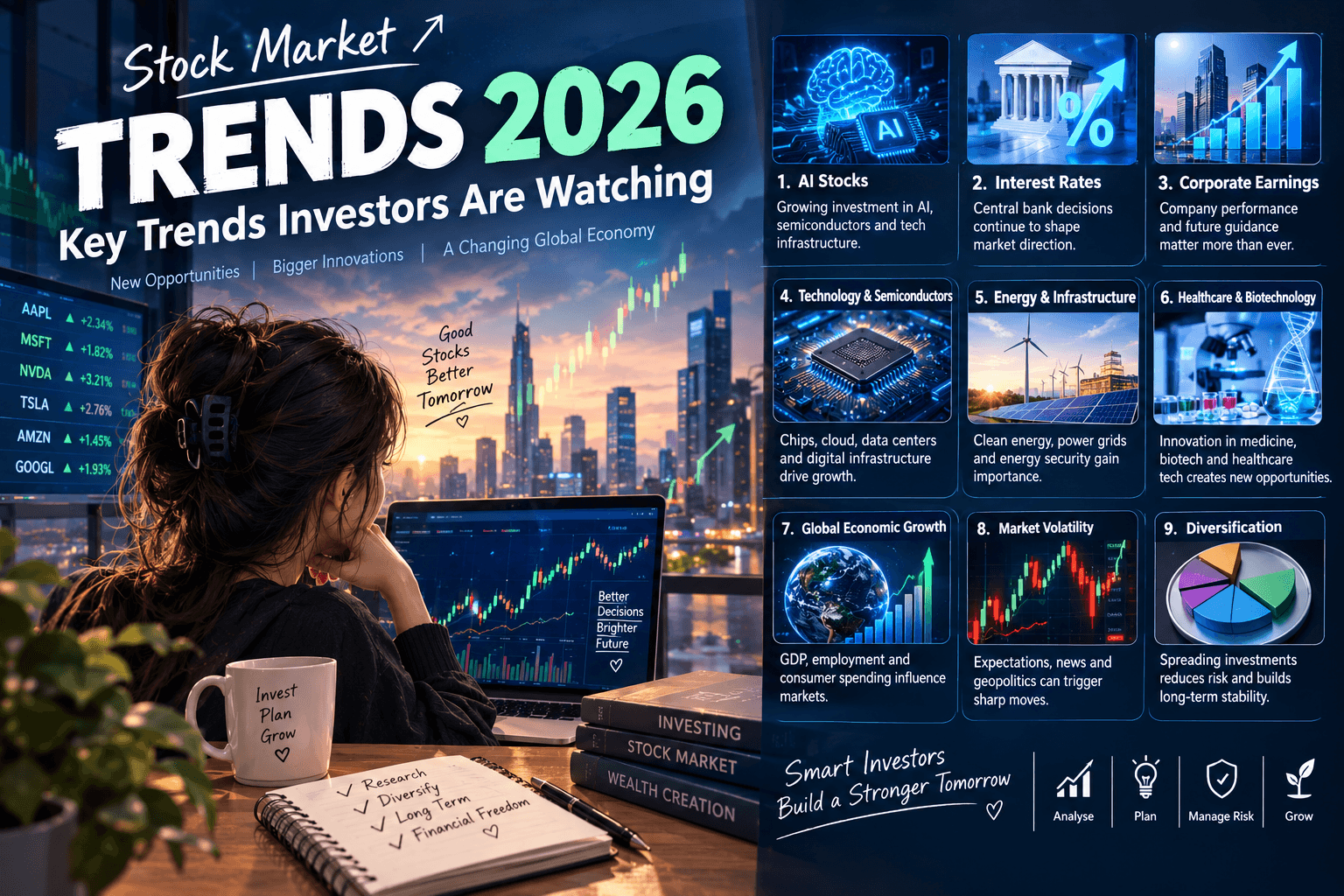
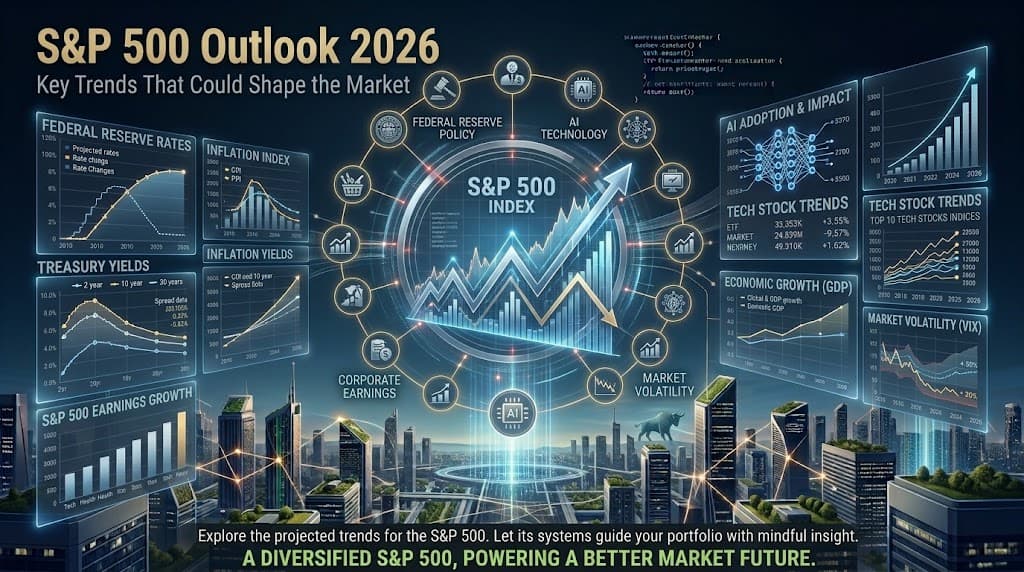
The S&P 500 remains one of the most important benchmarks for the U.S. stock market. As investors look ahead through 2026, several factors could influence the index, including interest rates, inflation, corporate earnings, artificial intelligence, economic growth, and investor sentiment.
Understanding these trends can help investors better evaluate the opportunities and risks surrounding the S&P 500.
What Is the S&P 500?
The S&P 500 is a stock-market index that tracks approximately 500 leading publicly traded companies in the United States. It covers major sectors of the economy, including technology, healthcare, financials, consumer companies, industrials, energy, and communications.
Because of its broad coverage, the S&P 500 is often used as a general indicator of the health of the U.S. stock market.
1. Federal Reserve Interest Rates
Federal Reserve policy could remain one of the biggest influences on the S&P 500 in 2026.
Interest rates affect borrowing costs, consumer spending, corporate investment, and stock valuations. Expectations for future rate changes can also cause significant movements in equities.
If monetary policy becomes more supportive, growth-oriented stocks could benefit. However, higher-for-longer rates could put pressure on valuations.
2. Inflation and the Stock Market
Inflation remains an important variable for investors.
Moderating inflation could give businesses greater control over costs and potentially allow consumers to maintain stronger purchasing power. Persistent inflation, however, could complicate monetary policy and affect corporate profit margins.
Investors will likely continue watching inflation data closely throughout 2026.
3. Corporate Earnings
Corporate earnings are another major factor shaping the S&P 500.
Strong revenue growth, improving margins, and positive earnings guidance can support stock prices. On the other hand, disappointing earnings or weaker forecasts could increase volatility.
The performance of the largest companies in the index can have an especially significant impact because the S&P 500 is weighted by market capitalization.
4. Artificial Intelligence and Technology
AI could remain one of the most important investment themes in 2026.
Companies involved in semiconductors, cloud computing, data centers, software, cybersecurity, and AI infrastructure may continue attracting investor attention.
However, investors may increasingly focus on whether massive AI investments are translating into sustainable revenue and profits.
5. S&P 500 Technology Sector
Technology companies represent a substantial portion of the S&P 500.
Large technology businesses have benefited from strong demand for cloud services, software, computing infrastructure, and AI-related products.
Their continued earnings growth could support the broader index, although high valuations may also increase sensitivity to disappointing results.
6. Market Valuations
Valuations are important when considering the S&P 500 outlook.
When stock prices rise faster than corporate earnings, valuation multiples can become elevated. Investors may then demand stronger earnings growth to justify those prices.
A market with high valuations can continue rising, but it may also become more sensitive to economic or earnings disappointments.
7. Consumer Spending
Consumer spending is a major component of the U.S. economy.
Strong employment, wage growth, and consumer confidence can support spending and benefit companies across several S&P 500 sectors.
A significant slowdown in consumer demand could have the opposite effect, particularly for consumer-focused businesses.
8. Economic Growth
The overall strength of the U.S. economy could play a major role in determining the market's direction.
Healthy economic growth can support corporate revenue and employment. A sharp slowdown, recession, or unexpected economic shock could increase pressure on stocks.
Investors should therefore watch economic indicators alongside market performance.
9. Small and Large Companies
The S&P 500 is dominated by large-cap companies, particularly some of the biggest technology and consumer businesses.
If market leadership broadens to financials, industrials, healthcare, energy, and other sectors, the index could become less dependent on a small group of companies.
Broader participation is often viewed as a sign of healthier market breadth.
10. Market Breadth
Market breadth measures how widely gains or losses are distributed across stocks.
If only a handful of large companies are driving the S&P 500 higher, investors may question how sustainable the rally is.
Increasing participation from a wider range of companies could provide stronger confirmation of an improving market environment.
11. Geopolitical Risks
Global events can create uncertainty for financial markets.
Trade disputes, conflicts, elections, changes in international policy, and disruptions to global supply chains can influence investor sentiment.
Because many S&P 500 companies operate internationally, global developments can affect both revenue and costs.
12. Energy Prices
Oil and other energy prices can influence inflation, transportation costs, consumer spending, and corporate profitability.
Energy companies within the S&P 500 can benefit from higher energy prices, while many other businesses may face increased operating costs.
This makes energy markets an important factor for investors to monitor.
13. The Role of Financial Stocks
Banks, insurers, and other financial companies are important components of the S&P 500.
Their performance can be influenced by interest rates, credit conditions, loan demand, and economic growth.
A stronger financial sector could contribute to broader market performance.
14. Healthcare Sector Outlook
Healthcare represents another major part of the index.
Pharmaceutical companies, biotechnology firms, medical-device manufacturers, and healthcare providers could be influenced by healthcare spending, innovation, regulation, and demographic trends.
The sector may also attract investors seeking defensive exposure during periods of uncertainty.
15. Investor Sentiment
Investor psychology can have a powerful short-term effect on stock prices.
Optimism can encourage buying and increase risk-taking, while fear can lead to rapid selling.
Even when economic fundamentals remain stable, changes in sentiment can produce significant market volatility.
16. Treasury Yields
Treasury yields are closely watched by stock investors.
When government bond yields rise significantly, bonds can become relatively more attractive compared with equities. Higher yields can also increase financing costs for businesses.
Falling yields, meanwhile, may support certain growth-oriented stocks.
17. Corporate Investment
Businesses may continue investing heavily in technology, automation, AI infrastructure, cybersecurity, and productivity improvements.
If these investments generate stronger long-term efficiency and profits, they could become an important driver of corporate earnings.
18. Productivity Growth
Productivity is an important long-term economic factor.
Technological innovation and AI could potentially allow businesses to produce more output with fewer resources.
If productivity growth accelerates, it could support economic expansion and corporate profitability.
19. Recession Risk
A recession remains one of the risks investors need to consider.
Economic contraction can reduce consumer demand, corporate revenues, and business investment.
However, markets often move ahead of economic data, meaning stock prices may begin recovering before the economy fully improves.
20. What Investors Should Watch in 2026
Investors following the S&P 500 should pay attention to:
Federal Reserve policy
Inflation reports
Employment data
Corporate earnings
Treasury yields
AI investment
Consumer spending
Economic growth
Market breadth
Geopolitical developments
Energy prices
Corporate guidance
Looking at several indicators together can provide a more balanced view than focusing on a single market statistic.
S&P 500 Outlook for 2026
The S&P 500's performance in 2026 could depend on the interaction between economic growth, monetary policy, corporate earnings, valuations, and investor expectations.
AI and technology could remain major themes, but market leadership could potentially broaden if other sectors begin contributing more strongly.
Investors should also remember that forecasts can change quickly as new economic and corporate information becomes available.
Final Thoughts
The S&P 500 enters 2026 with several important forces shaping its potential direction. Interest rates, inflation, earnings, AI investment, economic growth, valuations, and geopolitical risks could all influence market performance.
Rather than relying on a single prediction, investors may benefit from monitoring the broader economic and corporate picture and maintaining a long-term perspective.
This article is for informational purposes only and should not be considered personalized investment advice.
Frequently Asked Questions
1. What is the S&P 500?
The S&P 500 is a major U.S. stock-market index tracking approximately 500 large publicly traded companies.
2. Why is the S&P 500 important?
It provides a broad measure of the performance of major U.S. companies and is widely used as a benchmark for the stock market.
3. What could affect the S&P 500 in 2026?
Interest rates, inflation, earnings, economic growth, AI investment, valuations, and geopolitical events could all affect the index.
4. Can interest rates affect the S&P 500?
Yes. Changes in interest rates can influence borrowing costs, company valuations, consumer spending, and investor behavior.
5. How does inflation affect stocks?
High inflation can increase business costs and influence interest-rate policy, potentially creating pressure on stock valuations.
6. Could AI influence the S&P 500?
Yes. AI-related demand could affect technology companies, semiconductor businesses, cloud providers, and other companies throughout the index.
7. Why are corporate earnings important?
Stock prices are closely connected to expectations about future corporate profits. Strong earnings can support valuations.
8. What is market breadth?
Market breadth measures how many stocks are participating in a market move. Broader participation can indicate stronger market momentum.
9. Why do Treasury yields matter?
Treasury yields influence borrowing costs and can affect how investors compare bonds with stocks.
10. Could the S&P 500 experience volatility in 2026?
Yes. Markets can become volatile because of economic data, earnings reports, monetary policy, geopolitical events, and changes in investor sentiment.
11. What sectors are important in the S&P 500?
Major sectors include technology, healthcare, financials, consumer discretionary, communication services, industrials, energy, and others.
12. Could technology stocks continue leading the S&P 500?
Technology could remain an important source of growth, particularly if AI and cloud-computing demand remains strong.
13. What happens if corporate earnings disappoint?
Disappointing earnings can lead investors to lower their expectations, potentially putting pressure on individual stocks and the broader index.
14. How does consumer spending affect the S&P 500?
Consumer spending affects revenues for many businesses, making it an important indicator of economic and corporate health.
15. Can oil prices affect the S&P 500?
Yes. Oil prices can affect inflation, transportation expenses, consumer spending, and energy-company profits.
16. What is S&P 500 market capitalization?
Market capitalization is the total market value of a company's publicly traded shares. Larger companies have greater influence on a market-cap-weighted index.
17. Why are large technology companies important to the index?
Some of the largest companies in the S&P 500 are technology-oriented businesses, so their price movements can have a meaningful effect on the overall index.
18. Could a recession hurt the S&P 500?
A recession could reduce economic activity, corporate earnings, and investor confidence, potentially putting downward pressure on stocks.
19. What is a bull market?
A bull market generally refers to a sustained period of rising asset prices and positive investor sentiment.
20. What is a bear market?
A bear market generally refers to a substantial decline in stock prices accompanied by increased pessimism.
21. Could the Federal Reserve influence stock valuations?
Yes. Monetary policy can affect interest rates and financial conditions, which can influence equity valuations.
22. Why are valuations important?
Valuations help investors assess how much they are paying for expected corporate earnings or other financial metrics.
23. Could market leadership change in 2026?
Yes. Financials, healthcare, industrials, energy, and other sectors could gain greater market leadership depending on economic conditions.
24. What economic data should investors monitor?
Investors commonly watch inflation, employment, GDP growth, consumer spending, manufacturing activity, and interest-rate expectations.
25. Could AI spending create risks?
Yes. If businesses invest heavily in AI but expected financial returns fail to materialize, investors could reassess valuations and growth expectations.
26. Is the S&P 500 suitable for long-term investors?
The index is widely used for long-term market exposure, but suitability depends on an individual's goals, risk tolerance, time horizon, and overall financial situation.
27. Does the S&P 500 always rise over time?
No. The index can experience significant declines and periods of volatility. Historical performance does not guarantee future results.
28. Why is diversification important?
Diversification can reduce dependence on the performance of a single company, sector, or asset.
29. What could support the S&P 500 in 2026?
Potential supportive factors include strong earnings growth, stable economic expansion, moderating inflation, favorable financial conditions, and continued technology innovation.
30. What is the biggest thing to watch for the S&P 500 in 2026?
There is no single guaranteed driver. Investors may want to monitor the combination of Federal Reserve policy, earnings growth, inflation, economic activity, valuations, and market breadth.