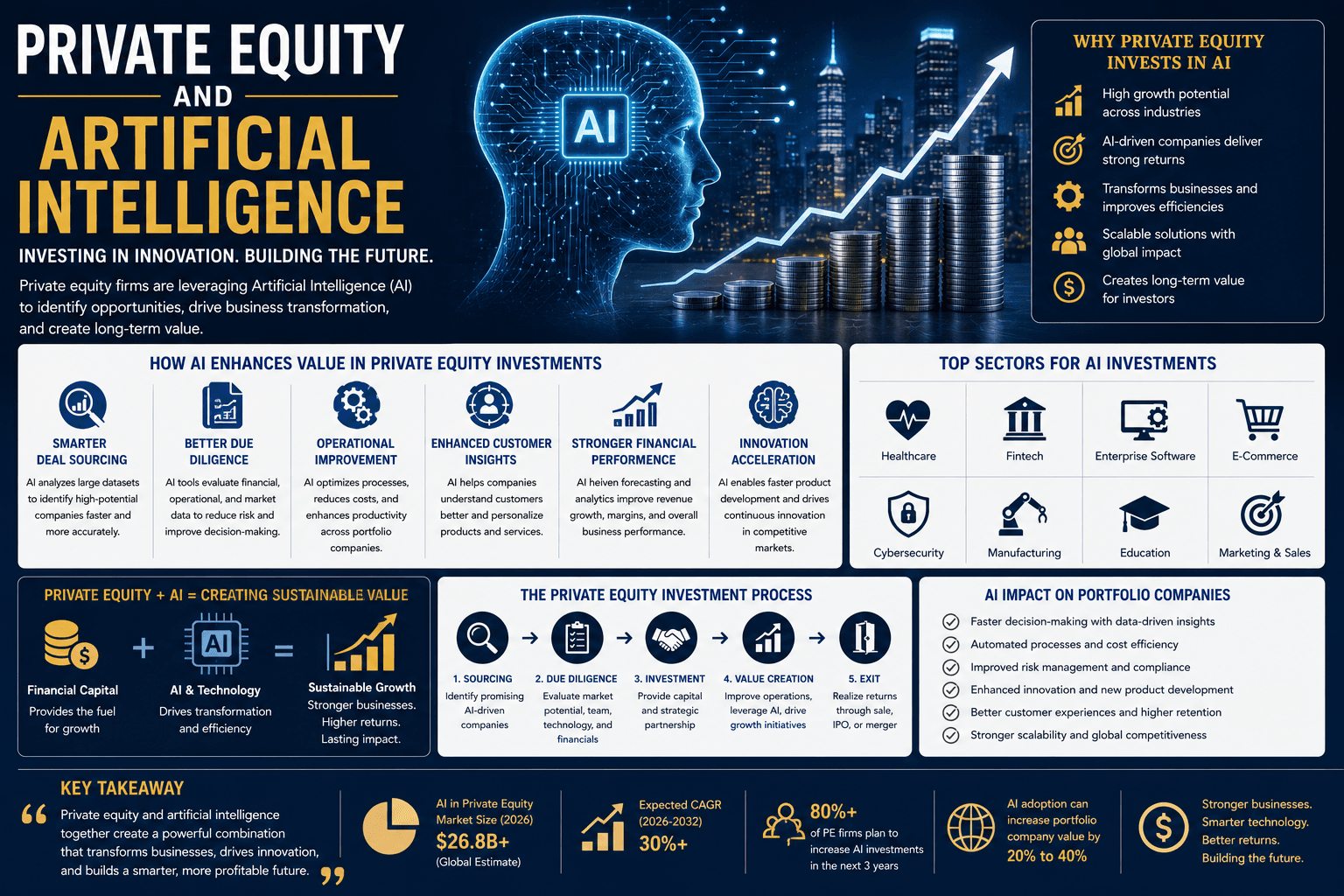


Artificial intelligence has become an important theme across the global investment landscape. In 2026, private-equity firms are examining AI not only as an investment opportunity but also as a technology that can improve how investors identify, evaluate, and manage businesses.
AI-related private-equity activity spans software, data infrastructure, cybersecurity, automation, cloud computing, semiconductors, and businesses that use AI to improve their operations.
For private-equity investors, understanding the difference between genuine AI-driven business value and hype remains an important part of evaluating opportunities.
What Is AI-Focused Private Equity?
AI-focused private equity involves investing in private companies whose products, services, or operations are significantly connected to artificial intelligence.
These businesses may develop:
AI software
Machine-learning platforms
Data infrastructure
AI cybersecurity tools
Automation systems
Enterprise AI solutions
AI-powered business services
Private-equity firms may also invest in traditional companies that can benefit substantially from adopting AI.
Why Is AI Important to Private Equity in 2026?
AI can potentially influence both investment opportunities and portfolio-company performance.
Private-equity firms may use AI to analyze large datasets, identify potential acquisition targets, evaluate market trends, and monitor portfolio companies.
At the same time, AI can help businesses automate processes, improve customer service, analyze data, and develop new products.
How Private-Equity Firms Evaluate AI Companies
AI companies require many of the same financial assessments as other businesses, but investors may also examine technology-specific factors.
Important areas can include:
Revenue growth
Customer retention
Recurring revenue
Gross margins
Technology infrastructure
Data quality
Intellectual property
AI model performance
Competitive positioning
Regulatory exposure
The quality and sustainability of the underlying business remain important.
AI Revenue vs. AI Hype
One challenge for investors is separating actual business performance from enthusiasm surrounding AI.
A company may describe itself as AI-powered without generating significant revenue from AI products.
Investors may therefore examine:
Actual AI-related revenue
Customer adoption
Product usage
Cost savings
Retention rates
Profitability
Long-term competitive advantages
This can help provide a more complete picture of an AI company's commercial potential.
AI and Due Diligence
Artificial intelligence can assist private-equity firms during due diligence.
AI tools can help process large volumes of information, identify patterns, summarize documents, and flag potentially relevant issues for further human review.
However, automated analysis does not replace professional judgment. Financial, legal, technical, and commercial due diligence still requires appropriate expertise.
AI in Portfolio Companies
Private-equity firms can encourage portfolio companies to adopt AI where it makes business sense.
Potential applications include:
Customer Service
AI-powered systems can help answer customer questions and route support requests.
Sales and Marketing
Businesses can use data analysis and automation to identify potential customers and personalize marketing.
Operations
AI can support forecasting, scheduling, inventory management, and quality control.
Finance
Automation can assist with reporting, forecasting, fraud detection, and financial analysis.
AI Infrastructure Investment
AI applications require significant computing and data infrastructure.
This has increased attention on businesses involved in:
Data centers
Cloud computing
Networking
Semiconductors
Data storage
Power infrastructure
These businesses can benefit from growing demand for computing capacity, although they also face substantial capital requirements and competitive pressures.
Cybersecurity and AI
As businesses adopt AI, cybersecurity becomes increasingly important.
Private-equity investors may examine companies providing security solutions for cloud environments, data, applications, and AI systems.
AI can also be used by both defenders and attackers, making cybersecurity an evolving area of investment and risk management.
AI and Private-Equity Valuations
Valuing AI companies can be challenging because some businesses have high growth expectations but limited operating history.
Investors may examine:
Revenue growth
Cash flow
Customer concentration
Market size
Competition
Technology differentiation
Capital requirements
Profitability prospects
High growth alone does not guarantee a successful investment.
Regulatory Considerations
AI-related businesses can face changing regulatory requirements.
Depending on the country and industry, regulations may address areas such as:
Data privacy
Consumer protection
Copyright
Algorithmic transparency
Cybersecurity
High-risk AI applications
Private-equity firms therefore need to consider regulatory exposure during investment analysis.
AI and Healthcare Private Equity
Healthcare is one area where AI may have significant applications.
Potential uses include medical imaging, administrative automation, drug discovery, clinical research, and healthcare analytics.
However, healthcare AI can involve strict regulatory requirements, data-protection obligations, and accuracy considerations.
AI and Enterprise Software
Enterprise software is another important area.
AI features are increasingly being incorporated into software used for finance, human resources, customer relationship management, cybersecurity, analytics, and business operations.
Private-equity investors may examine whether AI features create measurable value for customers rather than simply increasing product complexity.
Challenges of AI Investing
AI investment involves several risks.
These can include:
Rapid technological change
High valuations
Intense competition
Cybersecurity threats
Regulatory uncertainty
High computing costs
Dependence on specialized talent
Uncertain customer adoption
Technology can evolve quickly, meaning today's competitive advantage may not remain permanent.
The Human Role in AI Investment
AI can improve data analysis, but investment decisions still involve human judgment.
Private-equity professionals may combine technology with expertise in:
Finance
Strategy
Operations
Industry analysis
Management
Legal and regulatory matters
This combination can help investors evaluate both quantitative and qualitative factors.
What Private-Equity Investors Should Watch in 2026
Important areas include:
AI revenue growth
Enterprise AI adoption
Computing infrastructure demand
Data-center investment
Semiconductor demand
Cybersecurity
AI regulation
Operating costs
Customer retention
AI-related M&A activity
The Future of AI and Private Equity
AI is likely to remain an important part of private-market investing.
The technology can create new investment opportunities while also changing how private-equity firms conduct research, due diligence, portfolio management, and operational improvement.
However, successful AI investing requires more than identifying companies using the latest technology. Investors need to understand the underlying business model, financial performance, competitive position, technology, and risks.
Conclusion
AI and private equity are becoming increasingly connected in 2026.
Private-equity firms are evaluating AI companies across software, infrastructure, cybersecurity, healthcare, automation, and other industries. At the same time, AI tools are being used to improve investment research and portfolio-company operations.
The rapidly changing nature of AI means investors must carefully examine commercial results, technology capabilities, regulatory requirements, costs, and competitive advantages.
Understanding these factors can provide a more realistic view of the opportunities and risks surrounding AI-focused private equity.
Frequently Asked Questions
1. What is AI private equity?
AI private equity refers to private-equity investments in companies that develop, provide, or significantly use artificial intelligence technologies.
2. Why is AI important to private equity?
AI can create new investment opportunities and help private-equity firms analyze businesses and improve portfolio-company operations.
3. What types of AI companies attract private-equity interest?
AI software, data infrastructure, cybersecurity, automation, cloud computing, and enterprise AI businesses can attract investment interest.
4. How do private-equity firms evaluate AI companies?
They may examine revenue growth, customer retention, margins, technology, intellectual property, competition, regulatory exposure, and business scalability.
5. What is AI due diligence?
AI due diligence involves evaluating a company's technology, data, intellectual property, financial performance, customers, risks, and regulatory considerations.
6. Can AI replace private-equity professionals?
AI can automate and assist with many analytical tasks, but investment decisions still require human judgment and specialized expertise.
7. How can AI improve portfolio companies?
AI can support customer service, sales, marketing, forecasting, financial analysis, inventory management, and other business functions.
8. Why is AI infrastructure important?
AI systems require substantial computing, storage, networking, and data-center infrastructure.
9. What are AI infrastructure investments?
They can include businesses involved in data centers, cloud computing, semiconductors, networking, power systems, and data storage.
10. Is AI investing risky?
Yes. AI investments can face technology changes, competition, regulatory uncertainty, high costs, valuation risk, and uncertain customer adoption.
11. What is AI-related M&A?
AI-related M&A involves mergers, acquisitions, or investments involving companies developing or using artificial intelligence technologies.
12. Why is cybersecurity important for AI companies?
AI systems process valuable data and can introduce new security risks, making cybersecurity an important consideration for investors.
13. How does regulation affect AI investments?
AI regulations can influence data use, privacy, consumer protection, transparency, and high-risk applications depending on the jurisdiction.
14. Can traditional companies benefit from AI?
Yes. Companies in areas such as manufacturing, finance, healthcare, retail, and logistics can use AI to improve efficiency and decision-making.
15. What is AI revenue?
AI revenue refers to income generated directly from AI-related products or services. Investors may distinguish this from companies that simply use AI internally.
16. Why is valuation important for AI companies?
High growth expectations can affect valuations, but investors also need to consider revenue, profitability, cash flow, competition, and long-term business prospects.
17. How is AI used in private-equity research?
AI tools can help analyze documents, process datasets, identify patterns, and support research and due-diligence workflows.
18. What AI sectors are investors watching in 2026?
Enterprise AI, cybersecurity, data centers, semiconductors, cloud computing, automation, healthcare AI, and AI infrastructure are among the areas being monitored.
19. What is the biggest challenge in AI private equity?
One major challenge is evaluating whether an AI company's technology creates sustainable commercial value amid rapid technological change.
20. What should investors consider before investing in AI companies?
They should consider the business model, financial performance, technology, competition, customer demand, valuation, regulatory environment, and investment risks.