
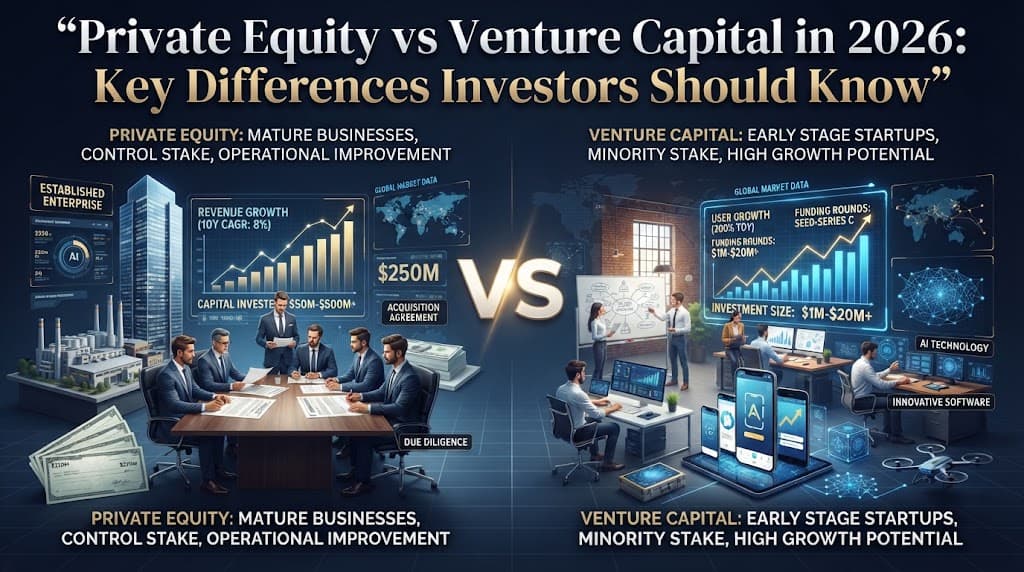

Private equity (PE) and venture capital (VC) are both important parts of the private investment market, but they operate differently. In 2026, businesses and investors continue to compare these strategies based on company stage, investment size, risk, ownership, growth expectations, and potential returns.
Understanding the differences can help entrepreneurs and investors better understand how each type of financing works.
What Is Private Equity?
Private equity involves investing capital in established private companies. PE firms may acquire a controlling interest in a company or purchase a significant stake.
Private equity firms commonly focus on:
Established businesses
Mature companies
Buyouts
Operational improvements
Mergers and acquisitions
Cost efficiency
Revenue growth
Strategic restructuring
The goal is often to improve the company's performance and eventually exit the investment through a sale, merger, recapitalization, or another transaction.
What Is Venture Capital?
Venture capital focuses primarily on young companies with significant growth potential.
VC investors commonly invest in:
Startups
Early-stage companies
Technology businesses
AI companies
Healthcare startups
Fintech companies
Software companies
Emerging technology businesses
Unlike traditional private equity, venture capital investors may take minority ownership while providing capital and strategic support.
Private Equity vs Venture Capital: The Basic Difference
The biggest difference is the type and stage of company being financed.
Feature | Private Equity | Venture Capital |
|---|---|---|
Typical company | Established business | Startup or young company |
Investment stage | Mature/growth stage | Early/growth stage |
Ownership | Often significant or controlling | Often minority |
Investment size | Often larger | Usually smaller per company |
Main objective | Improve and scale existing business | Support rapid growth |
Risk profile | Company-specific and transaction risks | Higher startup and technology risk |
Common sectors | Broad range | Technology and emerging sectors |
Exit | Sale, merger, IPO, recapitalization | Acquisition or IPO |
Company Stage Matters
One of the clearest differences between PE and VC is the stage of the company.
Private Equity
PE firms generally target companies that already have:
Established customers
Existing revenue
Operating history
Management teams
Recognizable business models
Opportunities for operational improvement
Venture Capital
VC firms generally look for businesses with:
Innovative products
Rapid growth potential
Large addressable markets
Scalable technology
Strong founding teams
A startup may not yet be profitable when it receives venture capital.
Investment Size
Private equity transactions can involve very large amounts of capital, particularly in major acquisitions.
Venture capital investments can range from relatively small seed investments to large late-stage financing rounds.
The exact investment size varies considerably depending on the company, fund strategy, financing stage, and market conditions.
Ownership Differences
Private equity firms frequently seek substantial ownership positions.
In a leveraged buyout, for example, a PE firm may acquire a controlling stake in an established business.
Venture capital investors often purchase minority stakes. Several VC firms may invest across different funding rounds as a startup grows.
Risk and Return Considerations
PE and VC have different risk characteristics.
Venture capital investments can involve substantial uncertainty because startups may have limited operating histories. Some startups may grow rapidly, while others may fail to achieve commercial success.
Private equity investments typically involve more established businesses, but they still carry risks related to debt, market conditions, competition, management, valuations, and economic cycles.
Neither strategy guarantees a particular investment outcome.
Private Equity and Venture Capital in Technology
Technology remains an important area for both PE and VC.
Venture capital often focuses on companies developing new technologies, while private equity may invest in established technology businesses that already have significant revenues.
For example:
VC: An early-stage AI software startup developing a new enterprise product.
PE: An established software company with recurring revenue and opportunities for international expansion.
AI Is Changing Both Markets
Artificial intelligence is influencing investment strategies across both private equity and venture capital.
VC investors may focus on startups developing:
AI models
AI software
Robotics
AI infrastructure
Machine learning tools
Generative AI applications
Private equity firms may look at established companies that can use AI to improve:
Customer service
Productivity
Marketing
Supply chains
Financial operations
Data analysis
This creates opportunities for both investment models, although their approaches can differ significantly.
Due Diligence Differences
Due diligence is important for both PE and VC, but the focus can vary.
PE Due Diligence
Private equity firms may examine:
Historical financial statements
Cash flow
Debt
Customers
Management
Market share
Operational efficiency
Legal risks
Potential synergies
VC Due Diligence
Venture capital firms may focus more heavily on:
Founding team
Product
Technology
Market size
User growth
Competitive advantages
Intellectual property
Business model
Scalability
The Role of Management
Management is important in both strategies.
PE firms may work closely with existing executives or bring in new leadership to improve company performance.
VC investors often work with founders by providing strategic guidance, industry connections, recruiting assistance, and access to future financing opportunities.
Exit Strategies
Both PE and VC investors eventually need an exit strategy.
Private equity exits may include:
Selling the company to another business
Selling to another investment firm
Initial public offering
Recapitalization
Strategic acquisition
Venture capital exits commonly occur through:
Acquisition
IPO
Secondary share sales
Later-stage transactions
The timing of exits can vary significantly.
Private Equity vs Venture Capital Fundraising
Both PE and VC firms raise money from investors, but their fundraising strategies can differ.
PE funds may target institutional investors such as:
Pension funds
Insurance companies
Sovereign wealth funds
Family offices
Endowments
VC funds can also attract institutional investors and family offices, along with investors interested specifically in technology and startup growth.
Why Investors Compare PE and VC
Investors may compare the two strategies because they can provide exposure to different parts of the private market.
Private equity can provide exposure to established companies and operational improvement strategies.
Venture capital provides exposure to younger companies with potentially significant growth opportunities but also considerable uncertainty.
Private Equity vs Venture Capital in 2026
In 2026, several trends are influencing both investment models.
Artificial Intelligence
AI continues to influence startup creation, corporate strategy, and investment analysis.
Higher Focus on Profitability
Investors may place greater emphasis on sustainable revenue, cash flow, and business fundamentals.
Technology Infrastructure
Data centers, cybersecurity, cloud computing, and AI infrastructure are attracting attention across private markets.
Healthcare Innovation
Healthcare technology and services remain areas of interest for both VC and PE investors.
Operational Value Creation
PE firms continue to emphasize operational improvements rather than relying only on changes in market valuations.
Which Companies Typically Seek VC?
Venture capital may be suitable for companies that are:
Early-stage
Rapidly growing
Technology-driven
Developing innovative products
Targeting large markets
Seeking capital for expansion
Which Companies Typically Seek PE Investment?
Private equity may be relevant to companies that are:
Established
Generating meaningful revenue
Looking to expand
Seeking an acquisition partner
Undergoing ownership transitions
Looking for operational improvements
The Importance of Investment Strategy
There is no single approach that fits every company or investor.
The appropriate financing structure depends on factors such as:
Company stage
Capital requirements
Growth strategy
Ownership preferences
Financial performance
Risk tolerance
Market conditions
Long-term objectives
Understanding these differences is important before evaluating either PE or VC.
Future Outlook
Private equity and venture capital are likely to remain important sources of private-market financing.
The two strategies may increasingly overlap in areas such as AI, healthcare technology, cybersecurity, fintech, and digital infrastructure. However, their fundamental differences—particularly company stage, ownership structure, investment approach, and risk profile—will remain important.
For entrepreneurs, understanding these differences can help when considering potential sources of capital. For investors, comparing fund strategies, portfolio construction, fees, risks, and historical performance can provide a more complete picture of an investment opportunity.
FAQs
1. What is the main difference between PE and VC?
Private equity generally invests in established businesses, while venture capital primarily invests in startups and younger high-growth companies.
2. Is private equity riskier than venture capital?
Risk depends on the specific investment. VC generally involves substantial startup and technology risk, while PE investments can involve financing, operational, market, and valuation risks.
3. Do PE firms buy companies?
Yes. PE firms frequently acquire significant or controlling interests in established companies.
4. Does venture capital invest in startups?
Yes. Supporting startups and early-stage companies is a central part of venture capital.
5. Can PE invest in technology companies?
Yes. PE firms can invest in established software, technology, cybersecurity, infrastructure, and other technology businesses.
6. Can VC invest in AI companies?
Yes. AI startups are a major area of interest for many venture capital investors.
7. Which type of investor usually takes controlling ownership?
Private equity firms frequently seek significant or controlling ownership, although structures vary.
8. Do VC investors always take minority stakes?
No. VC investments are often minority investments, but ownership structures can vary by financing round and company.
9. What is a leveraged buyout?
A leveraged buyout is an acquisition in which debt is used alongside investor capital to finance the purchase of a company.
10. What is a startup funding round?
A funding round is a financing event in which a company raises capital from investors.
11. What sectors attract venture capital?
Technology, AI, healthcare, fintech, cybersecurity, software, and other high-growth industries can attract VC investment.
12. What sectors attract private equity?
PE can invest across many industries, including healthcare, technology, manufacturing, consumer products, business services, and infrastructure.
13. How does AI affect PE and VC?
AI can create new investment opportunities while also helping investors with research, due diligence, analytics, and portfolio management.
14. What is a PE exit?
A PE exit occurs when a private equity investor sells or otherwise realizes its investment.
15. What is a VC exit?
A VC exit typically occurs when a startup is acquired, goes public, or shares are sold through another transaction.
16. Do PE and VC funds have the same investment horizon?
Not necessarily. Investment periods vary by fund strategy, company, market conditions, and exit opportunities.
17. What do VC investors look for?
They may evaluate the founding team, product, market opportunity, growth potential, technology, competition, and business model.
18. What do PE investors look for?
They may examine financial performance, cash flow, management, market position, operational improvements, valuation, and potential exit opportunities.
19. Can a company receive both VC and PE investment?
Yes. A company may receive venture capital during earlier growth stages and later attract private equity investment as it becomes more established.
20. Why is understanding PE vs VC important?
It helps entrepreneurs and investors understand different sources of private capital, investment structures, ownership models, risks, and potential growth strategies.