
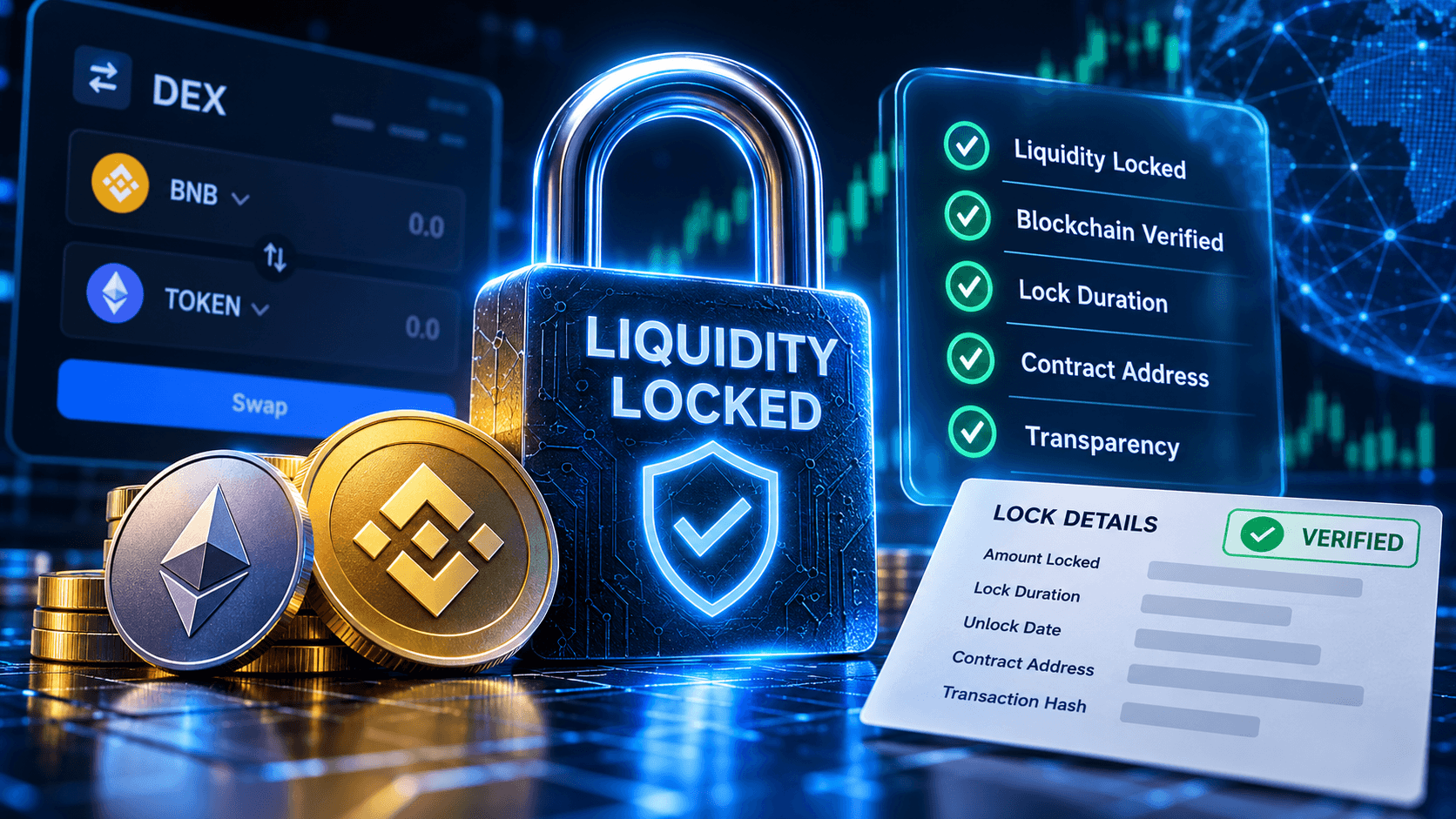

Crypto liquidity locks have become an important topic in decentralized finance (DeFi), particularly for investors evaluating new cryptocurrency tokens. As token launches continue across blockchain networks, understanding how liquidity is managed can help investors identify potential risks and make more informed decisions.
A liquidity lock is commonly used by cryptocurrency projects to restrict access to designated liquidity provider tokens or liquidity positions for a specific period. Although this mechanism can reduce certain risks associated with sudden liquidity withdrawals, it does not guarantee that a token is safe or that investors will make a profit.
Understanding how crypto liquidity locking works, what it protects against, and how to verify it on the blockchain is essential for anyone researching decentralized cryptocurrency projects.
What Is a Crypto Liquidity Lock?
A crypto liquidity lock is a mechanism that restricts access to specific liquidity-related assets for a predetermined period. It is often used by decentralized cryptocurrency projects to demonstrate that a portion of their trading liquidity cannot be withdrawn immediately.
On decentralized exchanges, liquidity pools allow users to trade cryptocurrency without relying on a traditional order book. Liquidity providers deposit token pairs into these pools to facilitate transactions. In many automated market maker systems, providers receive liquidity provider (LP) tokens representing their share of the pool.
These LP tokens may allow their holders to withdraw the underlying assets, subject to the protocol's rules. When LP tokens are deposited into a suitable locking contract, access to the associated liquidity is restricted according to the contract's conditions.
For example, a project might lock its LP tokens for six months. During that period, the tokens generally cannot be withdrawn through the normal process if the locking contract operates as intended.
However, the exact protection depends on the blockchain, liquidity mechanism, and contract design. Investors should verify the specific arrangement rather than relying solely on a project's statement that its liquidity is locked.
How Does Crypto Liquidity Locking Work?
Liquidity locking typically involves several steps, although the process differs across blockchain networks and decentralized exchanges.
1. Creating a Liquidity Pool
A token project or liquidity provider deposits a pair of assets into a decentralized exchange. These assets may include a newly launched token and an established cryptocurrency or blockchain-native asset.
The pool allows users to trade between the assets according to the exchange's pricing and liquidity mechanism.
2. Receiving Liquidity Provider Tokens
Depending on the protocol, the liquidity provider receives LP tokens or another representation of the liquidity position. These assets may provide the ability to withdraw the underlying liquidity.
Not every decentralized exchange uses traditional LP tokens. Some protocols represent liquidity positions differently, so investors must understand the specific system being used.
3. Locking the Liquidity Position
The project or liquidity provider transfers the relevant LP tokens or eligible liquidity position into a locking contract or another supported locking mechanism.
The contract specifies the applicable restrictions, such as the lock duration and conditions for accessing the assets.
4. Verifying the Lock
Investors can examine the relevant blockchain transaction, contract address, locked amount, and expiration date using an appropriate blockchain explorer.
Verification is important because promotional claims alone do not prove that the liquidity has been locked successfully.
5. Reaching the Unlock Date
When the lock period expires, the assets may become accessible according to the contract's rules. The liquidity provider may then be able to withdraw the underlying assets.
An approaching unlock date can therefore be an important consideration when assessing a token's liquidity arrangements.
Why Is Locked Liquidity Important in Crypto?
Liquidity is essential to the operation of decentralized cryptocurrency markets. When a trading pool has limited liquidity, even relatively small transactions can cause substantial price movements.
Locked liquidity can provide additional information about how a project manages its trading pool and whether designated liquidity assets are subject to withdrawal restrictions.
Reducing certain withdrawal risks: A properly implemented lock can prevent the holder from withdrawing the locked position before the specified conditions permit access.
Improving transparency: Publicly verifiable lock transactions allow investors to examine details rather than relying exclusively on project announcements.
Supporting investor due diligence: Lock duration, locked amounts, and contract permissions can help investors compare projects and understand their liquidity arrangements.
Demonstrating a defined commitment: A project that voluntarily locks a portion of its liquidity provides evidence that those specific assets are restricted for a stated period.
Nevertheless, locked liquidity does not eliminate price volatility, guarantee sufficient trading volume, or establish that a project is trustworthy.
How to Check Whether Crypto Liquidity Is Locked
Investors should independently verify liquidity-lock claims before making decisions about a cryptocurrency.
Check the Blockchain Explorer
Identify the blockchain network on which the token operates. Search for the token contract address, relevant liquidity pool, and locking transaction using the network's official or recognized blockchain explorer.
For example, Ethereum transactions can be investigated through Etherscan, while Solana transactions and token activity can be examined using Solscan.
Examine the Locking Contract
Confirm that the liquidity-related assets are held by the stated locking contract or otherwise restricted through the claimed mechanism. Review the contract information and available transaction records.
A screenshot or badge on a project website is not sufficient evidence by itself.
Confirm the Locked Amount
Determine how much liquidity is covered by the lock and compare it with the relevant liquidity position. A project may lock only a portion of its liquidity, so the distinction between partially and fully locked liquidity matters.
Review the Unlock Date
Check the precise expiration date and any conditions that apply to withdrawal. A short lock period may provide less long-term restriction than a longer one, although the appropriate duration depends on the project and its circumstances.
Investigate Other Contract Permissions
Examine whether the token contract includes administrative capabilities, such as minting additional tokens, pausing transfers, changing certain parameters, or imposing transfer restrictions.
The availability and significance of these permissions depend on the blockchain and token design. A liquidity lock does not automatically remove them.
Does Locked Liquidity Prevent Crypto Scams?
Liquidity locking can reduce some risks, but it cannot prevent every type of cryptocurrency scam.
One commonly discussed risk is a rug pull, in which project insiders withdraw accessible liquidity or otherwise exploit their control of a token ecosystem, potentially leaving holders with assets that are difficult to sell or have sharply reduced value.
A genuine liquidity lock may make one particular form of liquidity withdrawal more difficult during the lock period. However, malicious actors may still exploit other vulnerabilities.
For example, a token might have locked liquidity while its creators retain the ability to mint additional tokens, or while ownership remains heavily concentrated among a small number of wallets. A vulnerable smart contract or restrictive trading mechanism can also create risks that a liquidity lock does not address.
Investors should therefore investigate token distribution, contract permissions, ownership concentration, trading activity, and independent security reviews.
The key distinction is that locked liquidity is one risk-management indicator, not proof that a cryptocurrency project is legitimate.
Locked Liquidity vs. Unlocked Liquidity
Feature | Locked liquidity | Unlocked liquidity |
|---|---|---|
Withdrawal access | Restricted under the applicable lock conditions | May be withdrawn according to the protocol's rules |
Time limitations | Usually has a defined lock period | May have no separate lock period |
Verification | Can often be checked through blockchain records | Can often be assessed through pool and transaction data |
Risk implications | Reduces certain immediate withdrawal risks | May expose the pool to withdrawals by authorized holders |
Security guarantee | Does not guarantee project safety | Does not automatically mean the project is fraudulent |
The distinction is useful, but the actual level of risk depends on the liquidity mechanism, contract permissions, ownership structure, and broader project design.
Common Mistakes Investors Should Avoid
Investors researching crypto liquidity locks should avoid several common assumptions.
Assuming a lock guarantees profits: Cryptocurrency prices can fall even when liquidity remains locked.
Trusting every lock badge: Verify the underlying contract and transaction independently.
Ignoring partial locks: Determine what proportion of the relevant liquidity position is restricted.
Overlooking expiration dates: Understand when the restriction ends and what happens afterward.
Ignoring token permissions: Administrative control can introduce risks beyond liquidity withdrawal.
Confusing an audit with a lock: A liquidity lock and a smart contract audit serve different purposes and provide different information.
Careful verification can help investors distinguish between documented restrictions and unsupported marketing claims.
The Future of Liquidity Transparency in DeFi
As decentralized finance develops, verifiable liquidity information remains an important part of cryptocurrency research. Investors increasingly need accessible information about liquidity positions, locking contracts, token permissions, and unlock schedules.
Projects can improve transparency by publishing their liquidity pool addresses, locking contract addresses, transaction hashes, lock durations, and relevant contract documentation. Clear disclosures allow community members to investigate claims independently.
At the same time, better verification tools cannot eliminate the technical, financial, and market risks associated with decentralized assets. Investors must evaluate the broader project rather than depending on a single security indicator.
Conclusion
A crypto liquidity lock is a mechanism designed to restrict access to designated liquidity-related assets for a specific period. When implemented correctly and independently verified, it can help reduce certain risks associated with immediate liquidity withdrawal and provide useful information about a project's liquidity management.
However, a lock does not guarantee that a token is legitimate, protect investors from every scam, or ensure that an asset will retain its value. The most reliable assessment combines liquidity verification with research into smart contracts, token ownership, administrative permissions, and project transparency.
For anyone researching decentralized cryptocurrency projects, understanding liquidity locking is a valuable starting point for making more informed decisions.