
TCThe Cost of Cross-Border Trade: Navigating Supply Chain Disruptions in Regional Tech Sectors
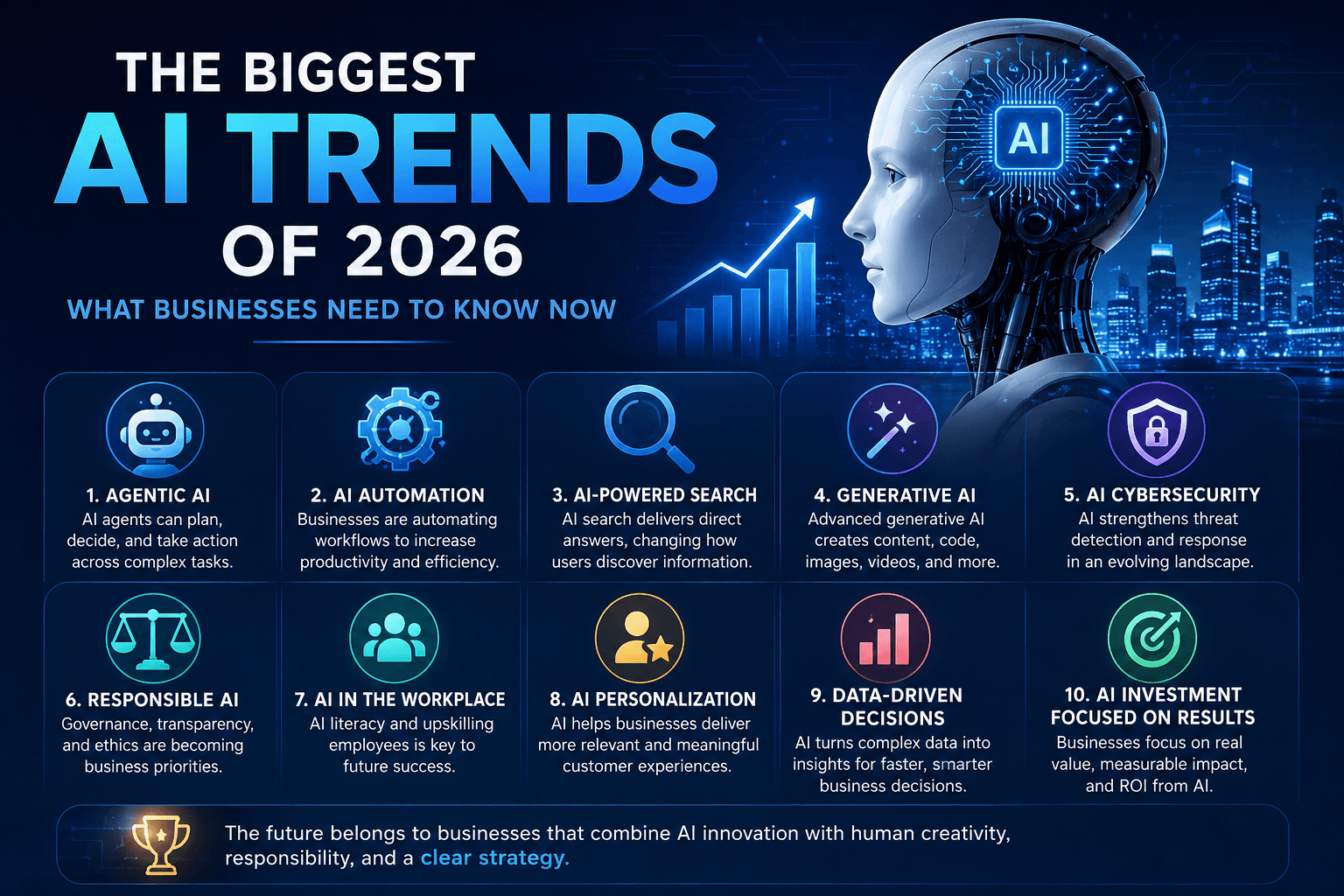
Artificial intelligence is no longer just a technology trend—it has become a major business driver in 2026. Companies of all sizes are using AI to automate tasks, improve customer experiences, analyze data, strengthen cybersecurity, and make faster decisions.
As AI continues to evolve, businesses that understand the latest trends can gain a significant competitive advantage. Here are the biggest AI trends businesses need to know in 2026.
1. Agentic AI Is Changing Business Operations
One of the biggest developments in 2026 is the rise of agentic AI. Unlike traditional AI tools that respond to individual prompts, AI agents can plan tasks, make decisions, use different software tools, and complete multi-step workflows with limited human intervention.
Businesses are using AI agents for customer support, sales research, marketing, scheduling, data analysis, and internal operations.
This shift is moving AI from being a simple assistant to becoming an active digital worker.
2. AI Automation Is Becoming Essential
Businesses are increasingly automating repetitive tasks with AI. From generating reports and processing documents to responding to customer inquiries and managing workflows, automation can reduce manual work and improve productivity.
Small businesses are particularly interested in AI automation because it allows smaller teams to handle workloads that previously required more employees.
The goal is not simply to replace human work but to allow employees to spend more time on creative, strategic, and customer-focused activities.
3. AI-Powered Search Is Transforming Online Visibility
Search is changing rapidly as users increasingly receive direct answers from AI-powered search systems instead of traditional lists of web links.
This creates a new challenge for businesses: they need to optimize their content not only for traditional search engines but also for AI-generated answers.
High-quality, authoritative, well-structured content is becoming increasingly important. Businesses that adapt their digital strategies to AI search can improve their chances of being discovered by potential customers.
4. Generative AI Is Becoming More Advanced
Generative AI continues to expand beyond basic text generation. Businesses are using AI to create marketing materials, images, presentations, videos, product descriptions, software code, and other digital assets.
The major change in 2026 is that organizations are becoming more focused on using generative AI strategically rather than simply experimenting with it.
Companies are developing internal AI workflows and guidelines to ensure that AI-generated content remains accurate, useful, consistent, and aligned with their brand.
5. AI Cybersecurity Is Growing in Importance
As businesses adopt more AI systems, cybersecurity is becoming an even bigger priority.
AI can help security teams identify unusual behavior, detect threats, analyze large amounts of security data, and respond to potential attacks faster. At the same time, criminals can also use AI to create more convincing phishing campaigns, automate attacks, and discover vulnerabilities.
Businesses therefore need security strategies that account for both the opportunities and risks created by AI.
6. Responsible AI and Governance Are Becoming Business Priorities
Companies are paying greater attention to how AI systems are developed and used.
AI governance includes areas such as data privacy, security, transparency, human oversight, compliance, and responsible use.
Businesses that establish clear AI policies can reduce risks while creating greater confidence among employees, customers, and business partners.
Responsible AI is increasingly becoming part of good corporate governance rather than simply an optional technology initiative.
7. AI Is Reshaping the Workplace
AI is changing the skills businesses need. Employees are increasingly expected to know how to work effectively with AI tools, evaluate AI-generated information, and integrate AI into everyday workflows.
This means AI literacy is becoming valuable across many departments—not only in technical teams.
Companies are investing in employee training so workers can use AI productively while understanding its limitations.
8. AI-Powered Personalization Is Improving Customer Experiences
Customers increasingly expect personalized digital experiences. AI enables businesses to analyze customer behavior and provide more relevant recommendations, messages, offers, and support.
E-commerce companies, financial services, travel businesses, and marketing teams are among those using AI-powered personalization to better understand customer needs.
When implemented responsibly, personalization can improve engagement and customer satisfaction.
9. AI Decision-Making Is Becoming More Data-Driven
Businesses generate enormous amounts of data, but collecting information is only useful when companies can turn it into actionable insights.
AI-powered analytics can identify patterns, forecast trends, detect potential problems, and support business decisions.
Executives can use AI to analyze market conditions, customer behavior, operational performance, and financial information more quickly than traditional analysis alone.
10. AI Investment Is Moving Toward Real Business Results
After years of AI experimentation, businesses in 2026 are increasingly asking an important question: What measurable value is AI creating?
Companies are looking beyond impressive demonstrations and focusing on productivity, revenue, customer satisfaction, cost reduction, and operational efficiency.
This means successful AI adoption will depend not only on having advanced technology but also on choosing the right use cases and measuring their results.
The Future of AI in Business
The AI landscape will continue to evolve throughout 2026 and beyond. Agentic AI, automation, generative AI, AI search, cybersecurity, and responsible AI are likely to remain important areas of business investment.
However, technology alone will not guarantee success. Businesses need clear strategies, skilled employees, reliable data, strong security, and responsible governance.
Companies that combine AI capabilities with human creativity and strategic thinking will be better positioned to compete in an increasingly AI-driven economy.
Conclusion
The biggest AI trends of 2026 demonstrate that artificial intelligence is becoming deeply integrated into modern business. From autonomous AI agents and automation to AI-powered search and cybersecurity, companies are finding new ways to use intelligent technologies.
For businesses, the key is to move beyond simply following the AI hype. The winners will be those that identify practical opportunities, manage risks carefully, train their teams, and use AI to create measurable value.
AI is no longer a technology businesses can simply watch from the sidelines. It is becoming an important part of how modern businesses operate, compete, and grow.
FAQs
1. What is the biggest AI trend in 2026?
Agentic AI is one of the most significant trends because AI agents can perform multi-step tasks and support business workflows with greater autonomy.
2. How is AI helping small businesses?
AI can automate repetitive work, assist with marketing, improve customer service, analyze data, and help small teams operate more efficiently.
3. Is AI replacing human employees?
AI is changing many jobs and automating certain tasks, but it is also creating demand for new skills. Human judgment, creativity, communication, and strategic thinking remain important.
4. Why is AI governance important?
AI governance helps businesses manage risks involving privacy, security, accuracy, transparency, and responsible AI use.
5. How can businesses prepare for the future of AI?
Businesses should identify useful AI applications, train employees, protect data, establish responsible-use policies, and continuously measure AI performance.
6. Will AI search affect businesses?
Yes. As AI-powered search becomes more common, businesses may need to create authoritative, useful, and well-structured content that can be understood by both traditional search engines and AI systems.