
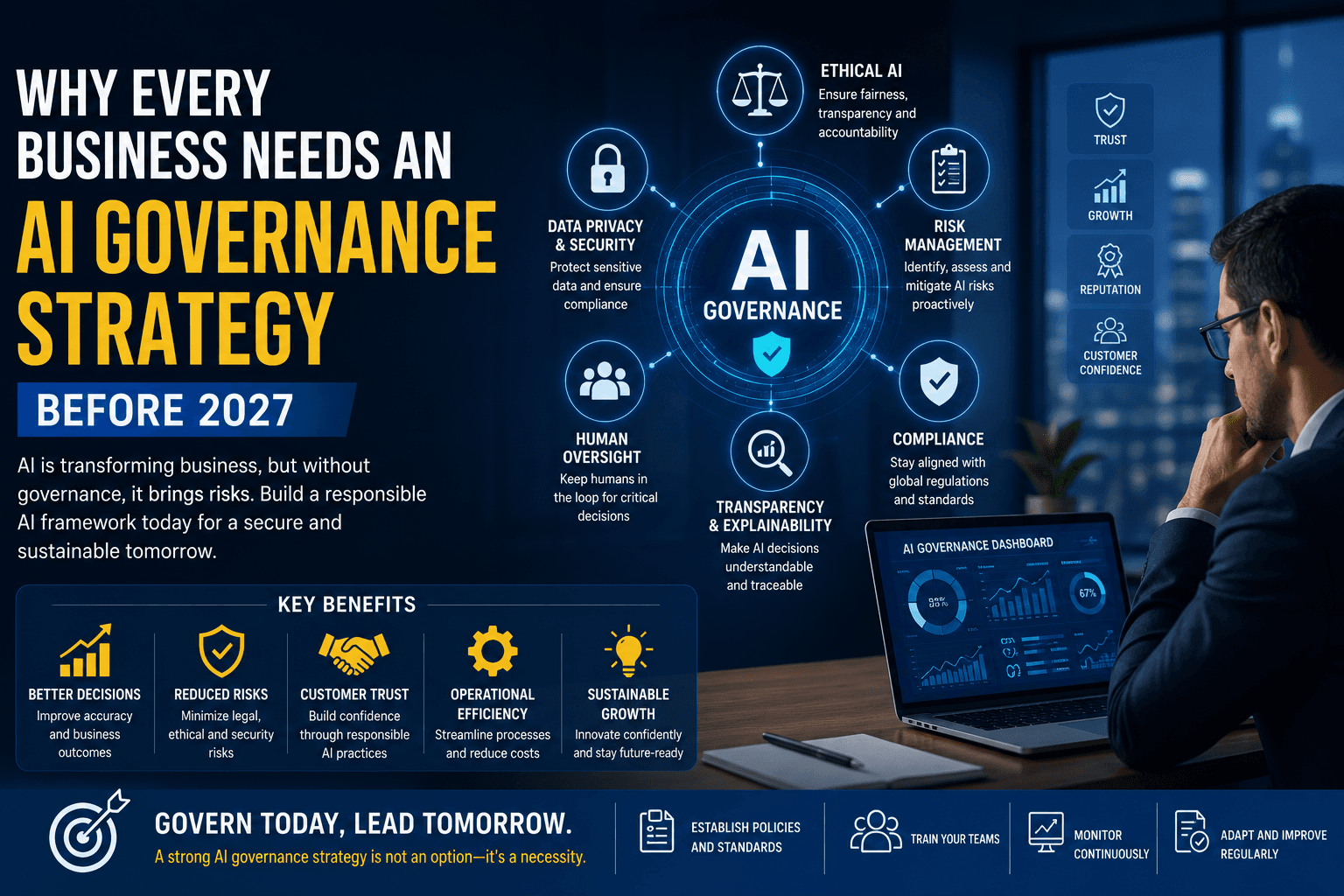

Artificial intelligence is moving from experimentation into the core of business operations. Companies are using AI for customer service, marketing, recruitment, analytics, software development, cybersecurity, financial decisions, and automation.
As adoption accelerates, businesses face an important question: How can AI be used responsibly, securely, and effectively at scale?
The answer increasingly involves AI governance.
An AI governance strategy provides the policies, processes, responsibilities, and controls a company needs to manage AI throughout its lifecycle. Before 2027, businesses that have not established a clear governance framework may face greater operational, legal, security, and reputational risks.
AI Adoption Is Expanding Rapidly
AI is no longer confined to specialized technology teams. Employees across departments can access powerful AI tools with little technical knowledge.
This creates opportunities for productivity and innovation, but it also creates a governance challenge.
An employee might use an AI tool to summarize confidential documents, generate customer communications, analyze sensitive information, or make recommendations without understanding the potential risks.
Without clear policies, organizations may not even know where AI is being used.
What Is AI Governance?
AI governance is the framework an organization uses to oversee its artificial intelligence systems and applications.
It can include:
AI policies
Risk assessments
Data protection controls
Security requirements
Human oversight
Vendor management
Model monitoring
Documentation
Employee training
Compliance procedures
Incident-response processes
The goal is not to prevent employees from using AI. Instead, governance creates a structure that allows organizations to use AI while managing its risks.
Why Businesses Need Governance Before 2027
The AI landscape is changing quickly.
New AI capabilities are emerging while governments and regulators continue developing rules and standards for artificial intelligence. Businesses therefore need governance systems that can adapt to changing requirements.
Waiting until a major compliance issue, security incident, or customer complaint occurs can be significantly more expensive than establishing responsible processes in advance.
A governance strategy gives organizations a foundation for scaling AI safely.
AI Governance Can Reduce Compliance Risks
Different AI applications can create different regulatory and legal considerations.
For example, an AI system used to generate marketing content may have very different risks from an AI system used to evaluate job candidates or support financial decisions.
A governance framework can classify AI systems according to their potential risk and establish appropriate controls.
This allows companies to apply stronger oversight where it is most necessary.
Data Privacy Makes Governance Essential
AI systems often depend on data.
Businesses may use customer information, employee information, transaction records, internal documents, or proprietary data with AI tools.
Poor data practices can create serious privacy and security concerns.
An AI governance strategy should establish rules for:
What data AI systems can access
How information can be processed
Who can access AI systems
How long data is retained
Which third-party AI tools are approved
How sensitive information is protected
These controls can help reduce unnecessary exposure.
Shadow AI Is a Growing Business Risk
One of the biggest challenges organizations face is shadow AI—the use of AI tools by employees without formal organizational approval.
Employees may adopt public AI applications because they are convenient and productive.
The problem is that companies may have limited visibility into what information is being entered into those systems or how the information is handled.
Instead of simply banning AI, organizations should provide approved tools and clear usage policies.
Employees need to understand both what they can do with AI and what they should avoid.
Human Oversight Remains Important
AI systems can produce incorrect or misleading outputs.
Even advanced models can misunderstand context, generate inaccurate information, or make recommendations based on incomplete data.
Human oversight is therefore especially important when AI affects high-impact business decisions.
Companies should establish clear rules for when employees must review AI outputs before they are used.
This is particularly important in areas such as hiring, finance, healthcare, legal services, and customer decisions.
AI Governance Can Improve Trust
Customers increasingly want to know how companies use their data and technology.
A business that can clearly explain its AI practices may be better positioned to build trust.
Transparency can include communicating when customers are interacting with AI, explaining how AI-supported decisions are made where appropriate, and providing mechanisms for human assistance.
Trust can become an important competitive advantage as AI becomes more common.
Governance Should Include AI Vendors
Businesses frequently rely on third-party AI providers rather than building every system internally.
This creates additional risks.
Organizations should evaluate vendors based on factors such as:
Data handling
Security practices
Privacy protections
Model reliability
Contractual terms
Compliance responsibilities
Data retention
Incident response
Service availability
A company should understand what happens to its information once it enters a third-party AI system.
AI Governance Supports Responsible Innovation
Some businesses worry that governance will slow down AI adoption.
Poorly designed governance can create unnecessary bureaucracy, but effective governance can actually accelerate responsible innovation.
When employees know which tools are approved and which uses are acceptable, they can experiment with greater confidence.
A clear framework can establish fast-track approval for low-risk AI applications while requiring deeper review for higher-risk systems.
AI Governance Needs Executive Support
AI governance should not exist only as an IT policy.
Senior leadership should understand how AI affects the company's strategy, operations, risk profile, workforce, and reputation.
A cross-functional governance team may include representatives from:
Executive leadership
Legal and compliance
IT
Cybersecurity
Data protection
Human resources
Finance
Business operations
Clear accountability ensures that AI governance becomes part of normal business management.
Businesses Should Create an AI Inventory
One of the first practical steps toward governance is identifying where AI is already being used.
Companies can create an AI inventory documenting:
AI applications
Business owners
Data used
Vendors
Purpose
Risk level
Users
Human oversight
Compliance requirements
This gives leadership visibility into the organization's AI ecosystem.
Without an inventory, it is difficult to manage AI effectively.
AI Governance Should Include Continuous Monitoring
AI governance is not a one-time project.
AI models, vendors, regulations, data, and business processes can change.
Organizations should periodically review AI systems to determine whether they continue to perform as expected and whether their risk profile has changed.
Monitoring can include accuracy testing, security assessments, bias evaluations, access reviews, and compliance checks.
Preparing for 2027
Businesses do not need a perfect AI governance system immediately.
They need a practical foundation that can evolve.
A strong starting point includes:
Create an AI inventory.
Establish acceptable-use policies.
Classify AI applications by risk.
Define data and privacy requirements.
Approve trusted AI vendors and tools.
Establish human-review requirements.
Train employees.
Monitor AI systems.
Document important decisions.
Regularly update governance policies.
These steps can help organizations move from uncontrolled AI adoption toward structured and responsible AI use.
The Competitive Advantage of Responsible AI
AI governance should not be viewed only as a compliance obligation.
It can also become a strategic advantage.
Companies with strong governance can potentially adopt AI faster because they have clearer processes for evaluating new technologies. They can reduce unnecessary risks while giving employees confidence to experiment.
In an increasingly AI-driven economy, responsible AI adoption may become an important part of corporate reputation and competitiveness.
Final Thoughts
Before 2027, AI governance is likely to become a core component of business strategy rather than a specialized technology concern.
Organizations need to know where AI is being used, what information it accesses, who is responsible for it, and what safeguards are in place.
The companies that prepare early can approach AI adoption with greater confidence and control.
AI governance is not about slowing down artificial intelligence. It is about creating the foundation that allows businesses to scale AI responsibly, securely, and sustainably.