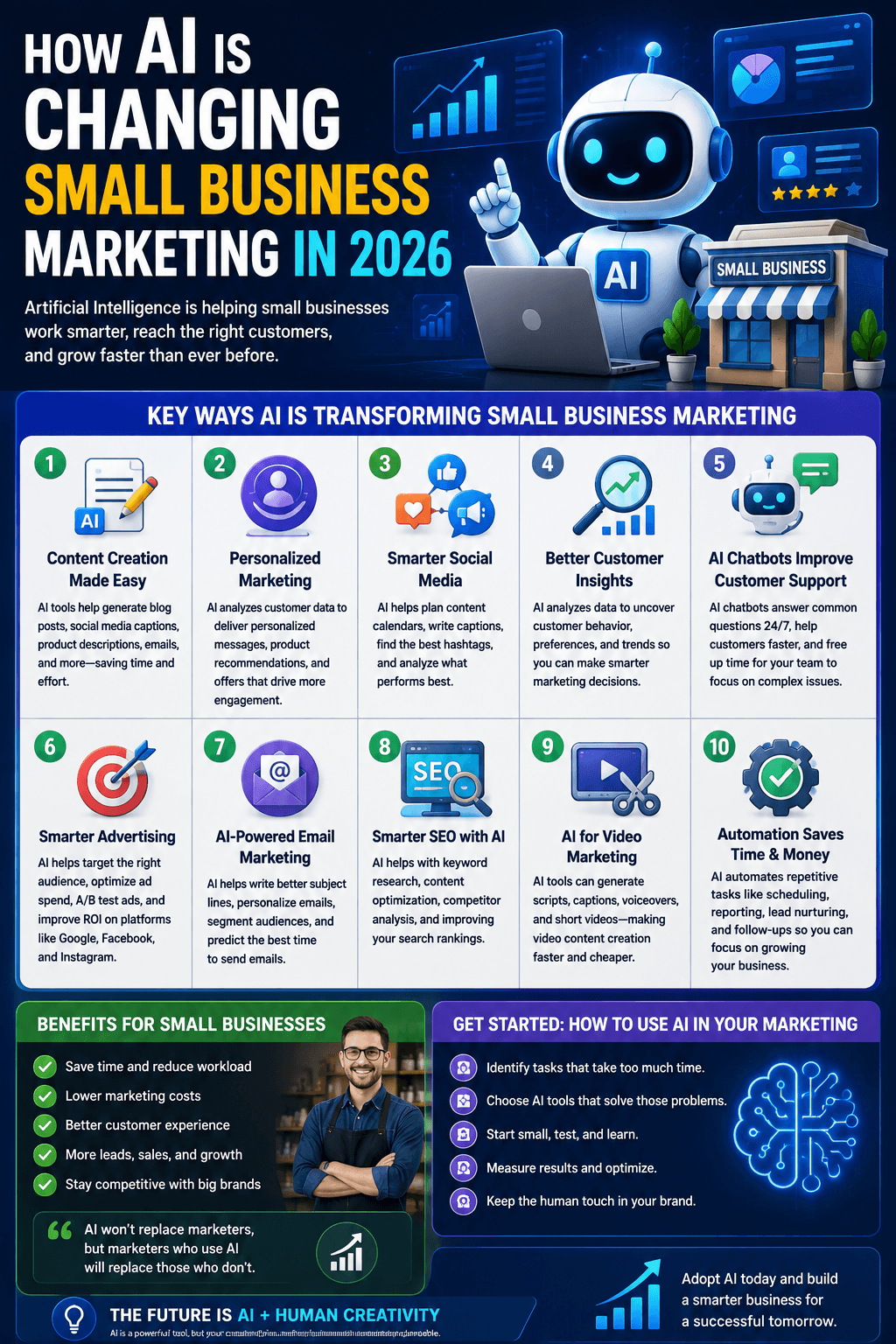

Artificial intelligence is transforming small business marketing in 2026. Tasks that once required hours of research, writing, design, analysis, and customer communication can now be completed much faster with AI-powered tools.
For small businesses with limited budgets and small teams, this can be a major advantage. AI allows entrepreneurs to compete more effectively by improving productivity, personalizing customer experiences, and creating marketing campaigns more efficiently.
However, successful AI marketing is not about replacing people. It is about using technology to make human creativity and business strategy more effective.
1. AI Is Making Content Creation Faster
Creating marketing content consistently can be difficult for a small business.
AI tools can help generate ideas, outlines, captions, email drafts, product descriptions, and blog content.
For example, a small online store can use AI to create initial descriptions for dozens of products instead of writing everything manually.
Businesses should still review and personalize AI-generated content to ensure that it accurately represents their brand.
2. Personalized Marketing Is Becoming Easier
Customers respond better to messages that are relevant to their interests.
AI can analyze customer information and help businesses create more personalized marketing campaigns.
For example, an online retailer could recommend different products based on customer interests or previous purchases.
Personalization can help businesses make marketing communication more relevant while respecting privacy and applicable data-protection requirements.
3. AI Is Improving Social Media Marketing
Social media requires a steady flow of content.
AI can help small businesses with:
Post ideas
Captions
Content calendars
Hashtag research
Short-form video concepts
Audience analysis
Performance summaries
Instead of spending hours planning every post, marketers can use AI to create a starting point and then add their own brand personality.
4. AI Is Helping Small Businesses Understand Customers
Customer data can contain valuable insights, but analyzing it manually can be difficult.
AI-powered analytics can help identify patterns in:
Customer behavior
Website activity
Sales
Marketing campaigns
Product performance
Customer feedback
These insights can help businesses understand what customers want and which marketing strategies are working.
5. AI Chatbots Are Changing Customer Communication
AI chatbots can answer common customer questions around the clock.
A chatbot can potentially help customers with:
Product information
Pricing
Store policies
Appointment scheduling
Order questions
Frequently asked questions
When a question is too complicated, the conversation can be transferred to a human employee.
This allows small businesses to provide faster support without requiring employees to respond manually to every basic question.
6. AI Is Making Advertising More Efficient
Digital advertising can become expensive when campaigns are poorly targeted.
AI can help marketers analyze campaign performance and identify patterns in audience behavior.
Businesses can use these insights to test different:
Headlines
Images
Offers
Audiences
Landing pages
Ad formats
Human marketers should continue monitoring campaigns and making strategic decisions rather than blindly accepting automated recommendations.
7. AI Can Help With Email Marketing
Email marketing remains useful for small businesses.
AI can assist with creating:
Newsletter ideas
Subject lines
Promotional emails
Welcome sequences
Follow-up messages
Customer re-engagement campaigns
AI can also help businesses organize customers into different segments so that messages are more relevant to each audience.
8. AI Is Changing SEO
Search is becoming increasingly influenced by AI.
Traditional SEO remains important, but businesses now need to consider how their content appears across AI-powered search and conversational discovery systems.
Small businesses can improve their visibility by creating content that answers real customer questions, demonstrates expertise, and provides original information.
Instead of focusing only on repeating keywords, businesses should focus on search intent and useful content.
9. AI Makes Video Marketing More Accessible
Video marketing used to require cameras, editing software, scripts, and significant production time.
AI tools are making parts of the process easier.
Small businesses can use AI to help create:
Video scripts
Captions
Voiceovers
Short-form videos
Product demonstrations
Educational videos
Social media clips
This allows businesses with limited resources to experiment with video marketing more easily.
10. AI Helps Small Teams Compete With Larger Businesses
One of the biggest benefits of AI is increased productivity.
A small marketing team can use AI to support research, writing, design, customer service, analytics, and campaign planning.
This does not mean a small business can automatically outperform a large corporation. However, AI can reduce some resource disadvantages by helping small teams accomplish more.
AI Marketing Strategies Small Businesses Should Try
Businesses should not adopt AI randomly. Instead, they should start with practical marketing problems.
Automate Repetitive Tasks
Identify tasks that employees perform repeatedly and determine whether AI or automation can safely handle them.
Create a Content System
Use AI to brainstorm and organize content while keeping human control over the brand voice.
Improve Customer Segmentation
Analyze customer groups and create more relevant campaigns for different audiences.
Test More Marketing Ideas
AI can help marketers create multiple variations of headlines, offers, and content for testing.
Monitor Results
Use analytics to determine whether AI-assisted marketing actually improves traffic, leads, sales, or customer engagement.
Benefits of AI Marketing for Small Businesses
AI can provide several advantages:
Lower workload: Employees can spend less time on repetitive marketing tasks.
Faster content production: Businesses can create initial drafts and ideas more quickly.
Better personalization: Marketing messages can be tailored to different customer groups.
Improved decision-making: AI can help identify patterns in marketing data.
Greater scalability: Small teams can manage more marketing activities.
24/7 customer support: AI chatbots can answer many basic questions outside business hours.
Challenges Small Businesses Should Consider
AI marketing also comes with risks.
Accuracy
AI-generated information can sometimes be incorrect. Businesses should fact-check important claims before publishing them.
Brand Voice
AI-generated content can sound generic if it is not properly edited and personalized.
Privacy
Businesses should be careful when providing customer information to AI systems and should understand how platforms handle data.
Over-Automation
Customers still value human interaction. Not every customer-service or marketing activity should be automated.
Increasing Competition
As AI tools become widely available, more businesses can produce content quickly. This makes originality, expertise, and strong branding even more important.
The Future of Small Business Marketing
AI marketing will likely become increasingly integrated into everyday business operations.
Instead of using AI as a separate experiment, businesses may incorporate it into their regular marketing workflows—from researching customers to creating content, analyzing campaigns, and providing support.
The businesses that benefit most will not necessarily be those using the most AI tools.
They will be the businesses that use the right AI tools for the right problems.
Conclusion
AI is changing small business marketing in 2026 by making content creation, personalization, analytics, advertising, customer service, SEO, and video production more accessible.
For entrepreneurs and small teams, this can create a significant opportunity to improve efficiency and compete in an increasingly digital marketplace.
But AI should remain a tool—not the entire marketing strategy.
The winning combination is AI technology, human creativity, strong strategy, and a deep understanding of customers.
FAQs
1. How is AI changing small business marketing?
AI is helping small businesses automate repetitive tasks, create content, analyze customer data, personalize marketing, improve customer service, and optimize campaigns.
2. Can small businesses afford AI marketing tools?
Many AI tools offer free or relatively affordable plans, while more advanced platforms can cost more. Businesses should choose tools based on their needs and expected return.
3. Can AI replace small business marketers?
AI can automate certain marketing tasks, but human creativity, strategy, communication, and decision-making remain important.
4. How can AI help with social media?
AI can generate content ideas, captions, calendars, video concepts, and performance insights, helping businesses manage social media more efficiently.
5. Can AI improve SEO?
AI can help with keyword research, content planning, optimization, and analysis. However, businesses still need useful, accurate, original content and sound technical SEO.
6. Is AI-generated content good for marketing?
It can be useful as a starting point, but businesses should edit, fact-check, and personalize AI-generated content before publishing it.
7. How can AI help customer service?
AI chatbots can answer common questions, provide information, and handle basic requests, while complex issues can be transferred to human employees.
8. What is the biggest benefit of AI marketing?
For many small businesses, the biggest benefit is the ability to accomplish more marketing work with limited time and resources.
9. What are the risks of AI marketing?
Potential risks include inaccurate information, privacy concerns, generic content, excessive automation, and insufficient human oversight.
10. Should every small business use AI?
AI can be useful for many businesses, but companies should adopt it selectively. The best starting point is a specific problem where AI can provide measurable value.