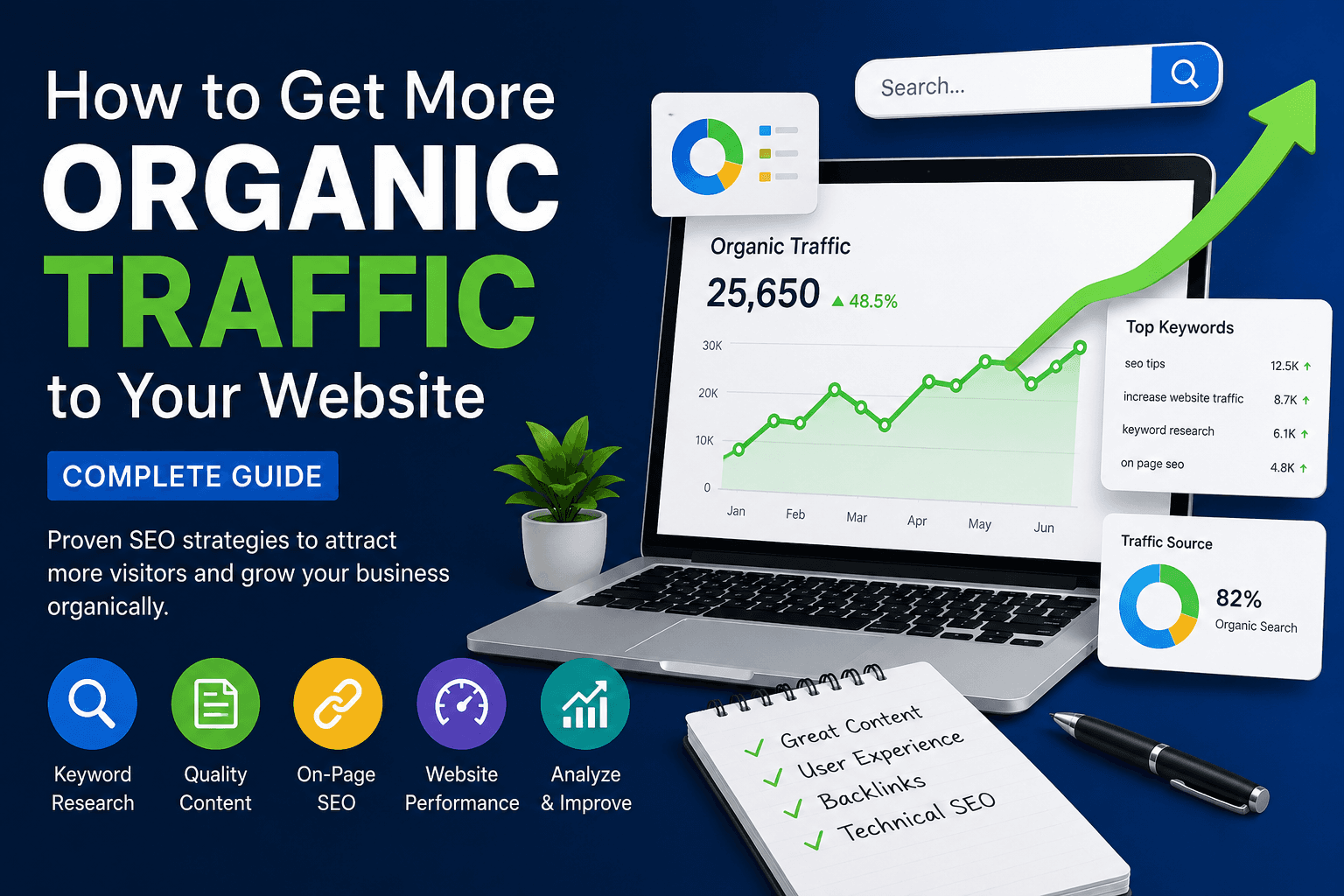
Organic traffic is one of the most valuable sources of website visitors. Unlike paid advertising, organic traffic can continue generating visitors long after you publish an article or optimize a page. However, getting consistent traffic from search engines requires more than simply publishing blog posts.
You need a combination of SEO, helpful content, keyword research, technical optimization, user experience, and ongoing improvement.
This guide explains practical strategies you can use to increase organic traffic and build sustainable search visibility.
What Is Organic Traffic?
Organic traffic refers to visitors who reach your website through unpaid search engine results.
For example, if someone searches Google for “best productivity tools for small businesses” and clicks your website from the search results, that visit is organic traffic.
Organic traffic is valuable because visitors are often actively searching for information, products, or solutions related to your content.
1. Understand What Your Audience Is Searching For
Before creating content, understand what your target audience actually searches for.
Instead of choosing topics based only on what you think people want, research search queries related to your industry.
Look for keywords that show clear intent, such as:
How to...
Best...
Guide to...
Tips for...
Why...
Comparison...
Tools for...
Examples of...
For example, a business website could target keywords such as “how to automate a small business” rather than publishing a general article about automation.
The more closely your content matches search intent, the better chance it has of attracting relevant visitors.
2. Focus on Long-Tail Keywords
Long-tail keywords are longer and more specific search phrases.
For example:
Broad keyword:
“SEO”
Long-tail keyword:
“How to improve SEO for a small business website”
Broad keywords can have enormous competition. Long-tail keywords are often easier to target and can bring highly relevant visitors.
A strong SEO strategy usually combines broad topics with specific long-tail searches.
3. Create Helpful, Original Content
Publishing content simply to target keywords is no longer enough.
Your articles should genuinely solve the reader's problem.
A useful article should:
Answer the main question quickly
Explain complicated concepts clearly
Provide practical examples
Include actionable steps
Address common questions
Avoid unnecessary repetition
Provide original insights where possible
Think about what would make someone finish your article and say, “That answered my question.”
That should be your content goal.
4. Build Topic Clusters
One of the most effective ways to build long-term organic visibility is to cover a subject comprehensively.
For example, if your main topic is SEO, you could create a central guide called:
SEO for Beginners: The Complete Guide
Then publish supporting articles about:
Keyword research
On-page SEO
Technical SEO
Link building
SEO content writing
Google Search Console
Local SEO
SEO mistakes
Internal linking
Website speed
Link these articles together naturally.
This creates a topic cluster that helps users discover more of your content and makes your website more comprehensive around the subject.
5. Optimize Your Titles
Your title is one of the first things users see in search results.
A strong title should clearly communicate what the page offers.
Instead of:
SEO Tips
Try:
15 Practical SEO Tips to Increase Organic Traffic
The second title provides more context and gives users a stronger reason to click.
Avoid misleading titles, though. Your title should accurately represent the content on the page.
6. Write Better Meta Descriptions
A meta description summarizes your page in search results.
Although it isn't generally a direct ranking factor, a compelling description can help encourage users to click.
For example:
Learn practical SEO strategies to increase organic traffic, improve search visibility, and attract more qualified visitors to your website.
Keep your description natural, relevant, and focused on the benefit to the reader.
7. Improve Your On-Page SEO
On-page SEO involves optimizing elements within your website.
Important areas include:
Page title
Headings
URL
Introduction
Main content
Internal links
Image alt text
Meta description
Structured content
Use your primary keyword naturally rather than forcing it repeatedly.
Search engines are increasingly capable of understanding topics and context, so writing naturally is more important than keyword stuffing.
8. Use Internal Linking
Internal links connect one page of your website to another.
For example, an article about SEO content writing could link to your guide about keyword research.
Internal linking can:
Help visitors discover related content
Improve website navigation
Distribute authority between pages
Help search engines discover and understand pages
Encourage visitors to spend more time exploring your website
Whenever you publish a new article, look for relevant older articles that you can link to.
9. Make Your Website Fast and Mobile-Friendly
Website experience matters.
If your pages load slowly or are difficult to use on mobile devices, visitors may leave quickly.
Pay attention to:
Page loading speed
Mobile responsiveness
Navigation
Readability
Image sizes
Unnecessary scripts
Pop-ups
Layout stability
A clean, fast website creates a better experience for both visitors and search engines.
10. Create Content That Answers Questions
Question-based searches are an excellent source of evergreen traffic.
For example:
What is SEO?
How does keyword research work?
How can I increase website traffic?
How long does SEO take?
What are the best free SEO tools?
How do I optimize a blog post?
Adding a useful FAQ section to relevant articles can help you address questions readers naturally have.
Don't add questions merely to increase word count. Every answer should provide genuine value.
11. Update Your Existing Content
SEO isn't only about creating new articles.
Your existing content may already have backlinks, impressions, rankings, and historical authority.
Review older articles regularly and update:
Outdated statistics
Broken links
Old examples
Screenshots
Recommendations
Titles
Meta descriptions
Missing sections
If an article is already receiving impressions but ranking poorly, improving it may produce better results than starting from zero with another article.
12. Use Google Search Console
Google Search Console is an essential tool for understanding how your website performs in Google Search.
You can use it to identify:
Search queries
Impressions
Clicks
Click-through rate
Average position
Indexed pages
Indexing problems
One particularly useful strategy is finding keywords where your pages already appear but receive few clicks.
For example, if your page ranks around positions 8–15 for a valuable query, you can improve the content and on-page optimization to try to move it higher.
13. Earn Quality Backlinks
Backlinks are links from other websites to your website.
High-quality, relevant backlinks can help strengthen your site's authority.
You can earn backlinks by:
Publishing original research
Creating useful statistics
Producing comprehensive guides
Creating valuable resources
Contributing expert insights
Building relationships with relevant websites
Promoting genuinely useful content
Focus on quality and relevance, not simply collecting as many links as possible.
14. Create Evergreen Content
Evergreen content remains useful for a long period.
Examples include:
Beginner's guides
How-to tutorials
Checklists
Definitions
Comparisons
Tool guides
Best-practice articles
Problem-solving tutorials
For example, “How to Perform Keyword Research” can remain useful for years with occasional updates.
Evergreen content can become a long-term traffic asset.
15. Track Your Results
You can't improve what you don't measure.
Monitor metrics such as:
Organic sessions
Search impressions
Click-through rate
Keyword rankings
Conversions
Pages generating the most traffic
New versus returning visitors
Don't judge your SEO strategy after only a few days. Search visibility can take time to develop.
Instead, look for trends over weeks and months.
Common SEO Mistakes to Avoid
Some practices can prevent your website from reaching its potential.
Avoid:
Keyword stuffing
Copying competitors
Publishing low-value AI-generated content
Creating hundreds of pages without a clear purpose
Buying spammy backlinks
Ignoring mobile users
Using misleading titles
Leaving outdated content untouched
Writing only for search engines
Ignoring user experience
AI can help with research, brainstorming, outlining, and productivity, but the final content should be useful, accurate, original, and reviewed by a human.
How Long Does It Take to Increase Organic Traffic?
There is no universal timeline.
Results depend on factors such as:
Website authority
Competition
Content quality
Technical SEO
Backlinks
Search demand
Existing rankings
Publishing consistency
Some pages may gain visibility relatively quickly, while competitive topics can take much longer.
SEO should therefore be treated as a long-term investment rather than a quick traffic trick.
Final Thoughts
Increasing organic traffic requires a consistent strategy rather than one isolated SEO technique.
Start by understanding your audience and researching relevant keywords. Create genuinely helpful content, organize related topics into clusters, improve internal linking, optimize your website experience, and regularly update existing pages.
Most importantly, focus on helping people find the information they need.
When your website consistently provides useful answers and a strong user experience, organic search can become a sustainable source of traffic, leads, and business growth.