Artificial intelligence (AI) has become one of the most influential technologies of the decade. In 2026, AI is no longer limited to research laboratories or large technology companies. It is now powering customer service, healthcare, education, finance, cybersecurity, manufacturing, marketing, and countless everyday business operations.
Organizations around the world are investing heavily in AI because it improves efficiency, supports better decision-making, and creates new opportunities for innovation. At the same time, consumers are experiencing AI through smarter search engines, digital assistants, recommendation systems, and productivity tools.
As AI continues to evolve, understanding its latest trends has become essential for businesses, professionals, and technology enthusiasts. This article explores the most important AI trends shaping the future of technology in 2026.
Artificial Intelligence Moves Beyond Automation
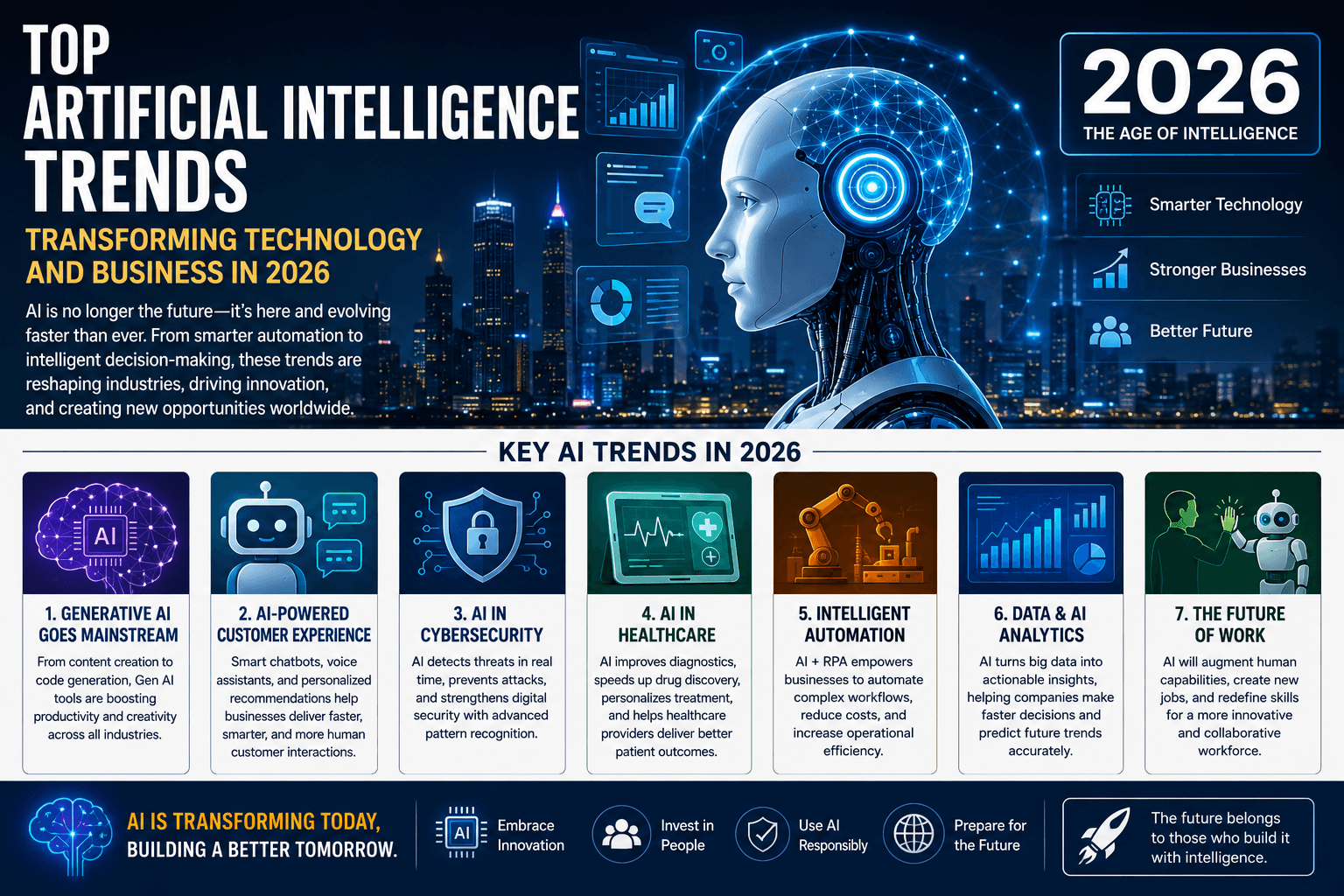
Earlier AI systems focused mainly on automating repetitive tasks. Modern AI solutions now assist with reasoning, problem-solving, content generation, software development, customer support, and data analysis.
Businesses increasingly use AI to improve productivity rather than simply replacing manual work.
Employees are using AI assistants to summarize reports, draft emails, analyze data, prepare presentations, and generate creative ideas, allowing teams to focus on strategic work.
Generative AI Continues Rapid Growth
Generative AI remains one of the fastest-growing technology sectors.
Modern AI systems can create:
Articles
Images
Videos
Computer code
Business reports
Marketing campaigns
Product descriptions
Educational materials
Businesses are integrating generative AI into daily workflows to save time while maintaining high-quality output.
Human review remains essential to ensure accuracy, originality, and compliance with company standards.
AI Improves Customer Experience
Customer expectations continue rising.
Organizations now use AI-powered solutions to provide:
24-hour customer support
Personalized recommendations
Faster response times
Multilingual assistance
Intelligent chatbots
Automated appointment scheduling
AI helps businesses deliver consistent service while reducing waiting times and improving customer satisfaction.
Cybersecurity Becomes Smarter
Cybersecurity threats continue evolving, making AI an important defense tool.
Security teams use artificial intelligence to:
Detect unusual activity
Identify malware
Prevent fraud
Monitor networks
Respond to cyberattacks
Analyze security risks
AI enables organizations to recognize threats much faster than traditional manual monitoring methods.
AI Supports Healthcare Innovation
Healthcare organizations increasingly rely on AI to improve patient care.
Applications include:
Medical imaging analysis
Drug discovery
Hospital resource planning
Clinical documentation
Personalized treatment recommendations
Remote patient monitoring
While medical professionals remain responsible for patient care, AI provides valuable decision support that improves efficiency.
Artificial Intelligence Changes Software Development
Developers increasingly use AI coding assistants to:
Write code
Detect programming errors
Suggest improvements
Generate documentation
Automate testing
These tools accelerate software development while allowing programmers to focus on solving complex technical challenges.
AI is becoming an important productivity partner for development teams rather than replacing software engineers.
Smart Business Analytics
Modern organizations generate enormous amounts of data.
AI-powered analytics platforms help businesses identify trends, forecast demand, improve financial planning, and understand customer behavior.
Decision-makers can now receive real-time insights that support faster and more informed business strategies.
Companies using AI analytics often gain competitive advantages through improved operational efficiency.
Responsible AI Becomes a Priority
As AI adoption increases, organizations are placing greater emphasis on ethical AI development.
Responsible AI includes:
Transparency
Fairness
Privacy protection
Human oversight
Secure data handling
Accountability
Businesses that implement responsible AI practices build stronger customer trust while reducing legal and reputational risks.
AI in Education
Educational institutions continue adopting AI-powered learning tools.
Students benefit from:
Personalized learning experiences
Intelligent tutoring systems
Language translation
Research assistance
Interactive study materials
Teachers use AI to simplify administrative tasks and create engaging educational content.
Technology supports learning while allowing educators to focus on student development.
AI and the Future of Work
Artificial intelligence is transforming workplaces rather than eliminating them.
Future employees will increasingly collaborate with AI systems to improve productivity.
Important skills will include:
Critical thinking
Creativity
Communication
Digital literacy
AI management
Data interpretation
Organizations that invest in employee training will be better prepared for future technological changes.
Challenges Ahead
Despite rapid progress, AI still faces important challenges.
Businesses must address issues including:
Data privacy
Security risks
Copyright concerns
Misinformation
Regulatory compliance
Workforce adaptation
Successful AI adoption requires balancing innovation with responsible governance.
Looking Ahead
Artificial intelligence will continue shaping nearly every industry over the coming years.
Future developments may include:
More capable AI assistants
Smarter business automation
Advanced robotics
Improved language translation
Faster scientific research
Personalized digital experiences
Organizations that embrace AI strategically while maintaining human oversight will be better positioned for long-term success.
Conclusion
Artificial intelligence has become one of the defining technologies of 2026. From improving customer service and cybersecurity to accelerating software development and transforming education, AI is reshaping how businesses and individuals work.
Companies that adopt AI responsibly, invest in employee skills, and focus on delivering value to customers will gain the greatest competitive advantage.
The future of technology will not be driven by AI alone, but by how effectively people and intelligent systems work together to solve problems, create opportunities, and build a more innovative digital economy.