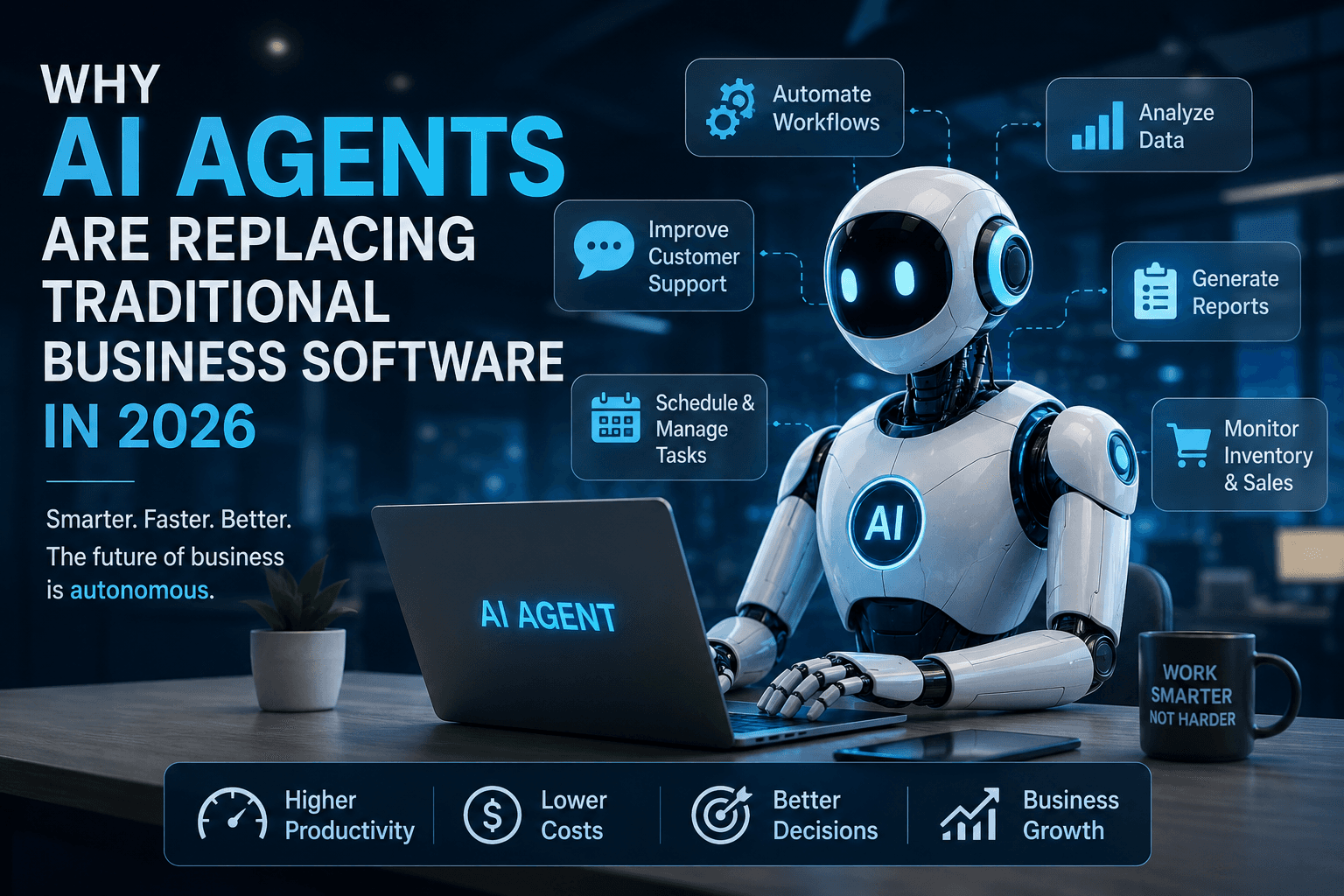

Artificial intelligence has evolved far beyond chatbots and simple automation. In 2026, AI agents are becoming the next generation of business software, helping organizations complete complex tasks with minimal human involvement. From managing customer service to analyzing financial data and coordinating workflows, AI agents are changing how companies operate and compete.
What Are AI Agents?
AI agents are intelligent software systems that can understand goals, make decisions, use multiple digital tools, and complete tasks independently. Unlike traditional software that requires users to perform every step manually, AI agents can plan, execute, and improve their work based on results.
For example, an AI agent can:
Respond to customer inquiries automatically.
Schedule meetings and manage calendars.
Analyze sales performance.
Create reports in seconds.
Monitor inventory and reorder products.
Assist marketing teams with campaign optimization.
Why Businesses Are Making the Shift
Traditional business software often requires employees to switch between multiple applications, manually enter information, and spend hours on repetitive work. AI agents reduce these inefficiencies by connecting systems and automating entire workflows.
Key benefits include:
Faster decision-making.
Lower operational costs.
Improved employee productivity.
Fewer manual errors.
Better customer experiences.
24/7 business operations.
These advantages make AI agents attractive for startups, small businesses, and large enterprises alike.
Industries Seeing the Biggest Impact
Several industries are already benefiting from AI-powered automation:
Healthcare
AI agents help manage appointments, process medical records, and assist healthcare professionals with administrative tasks.
Finance
Banks and financial institutions use AI agents to detect fraud, generate reports, assess risks, and provide customer support.
E-commerce
Online retailers rely on AI agents to recommend products, manage inventory, personalize shopping experiences, and answer customer questions instantly.
Marketing
Marketing teams use AI agents to create content, analyze campaign performance, manage advertising budgets, and identify emerging trends.
Challenges to Consider
Although AI agents offer significant advantages, businesses should also prepare for potential challenges.
These include:
Protecting sensitive business data.
Ensuring AI decisions remain transparent.
Training employees to work alongside AI systems.
Maintaining human oversight for critical decisions.
Successful adoption requires a balance between automation and human expertise.
What the Future Looks Like
Experts expect AI agents to become standard business tools over the next few years. Instead of using dozens of disconnected applications, companies may increasingly rely on intelligent assistants capable of managing multiple business functions from a single interface.
Businesses that embrace AI agents early are likely to improve efficiency, reduce costs, and adapt more quickly to changing market demands.
Conclusion
AI agents are redefining business software in 2026. By automating complex processes, improving productivity, and supporting better decision-making, they are helping organizations operate more efficiently than ever before. As AI technology continues to advance, companies that invest in intelligent automation today will be better positioned for long-term growth and innovation.