
TCThe Cost of Cross-Border Trade: Navigating Supply Chain Disruptions in Regional Tech Sectors
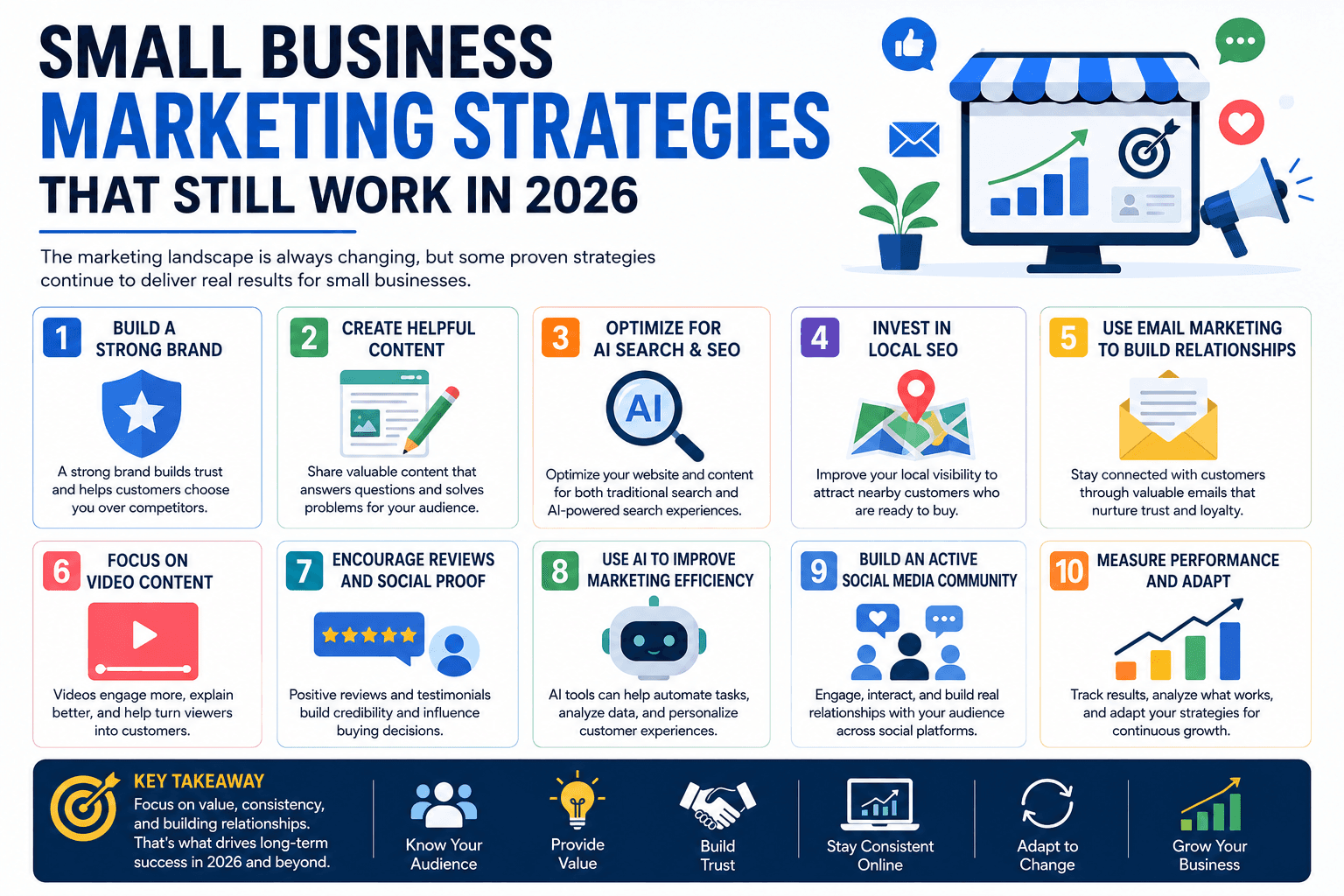
In 2026, small businesses have more marketing tools than ever—but that doesn’t mean every trend is worth chasing. AI-generated content, automation, social commerce, and search changes have transformed digital marketing, yet many of the most effective strategies remain surprisingly simple.
The key is to combine trust, useful content, customer relationships, local visibility, and smart technology rather than trying to compete with large companies on advertising budgets.
1. Build a Strong Local SEO Presence
Local SEO remains one of the most valuable strategies for small businesses serving a specific geographic area.
Make sure your Google Business Profile is complete and regularly updated. Include accurate business information, opening hours, services, photos, website links, and customer reviews.
Also optimize your website for location-based searches such as:
“best coffee shop near me”
“plumber in [city]”
“digital marketing agency in [location]”
“affordable accounting services near me”
Creating useful location-specific pages and earning local backlinks can further improve visibility.
2. Focus on Customer Reviews
Consumers continue to rely heavily on reviews before purchasing from unfamiliar businesses.
Encourage satisfied customers to leave honest reviews on platforms relevant to your industry. More importantly, respond to reviews—both positive and negative.
A thoughtful response to a negative review can demonstrate that your business takes customer concerns seriously.
Avoid fake reviews. Authentic customer experiences are far more valuable for long-term reputation.
3. Use Short-Form Video
TikTok, Instagram Reels, YouTube Shorts, and similar formats remain powerful ways for small businesses to reach audiences without huge production budgets.
You don't need expensive equipment. Simple videos can showcase:
Products and services
Behind-the-scenes activities
Customer success stories
Tutorials
Frequently asked questions
Before-and-after results
Employee personalities
Industry tips
The goal isn't necessarily to make every video viral. Consistent, useful content can gradually build familiarity and trust.
4. Create Helpful, Search-Friendly Content
Content marketing still works when the content genuinely answers customer questions.
Instead of publishing dozens of generic AI-written articles, create content around the problems your customers actually experience.
For example, a landscaping company could publish:
How much does lawn maintenance cost?
When is the best time to plant grass?
How often should you water a new lawn?
Common lawn problems and how to fix them
In 2026, content should be designed not only for traditional search engines but also for AI-powered search and answer engines. Clear explanations, original insights, expert experience, and well-structured information can help businesses become more discoverable.
5. Build an Email Marketing List
Social media platforms can change their algorithms, but an email list is an audience your business can communicate with directly.
Offer something useful in exchange for an email address, such as:
A discount
Free guide
Checklist
Consultation
Product updates
Exclusive content
Then send emails that provide genuine value instead of constantly pushing sales.
A small, engaged email list can be more valuable than thousands of passive social-media followers.
6. Personalize Customer Experiences
Customers increasingly expect businesses to understand their needs.
Small businesses can use CRM systems and AI tools to personalize marketing without manually tracking every interaction.
For example, you can segment customers based on:
Previous purchases
Interests
Location
Purchase frequency
Engagement
Customer lifecycle stage
Personalized recommendations and relevant follow-ups can improve customer retention and conversion rates.
7. Use Social Proof
People want evidence that a business delivers what it promises.
Beyond star ratings, showcase:
Customer testimonials
Case studies
User-generated content
Before-and-after examples
Client results
Product demonstrations
A short customer success story can often be more persuasive than a paragraph of promotional copy.
8. Partner With Micro-Influencers
Small businesses don't always need celebrities or massive influencers.
Micro-influencers with smaller but highly engaged audiences can provide excellent results, particularly for local and niche businesses.
For example, a local fitness studio might collaborate with a fitness creator who has 10,000 highly relevant followers in the same city.
The important metric isn't follower count alone—it is audience relevance, engagement, credibility, and conversion potential.
9. Use AI as a Marketing Assistant
AI is one of the biggest opportunities for small businesses in 2026.
Instead of replacing your entire marketing strategy with AI, use it to increase productivity.
AI can help with:
Brainstorming content ideas
Drafting social posts
Customer segmentation
Email personalization
Competitive research
Data analysis
Ad variations
Customer-service automation
Content repurposing
However, human oversight remains important. Generic AI content can make a brand sound indistinguishable from thousands of competitors.
10. Don't Ignore Community Marketing
Building relationships within your community can generate business for years.
Consider participating in:
Local events
Business associations
Community programs
Workshops
Sponsorships
Networking events
Local collaborations
Community involvement gives businesses opportunities to build recognition and trust beyond digital advertising.
11. Retain Existing Customers
One of the biggest marketing mistakes small businesses make is focusing entirely on acquiring new customers.
Existing customers already know your business. Encourage repeat purchases through:
Loyalty programs
Personalized offers
Memberships
Referral incentives
Follow-up emails
Exclusive customer benefits
Increasing customer retention can have a significant impact on revenue because repeat customers often require less marketing effort than completely new prospects.
12. Measure What Actually Generates Revenue
Marketing metrics can become overwhelming.
Instead of focusing only on likes, impressions, or follower counts, track metrics connected to business outcomes:
Leads → conversions → revenue → customer lifetime value
Identify which channels actually generate customers.
If Google search produces more qualified leads than a social campaign, allocate more resources to search. If email produces strong repeat sales, invest in your email strategy.
The best marketing strategy is not necessarily the trendiest one. It is the one that produces measurable business results.
Final Thoughts
Small business marketing in 2026 is less about trying every new platform and more about doing the fundamentals exceptionally well.
Local SEO, reviews, useful content, short-form video, email marketing, customer retention, social proof, community relationships, and strategic AI adoption can work together to create a powerful marketing system.
The businesses most likely to succeed are those that use new technology to become more efficient while preserving something technology cannot easily replace: authentic relationships with customers.
FAQs
1. What is the most effective marketing strategy for small businesses in 2026?
Local SEO, customer reviews, useful content, email marketing, social media, and customer retention remain highly effective. The best strategy depends on the business, target audience, and location.
2. Is social media still important for small businesses in 2026?
Yes. Platforms such as Instagram, TikTok, Facebook, LinkedIn, and YouTube can help businesses build awareness, engage customers, and generate leads.
3. Does SEO still work in 2026?
Yes. SEO remains important, although search behavior is changing because of AI-powered search. Businesses should create helpful, original, trustworthy content that directly answers customer questions.
4. How important is local SEO for small businesses?
Local SEO is extremely important for businesses that serve specific locations. An optimized Google Business Profile, positive reviews, and location-focused website content can improve local visibility.
5. Are Google reviews important for small businesses?
Yes. Positive and authentic customer reviews can strengthen credibility and influence potential customers when they are deciding whether to purchase.
6. Should small businesses invest in video marketing?
Yes. Short-form videos can provide an affordable way to demonstrate products, answer questions, educate customers, and showcase the personality behind a business.
7. Is email marketing still effective in 2026?
Yes. Email marketing remains useful for nurturing leads, promoting offers, retaining customers, and encouraging repeat purchases.
8. How can AI help small business marketing?
AI can assist with content ideas, customer segmentation, email personalization, data analysis, social media drafts, advertising variations, and marketing automation.
9. Should businesses rely completely on AI-generated content?
No. AI can improve productivity, but businesses should add human expertise, original insights, real experiences, and accurate information to make content valuable and trustworthy.
10. What type of content should small businesses create?
Businesses should create content that answers real customer questions. Tutorials, guides, FAQs, case studies, product demonstrations, comparisons, and problem-solving articles are good options.
11. Are influencers useful for small businesses?
Yes. Micro-influencers can be particularly effective because they often have highly engaged and niche audiences that closely match a business's target customers.
12. How can a small business get more customers without spending heavily on advertising?
Businesses can focus on local SEO, referrals, customer reviews, organic social media, email marketing, partnerships, community events, and valuable educational content.
13. What is customer retention, and why does it matter?
Customer retention means encouraging existing customers to continue buying from a business. Repeat customers can provide long-term revenue and often require less acquisition effort than new customers.
14. How important are customer testimonials?
Testimonials provide social proof and can help potential customers feel more confident about purchasing a product or service.
15. Should small businesses use paid advertising in 2026?
Paid advertising can be effective when carefully targeted and measured. Businesses should monitor conversions and revenue rather than simply focusing on impressions or clicks.
16. What marketing metrics should small businesses track?
Important metrics include leads, conversion rates, customer acquisition cost, revenue, return on marketing investment, website traffic, email engagement, and customer lifetime value.
17. Is blogging still useful for small businesses?
Yes, provided the content is genuinely useful. Blogs can help businesses answer customer questions, demonstrate expertise, attract search traffic, and support AI and traditional search visibility.
18. How can small businesses compete with larger companies?
Small businesses can compete through specialization, personalized customer service, local expertise, authentic branding, community relationships, faster communication, and strong customer experiences.
19. What is the biggest small business marketing mistake in 2026?
One common mistake is trying to use every new platform or trend without a clear strategy. Businesses should concentrate on channels that reach their specific customers and generate measurable results.
20. What is the future of small business marketing?
The future will combine AI-powered automation with human creativity and customer relationships. Businesses that use technology efficiently while maintaining authenticity, trust, and personalized experiences will have a strong advantage.