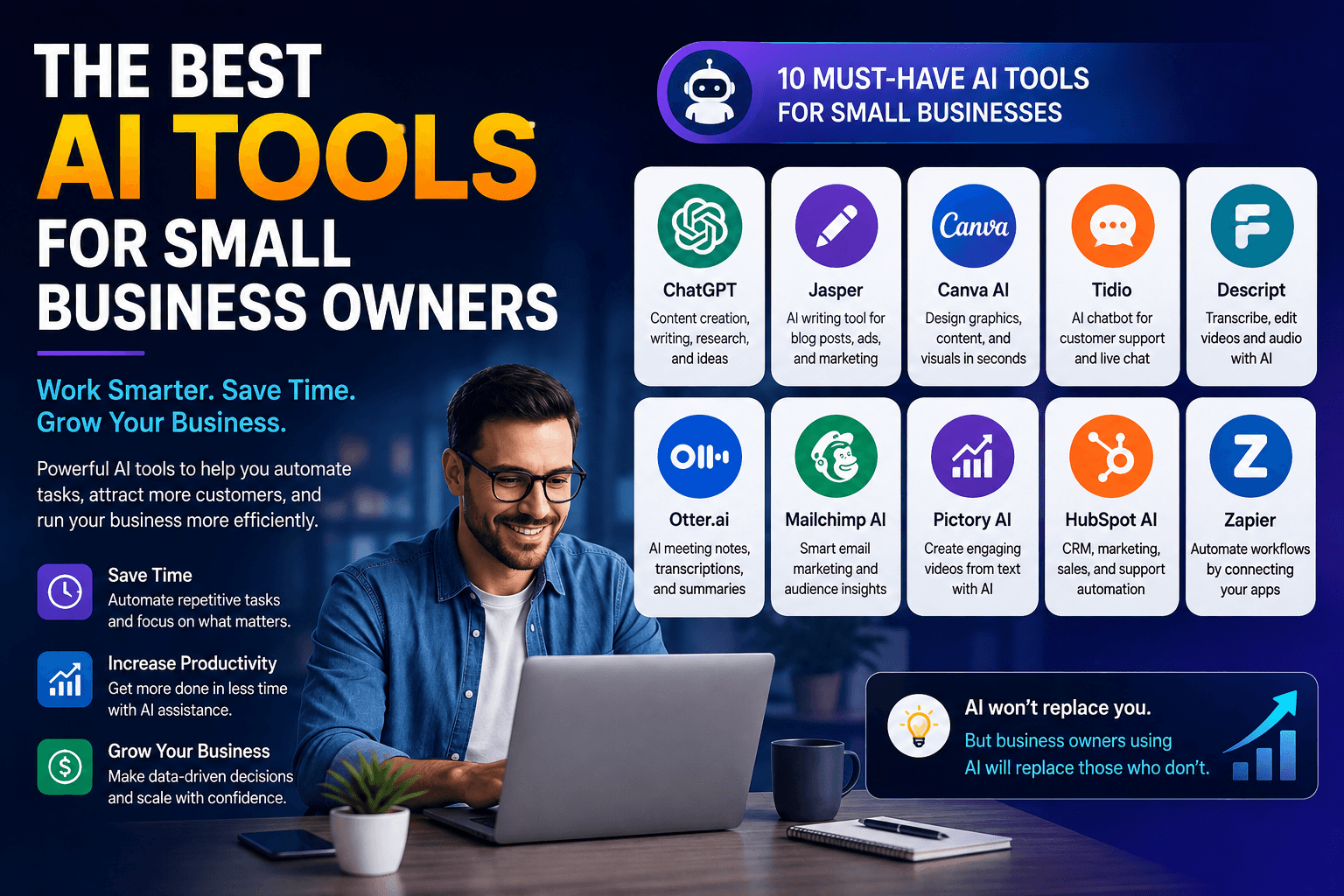

Artificial intelligence has quickly moved from being an experimental technology to becoming a practical business tool. Today, small businesses can use AI to automate repetitive tasks, improve marketing, communicate with customers, analyze information, and save valuable time.
The good news is that you don't need a large technology team or an enterprise-sized budget to benefit from AI. Many AI tools are designed specifically for individuals, startups, and small businesses.
The challenge is knowing which tools are actually useful and where they can make the biggest difference.
Why Small Businesses Are Turning to AI
Small businesses often operate with limited resources. Owners and employees may have to handle marketing, customer service, sales, administration, research, and operations at the same time.
AI can help reduce that workload.
For example, a small business can use AI to:
Draft emails and business documents
Generate content ideas
Automate customer support
Analyze business data
Create marketing materials
Summarize lengthy documents
Organize information
Automate repetitive workflows
Improve productivity
AI doesn't necessarily replace employees. In many cases, its biggest benefit is helping people spend less time on repetitive work and more time on tasks that require creativity, judgment, and human interaction.
1. ChatGPT for Business Productivity
ChatGPT can be useful for a wide range of everyday business tasks.
Small business owners can use it for brainstorming, writing, research assistance, customer communication, planning, and content development.
For example, you can use an AI assistant to help create:
Blog outlines
Email drafts
Social media ideas
Product descriptions
Meeting summaries
Business plans
Frequently asked questions
Customer response templates
The quality of the result depends heavily on the instructions you provide. Giving the AI context, goals, audience, and desired format generally produces more useful results.
The important point is to treat AI-generated information as a starting point and review important outputs before using them professionally.
2. AI Writing and Content Tools
Content marketing can be difficult for small businesses because consistently producing high-quality content takes time.
AI writing tools can help with parts of the process.
They can assist with:
Topic research
Content outlines
Headlines
First drafts
Editing
Summaries
Content repurposing
Social media captions
However, businesses should avoid publishing large amounts of generic AI-generated content without review.
Your content should still include real expertise, accurate information, original examples, and a clear understanding of your customers.
AI is most useful when it accelerates the content creation process rather than eliminating human involvement.
3. AI Design and Image Creation Tools
Visual content is important for websites, social media, presentations, advertisements, and marketing campaigns.
AI-powered design tools can help small businesses create visuals without requiring advanced graphic design skills.
Depending on the tool, businesses can generate or edit:
Social media graphics
Presentation visuals
Marketing images
Product concepts
Illustrations
Advertisements
Brand assets
This can reduce the time required to produce basic visual materials.
Businesses should still maintain consistent branding, including fonts, layouts, messaging, and visual identity.
4. AI Customer Support Tools
Customer service is another area where AI can provide significant value.
AI chatbots and virtual assistants can help answer common customer questions at any time.
For example, an AI support system could provide information about:
Business hours
Shipping
Returns
Pricing
Product features
Appointment availability
Frequently asked questions
This can reduce the number of repetitive questions employees need to answer manually.
However, customers should have a clear way to reach a human when an issue is complicated, sensitive, or outside the AI system's capabilities.
5. AI Meeting and Note-Taking Tools
Meetings can consume a surprising amount of time.
AI-powered meeting tools can help transcribe conversations, summarize discussions, and identify important action items.
Instead of manually reviewing an hour-long meeting, employees can use an AI-generated summary to quickly identify:
Key decisions
Tasks
Deadlines
Questions
Important discussion points
This can be particularly useful for remote and hybrid teams.
Businesses should ensure that meeting participants understand how recordings and transcripts are handled, especially when confidential information is involved.
6. AI Marketing Tools
Marketing is one of the most useful areas for small-business AI adoption.
AI can help businesses analyze audiences, generate campaign ideas, personalize messages, and improve content.
Marketing teams can use AI for:
Email campaigns
Social media planning
Ad copy
Customer segmentation
Content ideas
Marketing research
Campaign analysis
Instead of spending hours starting from a blank page, marketers can use AI to generate initial ideas and then refine them using their own expertise.
7. AI Data Analysis Tools
Small businesses generate data every day.
Sales numbers, website traffic, customer information, advertising results, and inventory records can all contain useful insights.
AI-powered analytics tools can make this information easier to understand.
They may help businesses identify:
Sales trends
Customer behavior
Marketing performance
Revenue patterns
Operational problems
Potential opportunities
The goal isn't simply to produce more reports.
The real value comes from turning data into better business decisions.
8. AI Accounting and Finance Tools
Financial administration can consume a lot of time.
AI-powered accounting and finance platforms can help automate tasks such as:
Expense categorization
Invoice processing
Transaction organization
Financial reporting
Cash-flow analysis
Payment reminders
Automation can reduce repetitive administrative work and help business owners maintain better visibility into their finances.
However, financial information is sensitive, so businesses should carefully evaluate security, privacy, integrations, and compliance before selecting a tool.
9. AI Sales Tools
Sales teams can also use AI to reduce administrative work.
AI-powered sales platforms can assist with:
Lead qualification
Customer research
Email personalization
Sales forecasting
CRM data organization
Follow-up reminders
Prospect prioritization
For a small sales team, these capabilities can help employees spend more time speaking with potential customers rather than performing repetitive administrative tasks.
10. AI Automation Platforms
One of the most powerful applications of AI is connecting different business tools together.
Automation platforms can allow businesses to create workflows between applications.
For example:
New customer form → CRM → email confirmation → task creation → sales notification
Instead of an employee performing every step manually, the workflow can run automatically.
AI can make these workflows even more flexible by helping categorize information, summarize messages, extract data, or make recommendations.
How to Choose the Right AI Tool
With thousands of AI products available, choosing the right one can be difficult.
Don't start by asking:
“What is the most advanced AI tool?”
Instead, ask:
“What business problem am I trying to solve?”
Consider these questions:
What task takes too much time?
Identify repetitive activities that employees perform frequently.
What does the business need to improve?
Maybe the priority is customer service, marketing, sales, or administration.
Does the tool integrate with existing software?
An impressive AI tool isn't very useful if it doesn't work with your existing workflow.
How much does it cost?
Look beyond the monthly subscription. Consider usage limits, additional users, integrations, and implementation costs.
How does it handle data?
Review the provider's privacy and security practices before entering confidential business information.
Don't Try to Automate Everything
One of the biggest mistakes businesses make is adopting AI simply because it is popular.
Not every task needs AI.
Some processes are already efficient, and adding another tool may create unnecessary complexity.
Start with one clear problem.
For example:
Problem: Employees spend five hours each week answering repetitive customer questions.
AI solution: Implement an FAQ chatbot that handles common questions and sends complex issues to employees.
Measure the results.
If the solution saves time and improves customer experience, expand AI adoption to another area.
AI Should Support Employees, Not Just Replace Tasks
Successful AI adoption isn't only about automation.
Businesses should think about how AI can help employees perform their jobs better.
An employee who previously spent three hours organizing information might use AI to complete the initial work in thirty minutes and then spend the remaining time reviewing results and making decisions.
This creates a human-AI workflow.
AI handles repetitive processing while people provide:
Judgment
Creativity
Context
Strategy
Empathy
Accountability
This combination can be more valuable than relying entirely on either humans or automation.
Common AI Mistakes Small Businesses Should Avoid
Before adopting AI, be aware of common problems.
Using too many tools
A business doesn't need a separate AI application for every task.
Ignoring data privacy
Never assume that every AI platform handles sensitive information in the same way.
Publishing unreviewed AI content
AI-generated content can contain inaccuracies, outdated information, or generic statements.
Failing to train employees
Employees need to understand how and when AI should be used.
Measuring activity instead of results
Generating thousands of AI outputs isn't success.
The real question is whether AI improves productivity, customer experience, revenue, or operational efficiency.
The Future of AI for Small Businesses
AI adoption among small businesses is likely to continue expanding as tools become easier to use and integrate into existing software.
Future AI systems will increasingly work across multiple business functions rather than operating as isolated tools.
A business might eventually have AI systems assisting with customer communication, marketing, scheduling, analytics, sales, and internal operations within connected workflows.
But technology alone won't create successful businesses.
Companies will still need strong products, good customer relationships, sound strategies, and responsible decision-making.
Final Thoughts
AI tools can give small businesses access to capabilities that were once available mainly to large organizations.
From writing and marketing to customer service, data analysis, sales, and automation, AI can reduce repetitive work and help teams operate more efficiently.
The best approach isn't to adopt every new AI product.
Instead, identify your biggest business challenges, choose tools that directly address those problems, protect sensitive information, train your team, and measure the results.
The goal isn't simply to use AI. The goal is to use AI to build a smarter, faster, and more efficient business.