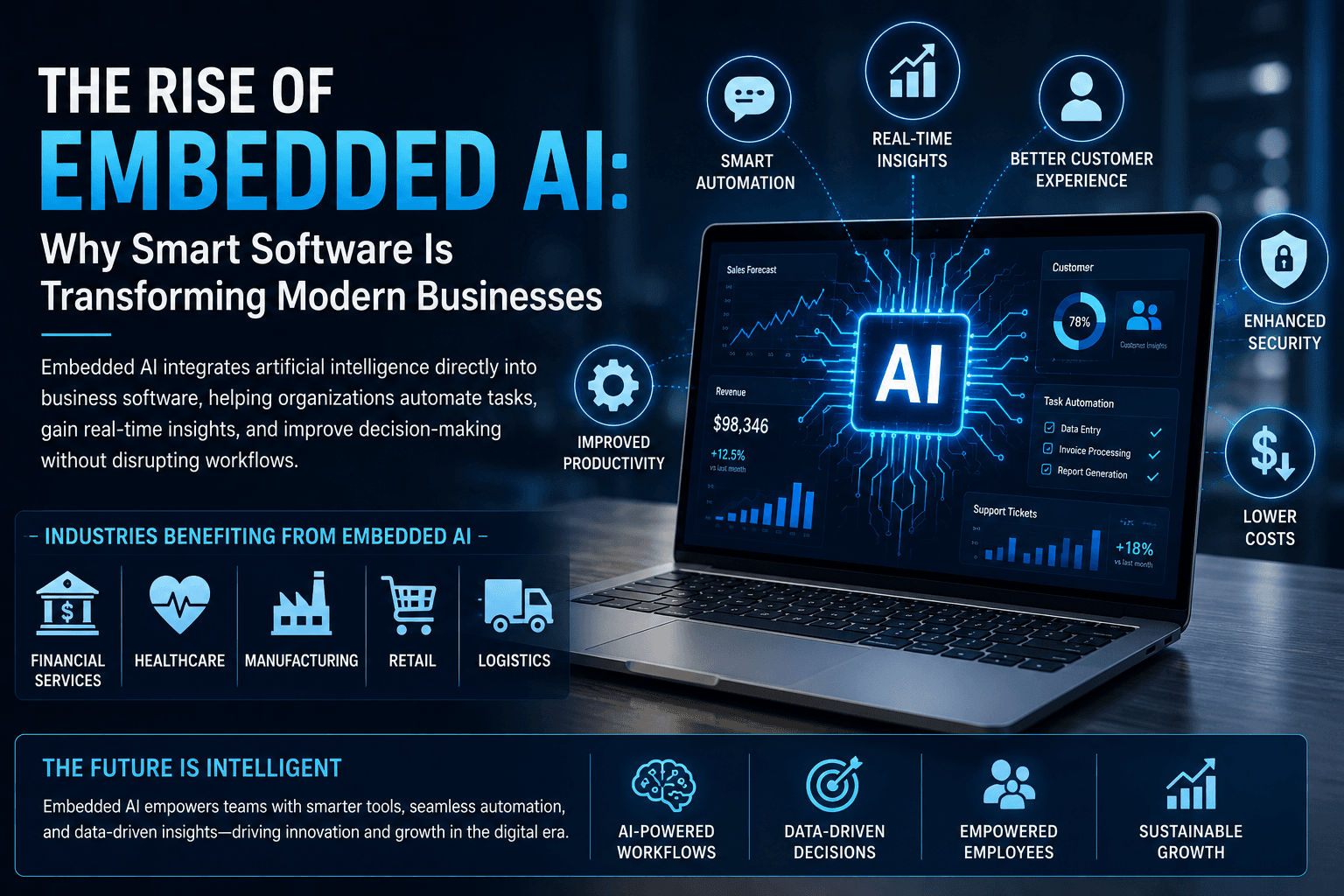
Artificial intelligence is no longer limited to standalone applications or specialized software. In 2026, AI is increasingly becoming an invisible part of everyday business tools through a technology known as Embedded AI. Instead of requiring employees to switch between multiple platforms, AI capabilities are now built directly into business software, allowing organizations to automate tasks, generate insights, and improve decision-making without disrupting existing workflows.
From customer relationship management (CRM) systems and accounting software to cybersecurity platforms and project management tools, Embedded AI is transforming how businesses operate. Organizations that embrace intelligent software are improving efficiency, reducing costs, and delivering better customer experiences while remaining competitive in an increasingly digital marketplace.
What Is Embedded AI?
Embedded AI refers to artificial intelligence capabilities integrated directly into software applications, business platforms, devices, or enterprise systems. Rather than functioning as a separate application, AI operates in the background, continuously analyzing data and providing intelligent recommendations or automation.
Examples of Embedded AI include:
AI writing assistants inside office software
Smart email categorization
Automated invoice processing
Predictive sales forecasting
Intelligent customer support
Fraud detection in financial systems
AI-powered cybersecurity monitoring
Smart inventory management
Employees benefit from AI without needing advanced technical expertise.
Why Businesses Are Adopting Embedded AI
Organizations are increasingly choosing Embedded AI because it delivers immediate business value without requiring major operational changes.
Key reasons include:
Improved Productivity
Employees spend less time performing repetitive tasks such as data entry, scheduling, reporting, and document management.
Faster Decision-Making
Embedded AI analyzes business data in real time and provides actionable recommendations, helping leaders make informed decisions quickly.
Better Customer Experiences
Businesses can personalize communications, recommend products, predict customer needs, and respond more efficiently to service requests.
Lower Operational Costs
Automation reduces manual workloads, minimizes errors, and improves resource utilization across departments.
Industries Benefiting from Embedded AI
Embedded AI is creating value across nearly every industry.
Financial Services
Banks and financial institutions use Embedded AI to detect fraud, automate compliance monitoring, assess credit risk, and improve customer support.
Healthcare
Healthcare providers use AI-enabled systems to assist with diagnostics, patient scheduling, medical imaging analysis, and administrative workflows.
Manufacturing
Manufacturers leverage Embedded AI to monitor equipment performance, predict maintenance needs, optimize production schedules, and improve quality control.
Retail
Retail businesses use intelligent software for demand forecasting, inventory optimization, personalized recommendations, and dynamic pricing.
Logistics
Transportation companies use AI to optimize delivery routes, reduce fuel consumption, improve warehouse operations, and monitor supply chains.
Cloud Computing Accelerates AI Adoption
Cloud technology has significantly expanded access to Embedded AI solutions. Businesses no longer need expensive infrastructure or specialized hardware to implement intelligent software.
Cloud-based AI platforms provide:
Flexible scalability
Lower deployment costs
Faster software updates
Enhanced collaboration
Improved security
Continuous innovation
These advantages make Embedded AI accessible for organizations of all sizes.
Challenges Businesses Must Consider
Despite its benefits, Embedded AI also introduces new responsibilities.
Organizations should address:
Data privacy protection
Cybersecurity risks
AI transparency
Employee training
Integration with existing systems
Responsible AI governance
A well-planned implementation strategy helps maximize value while minimizing operational risks.
Best Practices for Successful Implementation
Businesses planning to adopt Embedded AI should:
Identify processes suitable for automation.
Select software with proven AI capabilities.
Ensure high-quality business data.
Train employees on AI-powered features.
Monitor AI performance regularly.
Maintain strong cybersecurity controls.
Establish governance policies for responsible AI use.
Successful adoption depends on combining technology with effective leadership and workforce engagement.
The Future of Embedded AI
As AI technology continues to evolve, Embedded AI will become a standard feature in enterprise software rather than a competitive advantage. Future applications will provide even more intelligent automation, predictive analytics, natural language interactions, and autonomous decision support.
Organizations will increasingly rely on AI-powered software to improve collaboration, accelerate innovation, and adapt quickly to changing business environments.
Rather than replacing employees, Embedded AI will empower them with smarter tools that enhance creativity, productivity, and strategic thinking.
Final Thoughts
Embedded AI is reshaping modern business by bringing intelligent automation directly into the software organizations use every day. From improving customer experiences to streamlining operations and supporting better decision-making, intelligent software is becoming a critical driver of business success.
Companies that invest in Embedded AI today will be better positioned to improve efficiency, reduce costs, strengthen competitiveness, and prepare for the future of digital transformation.
As technology continues to advance, Embedded AI will play an increasingly important role in helping businesses innovate, scale, and thrive in the rapidly evolving global economy.
Read more business insights and technology trends at: https://www.1st4ebusiness.com