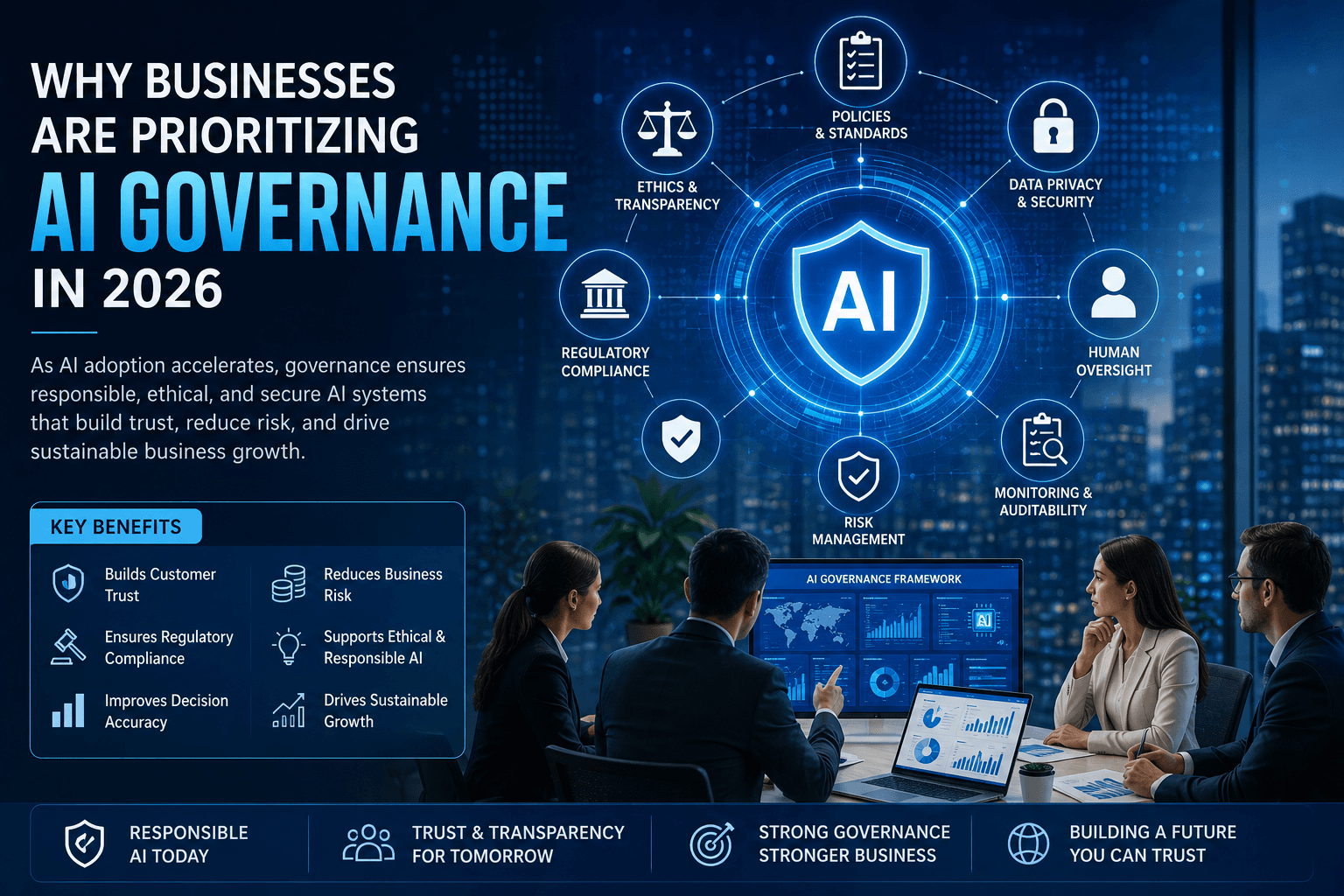

Artificial intelligence is transforming how businesses operate, from automating routine tasks to supporting strategic decision-making. As AI adoption accelerates across industries, organizations are recognizing that successful implementation requires more than powerful technology. It also demands clear governance, accountability, and responsible management.
In 2026, AI governance has become a top priority for businesses worldwide. Companies are developing policies and frameworks to ensure AI systems are transparent, secure, ethical, and compliant with evolving regulations. Organizations that establish strong AI governance are better positioned to reduce risks, build customer trust, and maximize the long-term value of their AI investments.
What Is AI Governance?
AI governance refers to the policies, processes, and standards that guide how artificial intelligence is developed, deployed, monitored, and managed within an organization. Its goal is to ensure AI systems operate responsibly while supporting business objectives.
An effective AI governance framework helps organizations:
Protect sensitive data
Reduce algorithmic bias
Improve transparency
Strengthen cybersecurity
Meet regulatory requirements
Ensure human oversight
Build stakeholder confidence
Rather than slowing innovation, governance provides the structure needed to scale AI responsibly.
Why AI Governance Matters More Than Ever
As AI becomes integrated into critical business functions, the consequences of poor oversight increase. AI systems now influence hiring decisions, financial services, healthcare, customer support, cybersecurity, and supply chain operations.
Without proper governance, businesses may face:
Inaccurate or biased AI decisions
Data privacy violations
Security vulnerabilities
Regulatory penalties
Reputational damage
Loss of customer trust
These risks make governance an essential component of every enterprise AI strategy.
Key Drivers Behind AI Governance in 2026
Expanding AI Regulations
Governments and regulatory bodies around the world are introducing new rules for AI transparency, accountability, and data protection. Businesses must demonstrate that their AI systems are compliant with applicable laws and industry standards.
Customer Expectations
Customers want assurance that AI is being used responsibly. Organizations that communicate clearly about how AI supports their products and services are more likely to earn long-term loyalty.
Growing Cybersecurity Risks
AI systems often process large volumes of sensitive information. Governance frameworks help organizations strengthen security controls, manage access permissions, and monitor AI systems for unusual activity.
Ethical Business Practices
Responsible AI has become an important part of corporate reputation. Businesses are investing in governance to ensure AI decisions are fair, explainable, and aligned with ethical principles.
Core Elements of an AI Governance Framework
Successful organizations typically include the following components in their AI governance strategy:
Clear Policies
Businesses should establish documented guidelines covering AI development, deployment, data usage, monitoring, and ongoing maintenance.
Data Quality Management
AI systems depend on accurate, relevant, and secure data. Strong governance includes regular data validation, access controls, and protection against unauthorized use.
Human Oversight
AI should support—not replace—human judgment. Critical business decisions should include appropriate review and accountability from qualified professionals.
Continuous Monitoring
Organizations should regularly evaluate AI performance, identify unexpected behavior, and update models as business needs and regulations evolve.
Risk Management
Businesses should assess potential risks before deploying AI systems and develop response plans for security incidents, compliance issues, or operational failures.
Benefits of Strong AI Governance
Organizations that invest in AI governance gain significant business advantages.
Greater Customer Trust
Transparent AI practices reassure customers that their information is handled responsibly and securely.
Better Regulatory Compliance
Governance helps businesses meet legal obligations, reducing the risk of fines and operational disruptions.
Improved Decision-Making
High-quality data and continuous oversight improve the accuracy and reliability of AI-generated insights.
Reduced Business Risk
Proactive governance minimizes cybersecurity threats, operational failures, and reputational damage.
Sustainable Innovation
Well-managed AI programs enable organizations to expand AI adoption confidently while maintaining control and accountability.
Best Practices for Business Leaders
To build an effective AI governance strategy, organizations should:
Create a cross-functional AI governance committee.
Define clear roles and responsibilities for AI oversight.
Conduct regular AI risk assessments.
Maintain detailed documentation of AI systems and data sources.
Train employees on responsible AI use.
Monitor AI performance continuously.
Review governance policies as technology and regulations evolve.
These practices help organizations adapt to changing business and regulatory environments while maintaining confidence in AI-driven operations.
The Future of AI Governance
As artificial intelligence continues to evolve, governance will become even more important. Businesses will increasingly adopt automated monitoring tools, standardized governance frameworks, and advanced auditing processes to ensure AI systems remain secure, transparent, and effective.
Organizations that prioritize responsible AI today will be better prepared for future regulatory requirements and technological advancements. AI governance will no longer be viewed as a compliance exercise but as a strategic capability that supports innovation, resilience, and long-term business success.
Final Thoughts
Artificial intelligence is reshaping the global business landscape, but its success depends on responsible management. AI governance provides the foundation for trustworthy, secure, and ethical AI adoption.
Businesses that establish clear governance frameworks can reduce risks, strengthen customer relationships, improve compliance, and unlock the full potential of AI technologies. As enterprise AI continues to expand in 2026 and beyond, organizations that combine innovation with accountability will be the ones that achieve lasting competitive advantage.
For more insights on business technology, digital transformation, and emerging industry trends, visit https://www.1st4ebusiness.com.