

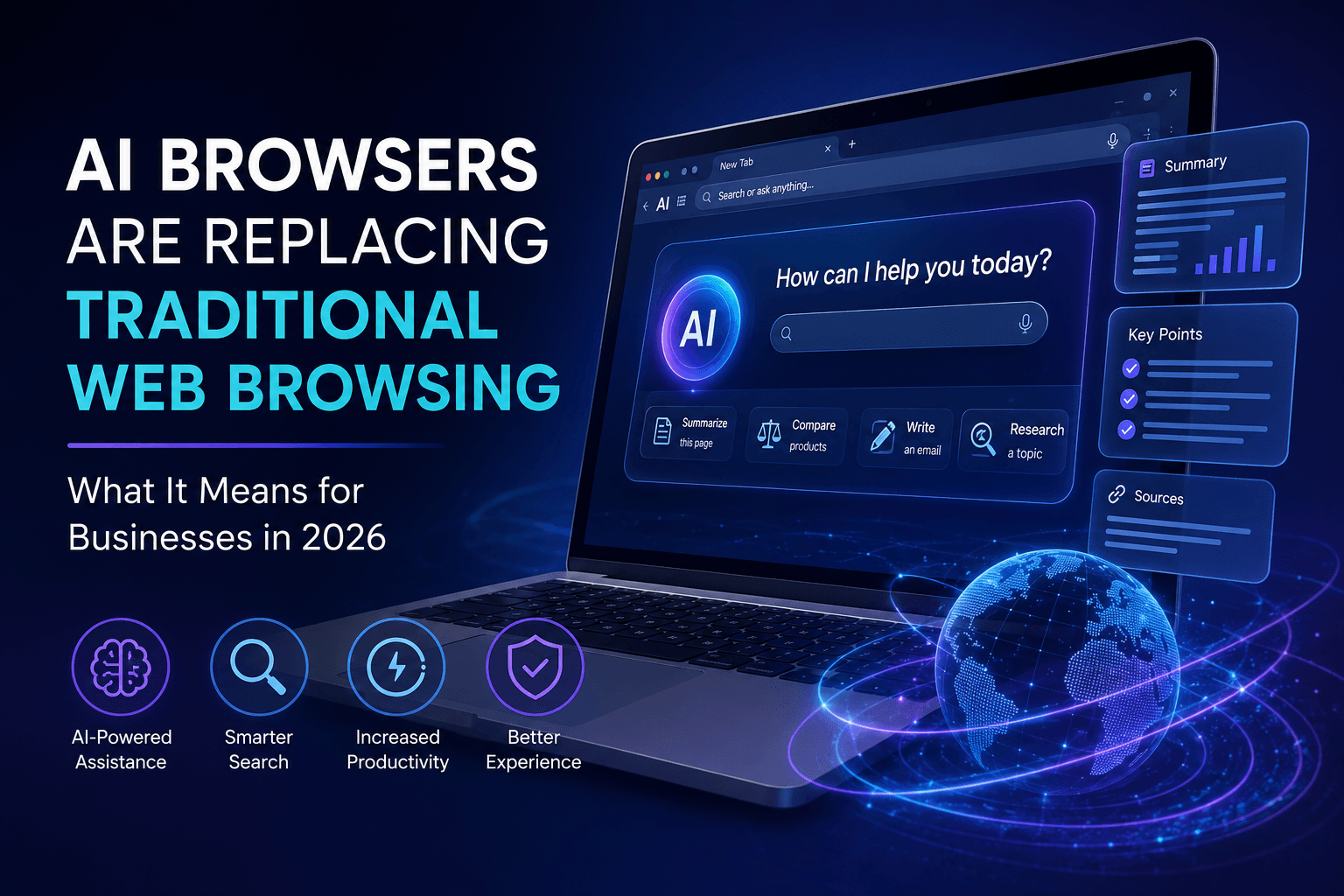
AI Browsers Are Replacing Traditional Web Browsing: What It Means for Businesses in 2026
R
The Browser Is Becoming an AI Assistant
For decades, web browsers have served as simple gateways to the internet. Users typed queries into search engines, clicked through multiple websites, compared information, and eventually found the answers they needed. In 2026, that experience is changing rapidly.
Artificial intelligence is transforming browsers from passive tools into active digital assistants. Instead of presenting dozens of links, AI-powered browsers can summarize content, answer complex questions, automate repetitive tasks, compare products, draft emails, organize research, and even complete workflows directly inside the browser.
This shift represents one of the most significant changes to the internet since the introduction of modern search engines. Businesses that understand how AI browsers work—and adapt their digital strategies accordingly—will be better positioned to reach customers in the years ahead.
What Is an AI Browser?
An AI browser combines traditional web browsing with built-in artificial intelligence. Rather than simply displaying webpages, it understands user intent and assists throughout the browsing experience.
Modern AI browsers can:
Summarize lengthy articles
Compare information from multiple websites
Answer questions without requiring multiple searches
Generate emails, reports, and presentations
Organize tabs and research automatically
Translate content instantly
Assist with coding and technical tasks
Automate repetitive online workflows
Instead of switching between numerous applications, users increasingly rely on AI directly inside their browser.
Why AI Browsers Are Growing So Quickly
Several factors are driving the rapid adoption of AI browsers.
Faster Access to Information
Users no longer want to spend time opening multiple tabs and reading lengthy articles. AI can analyze information from various sources and deliver concise summaries in seconds.
Increased Workplace Productivity
Businesses are embracing AI tools that reduce repetitive work. AI browsers help employees research markets, draft documents, analyze competitors, and prepare presentations more efficiently.
Better User Experience
Natural language conversations feel more intuitive than traditional keyword searches. Users can ask follow-up questions, request explanations, or refine their searches without starting over.
Integrated Workflows
AI browsers increasingly connect with calendars, email, cloud storage, and productivity software, allowing users to complete tasks without constantly switching applications.
How Businesses Will Be Affected
The rise of AI browsers extends beyond technology enthusiasts. It has meaningful implications for organizations of every size.
Search Traffic Will Continue to Change
As AI increasingly provides answers directly within the browser, some users may visit fewer websites. Businesses that rely solely on traditional search traffic could experience changing visitor patterns.
This makes high-quality, authoritative content more valuable than ever.
Content Must Demonstrate Expertise
AI systems prioritize trustworthy, well-structured information. Companies publishing original research, industry insights, and expert analysis are more likely to remain visible in AI-generated responses.
Thin, repetitive, or low-value content is less likely to be surfaced.
Website Quality Matters More
AI systems evaluate factors beyond keywords, including:
Clear page structure
Fast loading speeds
Mobile responsiveness
Accurate information
Helpful content
Strong user experience
Businesses investing in technical performance and content quality are likely to benefit.
Marketing Strategies Need to Evolve
Digital marketing is entering a new phase.
Instead of focusing only on traditional SEO, businesses should also optimize for AI-powered discovery.
Key priorities include:
Publishing in-depth educational content
Using descriptive headings and logical page structures
Answering common customer questions clearly
Building topical authority within a niche
Keeping information accurate and up to date
Organizations that consistently produce valuable content increase their chances of appearing in AI-generated summaries.
Customer Expectations Are Changing
AI browsers enable customers to research products faster than ever before.
Before contacting a business, buyers may already understand:
Product features
Pricing comparisons
Customer reviews
Industry alternatives
Frequently asked questions
As a result, businesses need websites that provide detailed, transparent, and trustworthy information.
Opportunities for Small Businesses
The transition to AI browsing is not only an advantage for large enterprises.
Small businesses that publish expert content and maintain informative websites can compete effectively by demonstrating authority in their industries.
Helpful resources include:
Buying guides
Industry explainers
Frequently asked questions
Case studies
Original insights
Practical tutorials
These content formats are valuable for both human readers and AI systems.
Industries Likely to Benefit
AI browsers are expected to influence nearly every sector, including:
E-commerce
Healthcare
Finance
Education
Legal services
Software
Manufacturing
Marketing
Travel
Real estate
Organizations in these industries can improve customer experiences by creating content that answers real questions and supports informed decision-making.
Challenges Businesses Should Consider
While AI browsers offer significant advantages, they also introduce new considerations.
Reduced Click-Through Rates
If AI answers user questions directly, some websites may receive fewer visits.
Businesses should focus on creating unique insights that encourage users to explore further.
Maintaining Accuracy
AI systems depend on reliable information. Companies should regularly review and update their content to ensure accuracy and relevance.
Privacy Considerations
As AI browsers become more integrated with workplace tools, organizations must carefully manage data security, permissions, and compliance requirements.
Preparing for an AI-First Internet
Businesses can take practical steps today to prepare for the future of browsing.
Publish original, research-based content.
Improve website speed and mobile usability.
Organize pages with clear headings and logical structure.
Build authority within a specific niche.
Update existing articles regularly.
Focus on solving customer problems rather than simply targeting keywords.
Monitor how AI platforms reference and summarize your content.
These practices support both traditional search visibility and AI-driven discovery.
Looking Ahead
The evolution of AI browsers represents a broader transformation in how people interact with the internet. Browsers are becoming intelligent assistants capable of researching, summarizing, organizing, and completing tasks on behalf of users.
For businesses, success in this new environment will depend on creating trustworthy, high-quality content and delivering exceptional online experiences. Organizations that adapt early will be better positioned to remain visible, build customer trust, and compete effectively as AI reshapes the future of web browsing.
Rather than replacing the web, AI browsers are changing how people navigate it. Businesses that embrace this shift today will be better prepared for the next generation of digital engagement.
| Category | Details |
|---|---|
| Topic | AI |
| Author | Rose |
| Published | 12/07/2026 |
| Read Time | Not set |
R