How AI Voice Agents Are Transforming Customer Communication
L
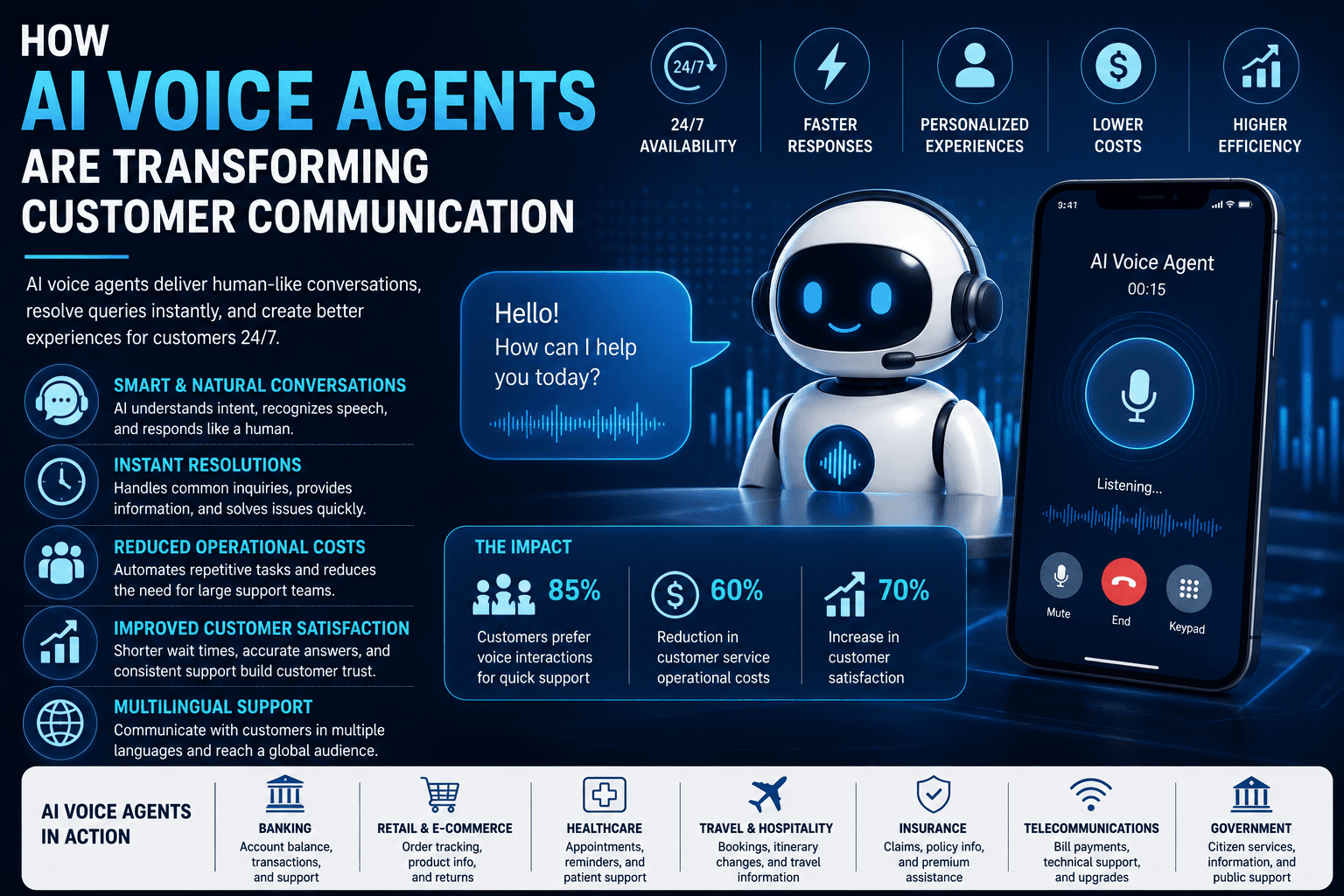
Customer communication is evolving rapidly as businesses embrace artificial intelligence (AI) to deliver faster, smarter, and more personalized experiences. One of the most significant innovations driving this transformation is the rise of AI voice agents. These intelligent virtual assistants can answer customer inquiries, schedule appointments, process orders, provide technical support, and even conduct sales conversations with remarkable accuracy.
In 2026, AI voice agents are becoming a key part of customer service strategies across industries. Powered by advanced natural language processing (NLP), speech recognition, and machine learning, they help businesses improve efficiency, reduce costs, and enhance customer satisfaction while remaining available 24/7.
## What Are AI Voice Agents?
AI voice agents are software applications that communicate with customers using natural, human-like speech. Unlike traditional automated phone systems that rely on fixed menus, AI voice agents understand spoken language, recognize customer intent, and respond intelligently in real time.
They can answer questions, access business databases, transfer complex issues to human representatives, and continuously improve their performance through machine learning.
## 24/7 Customer Support
One of the greatest advantages of AI voice agents is their ability to provide round-the-clock customer support. Businesses no longer need to limit service to standard working hours.
Customers can receive assistance anytime, whether they need product information, account support, appointment scheduling, or order tracking. This improves customer satisfaction while reducing waiting times.
## Faster Response Times
Customers expect immediate answers. AI voice agents can process thousands of conversations simultaneously without placing callers on hold.
By instantly retrieving information from company systems, they resolve common inquiries within seconds, allowing human agents to focus on more complex cases.
## Personalized Customer Experiences
Modern AI voice agents analyze customer history, preferences, and previous interactions to deliver personalized responses.
For example, they can recommend products based on past purchases, remind customers about upcoming appointments, or provide tailored support based on individual needs. Personalization strengthens customer relationships and increases loyalty.
## Lower Operational Costs
Hiring and training large customer support teams can be expensive. AI voice agents automate repetitive conversations, reducing staffing requirements while maintaining high service quality.
Businesses can significantly lower operational costs without sacrificing customer experience, making AI an attractive investment for organizations of all sizes.
## Supporting Multiple Languages
Global businesses often serve customers across different countries. AI voice agents can communicate in multiple languages and adapt to regional accents, helping organizations provide consistent support to international audiences.
This capability expands market reach while improving accessibility for diverse customer groups.
## AI Across Multiple Industries
AI voice agents are transforming customer communication in various sectors, including:
* Banking and financial services
* Healthcare
* Retail and e-commerce
* Telecommunications
* Travel and hospitality
* Insurance
* Government services
* Education
From booking appointments to processing payments and resolving technical issues, AI voice agents are becoming essential across industries.
## Business Benefits
Organizations implementing AI voice agents experience several important advantages:
* 24/7 customer availability
* Faster response times
* Lower customer service costs
* Increased customer satisfaction
* Improved employee productivity
* Personalized customer interactions
* Multilingual communication
* Scalable support during peak demand
These benefits help businesses improve service quality while operating more efficiently.
## Challenges to Consider
Although AI voice agents are highly capable, businesses must ensure customer data privacy, maintain secure systems, and provide seamless handoffs to human agents when conversations become too complex.
Continuous training and monitoring are also essential to ensure accurate responses and maintain customer trust.
## The Future of AI Voice Communication
The next generation of AI voice agents will become even more conversational, emotionally aware, and context-sensitive. Future systems will integrate generative AI, real-time translation, predictive analytics, and autonomous decision-making to handle increasingly complex customer interactions.
Businesses will also combine voice agents with chatbots, CRM platforms, and business intelligence systems to create unified customer experiences across every communication channel.
## Conclusion
AI voice agents are revolutionizing customer communication by delivering fast, intelligent, and personalized support around the clock. They help businesses improve operational efficiency, reduce costs, enhance customer satisfaction, and scale support services without compromising quality.
As AI technology continues to evolve, voice agents will play an increasingly important role in digital customer engagement. Businesses that adopt AI-powered voice solutions today will be better positioned to meet growing customer expectations, s
trengthen relationships, and remain competitive in the rapidly changing digital economy.
| Category | Details |
|---|---|
| Topic | AI |
| Author | Lora |
| Published | 03/07/2026 |
| Read Time | Not set |
L