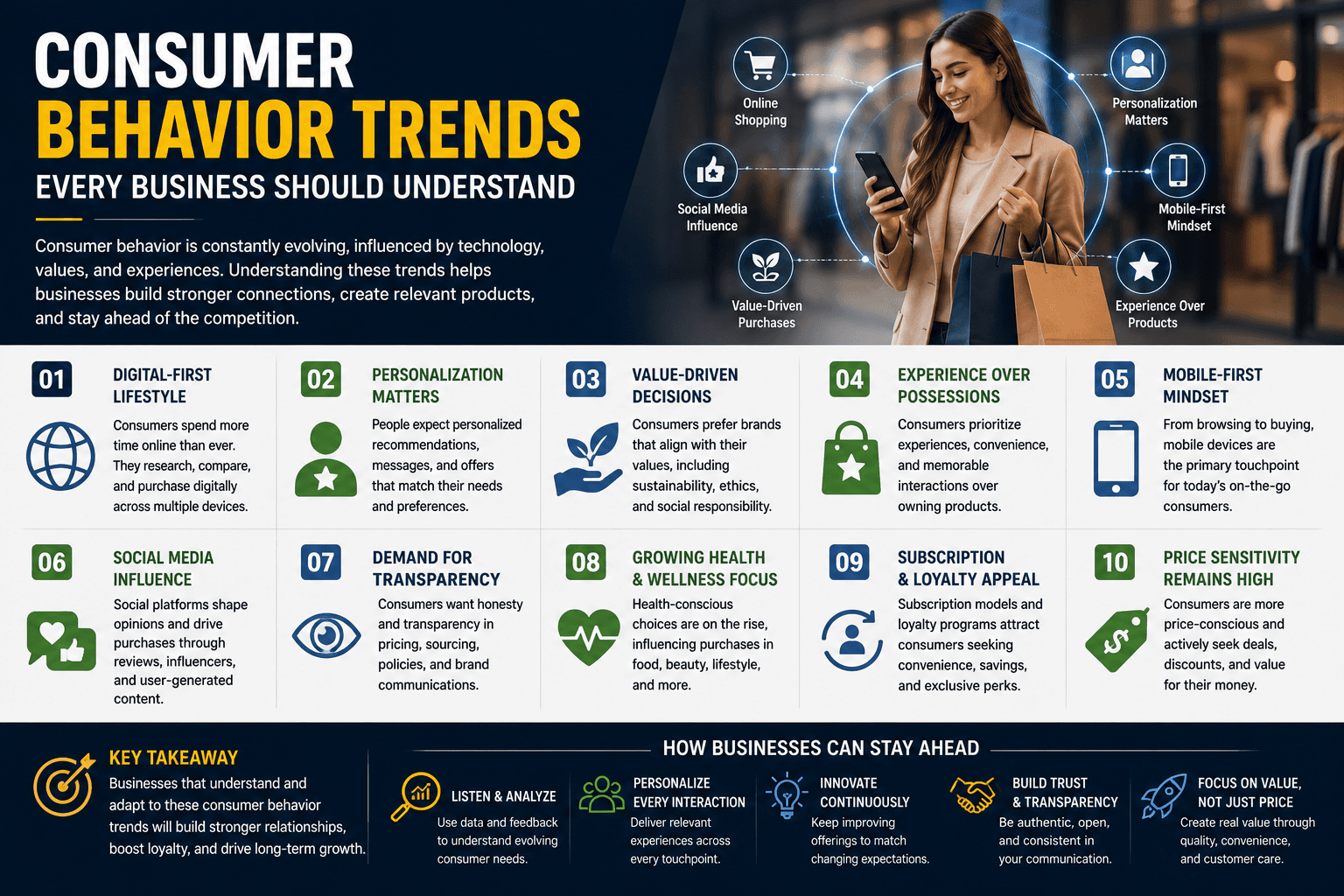

Consumer behavior is evolving faster than ever before. In 2026, businesses are no longer competing solely on product quality or pricing—they are competing on customer experience, personalization, trust, convenience, and digital innovation. Organizations that understand these changing expectations are better positioned to attract customers, strengthen loyalty, and drive sustainable growth.
Today's consumers are more informed than any previous generation. They compare products, read reviews, watch demonstrations, and seek recommendations before making purchasing decisions. Artificial intelligence, social media, mobile technology, and e-commerce have fundamentally reshaped the customer journey, forcing businesses to rethink their marketing, sales, and customer engagement strategies.
Digital-First Customers Are Reshaping Every Industry
Modern purchasing journeys begin online. Whether customers eventually buy in-store or online, they typically research products through search engines, social media, review platforms, and AI-powered assistants before making a decision.
Businesses must therefore prioritize digital experiences by investing in responsive websites, fast-loading pages, mobile optimization, and seamless checkout processes. Companies with strong digital ecosystems gain a significant competitive advantage over those relying primarily on traditional sales channels.
Personalization Has Become a Competitive Advantage
Consumers increasingly expect businesses to understand their preferences and deliver personalized experiences. Generic marketing campaigns are becoming less effective as customers respond better to relevant recommendations and tailored communications.
Businesses are leveraging artificial intelligence to personalize:
Product recommendations
Email campaigns
Promotional offers
Customer support
Shopping experiences
Organizations that successfully personalize customer interactions often achieve higher conversion rates, increased customer satisfaction, and stronger long-term loyalty.
Social Media Now Influences Purchasing Decisions
Social media has evolved beyond brand awareness into a major sales and discovery channel. Consumers regularly discover products through creators, industry experts, short-form videos, and customer-generated content.
Businesses are responding by building authentic communities, collaborating with trusted influencers, and encouraging customers to share real experiences. Authenticity now plays a greater role in purchasing decisions than traditional advertising alone.
Customers Are Looking for Value, Not Just Lower Prices
While pricing remains important, consumers increasingly evaluate the overall value a product or service delivers. Factors such as quality, reliability, customer support, warranty coverage, and brand reputation influence purchasing decisions alongside price.
Businesses that clearly communicate long-term value rather than competing solely on discounts are more likely to build customer trust and reduce price-based competition.
Trust Has Become a Business Asset
Trust is one of the strongest drivers of customer loyalty in 2026. Consumers expect businesses to operate transparently and communicate honestly throughout the buying journey.
Customers increasingly value:
Clear product information
Transparent pricing
Secure payment systems
Data privacy protection
Fair return policies
Responsive customer service
Companies that consistently demonstrate reliability and transparency strengthen their reputation and improve customer retention.
Sustainability Influences Buying Decisions
Environmental responsibility is becoming an important factor across many industries. Consumers increasingly support companies that demonstrate genuine commitments to sustainability rather than treating it as a marketing slogan.
Businesses are responding by introducing eco-friendly packaging, reducing waste, improving supply chain transparency, and adopting responsible manufacturing practices. Sustainability has become both a brand differentiator and a long-term business strategy.
Convenience Drives Customer Expectations
Consumers increasingly expect frictionless experiences across every touchpoint. Fast delivery, simple checkout, multiple payment options, and easy returns are no longer premium features—they are standard expectations.
Businesses that remove unnecessary complexity from the customer journey often see higher conversion rates, improved customer satisfaction, and stronger repeat purchase behavior.
Subscription Models Continue to Expand
Subscription-based business models continue to grow across software, entertainment, education, health, and consumer products. Customers appreciate predictable pricing, convenience, and continuous access to services.
For businesses, subscription models create recurring revenue streams while providing valuable customer insights that support ongoing personalization and product improvement.
Experiences Matter More Than Ownership
Consumer preferences continue shifting toward access and experiences rather than permanent ownership. Streaming platforms, rental services, shared mobility, and on-demand solutions reflect this growing trend.
Businesses are adapting by creating flexible service models that prioritize customer convenience while generating recurring engagement.
Mobile Commerce Continues to Dominate
Smartphones remain the primary device for product discovery and online shopping. Mobile commerce now influences nearly every stage of the customer journey, from research and comparison to payment and customer support.
Businesses must ensure that websites, applications, payment systems, and digital marketing campaigns deliver fast, intuitive, and mobile-friendly experiences.
Artificial Intelligence Is Influencing Consumer Decisions
Artificial intelligence has become deeply integrated into modern commerce. AI-powered recommendations, intelligent search, predictive analytics, chatbots, and virtual shopping assistants help customers discover products more efficiently.
Businesses are increasingly using AI to improve customer experiences, automate support, optimize marketing campaigns, and deliver highly personalized interactions at scale.
Emotional Connection Builds Stronger Brands
Beyond functionality and price, consumers increasingly support brands that reflect their values and create meaningful emotional connections.
Businesses strengthen customer relationships through authentic storytelling, community engagement, ethical business practices, and consistent brand experiences. Companies that establish emotional trust often achieve higher customer loyalty and stronger long-term growth.
Looking Ahead
Consumer behavior in 2026 reflects a marketplace shaped by digital innovation, personalization, convenience, trust, and evolving customer expectations. Businesses that continuously monitor these trends and adapt their strategies will be better positioned to remain competitive in rapidly changing markets.
Rather than reacting to changing customer expectations, successful organizations proactively invest in technology, customer experience, and long-term relationship building. Those that align their business strategies with modern consumer behavior will be best equipped to achieve sustainable growth and lasting competitive advantage.How Consumer Behavior Is Transforming Business Strategy in 2026
Consumer behavior is evolving faster than ever before. In 2026, businesses are no longer competing solely on product quality or pricing—they are competing on customer experience, personalization, trust, convenience, and digital innovation. Organizations that understand these changing expectations are better positioned to attract customers, strengthen loyalty, and drive sustainable growth.
Today's consumers are more informed than any previous generation. They compare products, read reviews, watch demonstrations, and seek recommendations before making purchasing decisions. Artificial intelligence, social media, mobile technology, and e-commerce have fundamentally reshaped the customer journey, forcing businesses to rethink their marketing, sales, and customer engagement strategies.
Digital-First Customers Are Reshaping Every Industry
Modern purchasing journeys begin online. Whether customers eventually buy in-store or online, they typically research products through search engines, social media, review platforms, and AI-powered assistants before making a decision.
Businesses must therefore prioritize digital experiences by investing in responsive websites, fast-loading pages, mobile optimization, and seamless checkout processes. Companies with strong digital ecosystems gain a significant competitive advantage over those relying primarily on traditional sales channels.
Personalization Has Become a Competitive Advantage
Consumers increasingly expect businesses to understand their preferences and deliver personalized experiences. Generic marketing campaigns are becoming less effective as customers respond better to relevant recommendations and tailored communications.
Businesses are leveraging artificial intelligence to personalize:
Product recommendations
Email campaigns
Promotional offers
Customer support
Shopping experiences
Organizations that successfully personalize customer interactions often achieve higher conversion rates, increased customer satisfaction, and stronger long-term loyalty.
Social Media Now Influences Purchasing Decisions
Social media has evolved beyond brand awareness into a major sales and discovery channel. Consumers regularly discover products through creators, industry experts, short-form videos, and customer-generated content.
Businesses are responding by building authentic communities, collaborating with trusted influencers, and encouraging customers to share real experiences. Authenticity now plays a greater role in purchasing decisions than traditional advertising alone.
Customers Are Looking for Value, Not Just Lower Prices
While pricing remains important, consumers increasingly evaluate the overall value a product or service delivers. Factors such as quality, reliability, customer support, warranty coverage, and brand reputation influence purchasing decisions alongside price.
Businesses that clearly communicate long-term value rather than competing solely on discounts are more likely to build customer trust and reduce price-based competition.
Trust Has Become a Business Asset
Trust is one of the strongest drivers of customer loyalty in 2026. Consumers expect businesses to operate transparently and communicate honestly throughout the buying journey.
Customers increasingly value:
Clear product information
Transparent pricing
Secure payment systems
Data privacy protection
Fair return policies
Responsive customer service
Companies that consistently demonstrate reliability and transparency strengthen their reputation and improve customer retention.
Sustainability Influences Buying Decisions
Environmental responsibility is becoming an important factor across many industries. Consumers increasingly support companies that demonstrate genuine commitments to sustainability rather than treating it as a marketing slogan.
Businesses are responding by introducing eco-friendly packaging, reducing waste, improving supply chain transparency, and adopting responsible manufacturing practices. Sustainability has become both a brand differentiator and a long-term business strategy.
Convenience Drives Customer Expectations
Consumers increasingly expect frictionless experiences across every touchpoint. Fast delivery, simple checkout, multiple payment options, and easy returns are no longer premium features—they are standard expectations.
Businesses that remove unnecessary complexity from the customer journey often see higher conversion rates, improved customer satisfaction, and stronger repeat purchase behavior.
Subscription Models Continue to Expand
Subscription-based business models continue to grow across software, entertainment, education, health, and consumer products. Customers appreciate predictable pricing, convenience, and continuous access to services.
For businesses, subscription models create recurring revenue streams while providing valuable customer insights that support ongoing personalization and product improvement.
Experiences Matter More Than Ownership
Consumer preferences continue shifting toward access and experiences rather than permanent ownership. Streaming platforms, rental services, shared mobility, and on-demand solutions reflect this growing trend.
Businesses are adapting by creating flexible service models that prioritize customer convenience while generating recurring engagement.
Mobile Commerce Continues to Dominate
Smartphones remain the primary device for product discovery and online shopping. Mobile commerce now influences nearly every stage of the customer journey, from research and comparison to payment and customer support.
Businesses must ensure that websites, applications, payment systems, and digital marketing campaigns deliver fast, intuitive, and mobile-friendly experiences.
Artificial Intelligence Is Influencing Consumer Decisions
Artificial intelligence has become deeply integrated into modern commerce. AI-powered recommendations, intelligent search, predictive analytics, chatbots, and virtual shopping assistants help customers discover products more efficiently.
Businesses are increasingly using AI to improve customer experiences, automate support, optimize marketing campaigns, and deliver highly personalized interactions at scale.
Emotional Connection Builds Stronger Brands
Beyond functionality and price, consumers increasingly support brands that reflect their values and create meaningful emotional connections.
Businesses strengthen customer relationships through authentic storytelling, community engagement, ethical business practices, and consistent brand experiences. Companies that establish emotional trust often achieve higher customer loyalty and stronger long-term growth.
Looking Ahead
Consumer behavior in 2026 reflects a marketplace shaped by digital innovation, personalization, convenience, trust, and evolving customer expectations. Businesses that continuously monitor these trends and adapt their strategies will be better positioned to remain competitive in rapidly changing markets.
Rather than reacting to changing customer expectations, successful organizations proactively invest in technology, customer experience, and long-term relationship building. Those that align their business strategies with modern consumer behavior will be best equipped to achieve sustainable growth and lasting competitive advantage.