Introduction
global supply chains have become the backbone of the modern economy, enabling businesses to source raw materials, manufacture products, and deliver goods to customers across international markets. In 2026, however, supply chains are operating in an increasingly complex environment shaped by geopolitical tensions, climate change, technological disruption, rising costs, and shifting consumer demand.
While globalization and digital transformation have improved efficiency and expanded market opportunities, they have also created interconnected networks that are more vulnerable to disruption. A delay in one region can quickly ripple across multiple countries, affecting production schedules, inventory levels, transportation, and customer satisfaction.
To remain competitive, businesses must move beyond traditional supply chain management and adopt more resilient, technology-driven strategies. This article explores the biggest global supply chain challenges businesses face in 2026 and the solutions organizations are implementing to strengthen operational resilience.
Geopolitical Instability and Trade Uncertainty
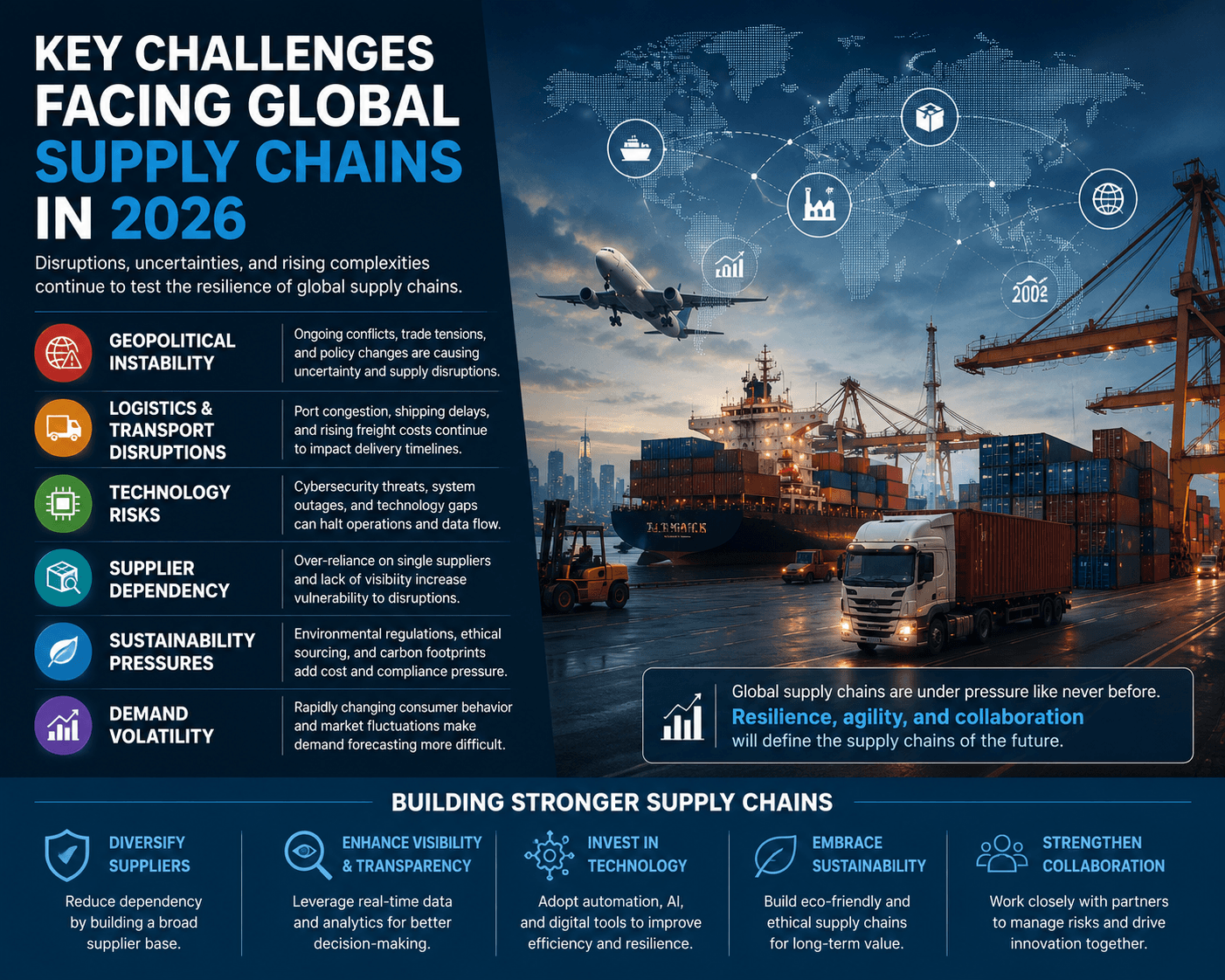
Geopolitical events continue to create uncertainty for businesses operating across international markets. Trade disputes, sanctions, export controls, and changing government policies can significantly disrupt sourcing and distribution strategies.
Major challenges include:
Trade restrictions and tariffs
Export controls on critical technologies
Political instability in key manufacturing regions
International sanctions affecting suppliers
Border delays and customs complications
As a result, many organizations are diversifying suppliers and reducing dependence on a single country to improve supply chain resilience.
Raw Material Shortages
Growing demand for advanced technologies and renewable energy has intensified competition for essential raw materials.
Industries face shortages of:
Semiconductors
Rare earth minerals
Lithium
Cobalt
Nickel
Copper
Aluminum
Limited availability and increasing demand have driven price volatility while extending production timelines for manufacturers worldwide.
Businesses are responding by securing long-term supplier agreements and exploring alternative sourcing options.
Transportation and Logistics Disruptions
Transportation remains one of the most vulnerable areas of global supply chains.
Common logistics challenges include:
Port congestion
Shipping container shortages
Rising freight costs
Fuel price fluctuations
Truck driver shortages
Limited air cargo capacity
Even localized disruptions at major ports can delay shipments across global markets, increasing operational costs and reducing customer satisfaction.
To improve efficiency, many companies are investing in AI-powered logistics platforms and real-time shipment tracking.
Climate Change and Environmental Risks
Climate change is becoming an increasingly important factor in supply chain planning.
Extreme weather events affect manufacturing facilities, transportation networks, and agricultural production through:
Flooding
Hurricanes
Wildfires
Heatwaves
Droughts
Severe storms
These disruptions can halt production, delay deliveries, and increase insurance and operating costs.
Businesses are strengthening climate resilience by diversifying suppliers, improving disaster recovery plans, and investing in sustainable infrastructure.
Cybersecurity Threats
As supply chains become more digital, cybersecurity risks continue to grow.
Organizations now rely heavily on interconnected cloud platforms, warehouse management systems, transportation software, and supplier portals.
Major cybersecurity threats include:
Ransomware attacks
Data breaches
Supply chain malware
Phishing attacks
Unauthorized system access
A successful cyberattack can interrupt manufacturing, delay shipments, compromise sensitive business data, and damage customer trust.
Companies are strengthening cybersecurity through:
Multi-factor authentication
Zero-trust security frameworks
Continuous network monitoring
Employee cybersecurity training
Advanced threat detection systems
Labor Shortages Across the Supply Chain
Many industries continue to experience shortages of skilled workers in logistics, manufacturing, transportation, and warehousing.
Contributing factors include:
Aging workforces
Skills shortages
Increasing automation requirements
Immigration restrictions
Declining interest in physically demanding jobs
Labor shortages increase operating costs while slowing production and delivery schedules.
Businesses are investing in automation, robotics, and workforce training to address these challenges.
Rising Operational Costs
Inflation continues to affect every stage of the supply chain.
Businesses face higher costs for:
Raw materials
Energy
Transportation
Warehousing
Labor
Insurance
Regulatory compliance
These rising expenses reduce profit margins and force organizations to optimize procurement strategies while improving operational efficiency.
Many companies are using predictive analytics and AI-powered planning systems to better control costs.
Overdependence on Limited Suppliers
Many global businesses still depend heavily on a small number of suppliers concentrated in specific regions.
This creates risks such as:
Production shutdowns
Supplier bankruptcy
Political disruptions
Export restrictions
Natural disasters affecting manufacturing hubs
To reduce vulnerability, companies are adopting supplier diversification strategies such as nearshoring, reshoring, and the "China Plus One" approach.
A broader supplier network improves flexibility and reduces the impact of regional disruptions.
Technology Integration Challenges
Digital transformation offers significant advantages, but implementing new technologies remains difficult for many organizations.
Common challenges include:
Legacy software compatibility
High implementation costs
Lack of skilled technology professionals
Data integration problems
Organizational resistance to change
Businesses that modernize successfully gain improved visibility, faster decision-making, and better operational efficiency.
Regulatory Compliance
International supply chains must comply with increasingly complex regulations across multiple countries.
Compliance requirements include:
Environmental regulations
Import and export documentation
Data privacy laws
Product safety standards
Ethical sourcing requirements
Labor regulations
Managing compliance across different jurisdictions increases administrative workloads and operational costs.
Technology platforms that automate compliance reporting are becoming increasingly valuable.
Demand Volatility and Forecasting Challenges
Consumer demand has become more unpredictable due to economic uncertainty, changing buying behavior, and rapidly evolving markets.
Factors contributing to demand volatility include:
Inflation
Economic slowdowns
Seasonal fluctuations
E-commerce growth
Global events
Changing consumer preferences
Accurate forecasting has become essential for inventory optimization and production planning.
Businesses increasingly rely on AI-powered demand forecasting tools to improve inventory management and reduce waste.
Infrastructure Limitations in Emerging Markets
Emerging markets offer significant growth opportunities but often face infrastructure challenges that affect supply chain performance.
Common limitations include:
Poor transportation networks
Limited port capacity
Unreliable electricity supply
Inefficient customs procedures
Underdeveloped logistics infrastructure
These challenges can increase shipping times and operational costs for multinational organizations.
Strategic partnerships with local logistics providers often help businesses navigate these obstacles more effectively.
Strategies for Building Supply Chain Resilience
To prepare for future disruptions, businesses are investing in long-term resilience rather than focusing solely on cost reduction.
Effective strategies include:
Diversifying supplier networks
Investing in AI and predictive analytics
Increasing inventory visibility
Automating warehouse operations
Strengthening cybersecurity
Expanding regional sourcing
Developing contingency plans
Improving collaboration with suppliers
Organizations that proactively manage supply chain risks are better positioned to maintain continuity during unexpected disruptions.
Conclusion
Global supply chains in 2026 operate in an environment defined by uncertainty, rapid technological change, and increasing interconnectedness. Geopolitical tensions, transportation bottlenecks, cybersecurity threats, labor shortages, climate change, and rising operational costs continue to challenge businesses across industries.
Companies that prioritize resilience, digital transformation, automation, and supplier diversification are better equipped to manage disruptions while maintaining efficiency and customer satisfaction. Investments in artificial intelligence, cloud-based supply chain management, predictive analytics, and advanced logistics technologies are helping organizations respond more quickly to changing market conditions.
As global commerce continues to evolve, supply chain resilience is no longer just a competitive advantage—it has become a strategic necessity. Businesses that build agile, secure, and diversified supply chains today will be better prepared to navigate future challenges and achieve sustainable long-term growth.
Frequently Asked Questions (FAQs)
1. What are the biggest global supply chain challenges in 2026?
The biggest challenges include geopolitical instability, raw material shortages, transportation delays, cybersecurity threats, climate change, labor shortages, inflation, regulatory compliance, and unpredictable consumer demand.
2. Why are supply chains more vulnerable today?
Modern supply chains are highly interconnected and depend on global suppliers, digital systems, and international logistics. A disruption in one region can quickly impact production and deliveries worldwide.
3. How is artificial intelligence improving supply chain management?
AI helps businesses forecast demand, optimize inventory, improve logistics planning, automate warehouse operations, identify risks, and make faster, data-driven decisions to improve efficiency.
4. How does climate change affect global supply chains?
Extreme weather events such as floods, hurricanes, droughts, and heatwaves can disrupt manufacturing, damage transportation infrastructure, delay shipments, and increase operational costs.
5. Why is supplier diversification important?
Relying on a single supplier or region increases business risk. Diversifying suppliers helps companies reduce disruptions, improve flexibility, and maintain production during geopolitical or economic uncertainties.
6. What role does cybersecurity play in supply chains?
As supply chains become more digital, cybersecurity protects logistics systems, supplier data, cloud platforms, and warehouse operations from cyberattacks, ransomware, and data breaches.
7. How can businesses build resilient supply chains?
Businesses can improve resilience by adopting automation, investing in AI and predictive analytics, strengthening cybersecurity, diversifying suppliers, improving inventory visibility, and creating contingency plans for unexpected disruptions.
8. What is the future of global supply chains?
The future of supply chains will focus on digital transformation, AI-powered decision-making, automation, sustainable logistics, regional sourcing strategies, and greater resilience to geopolitical, economic, and environmental challenges.