

Introduction
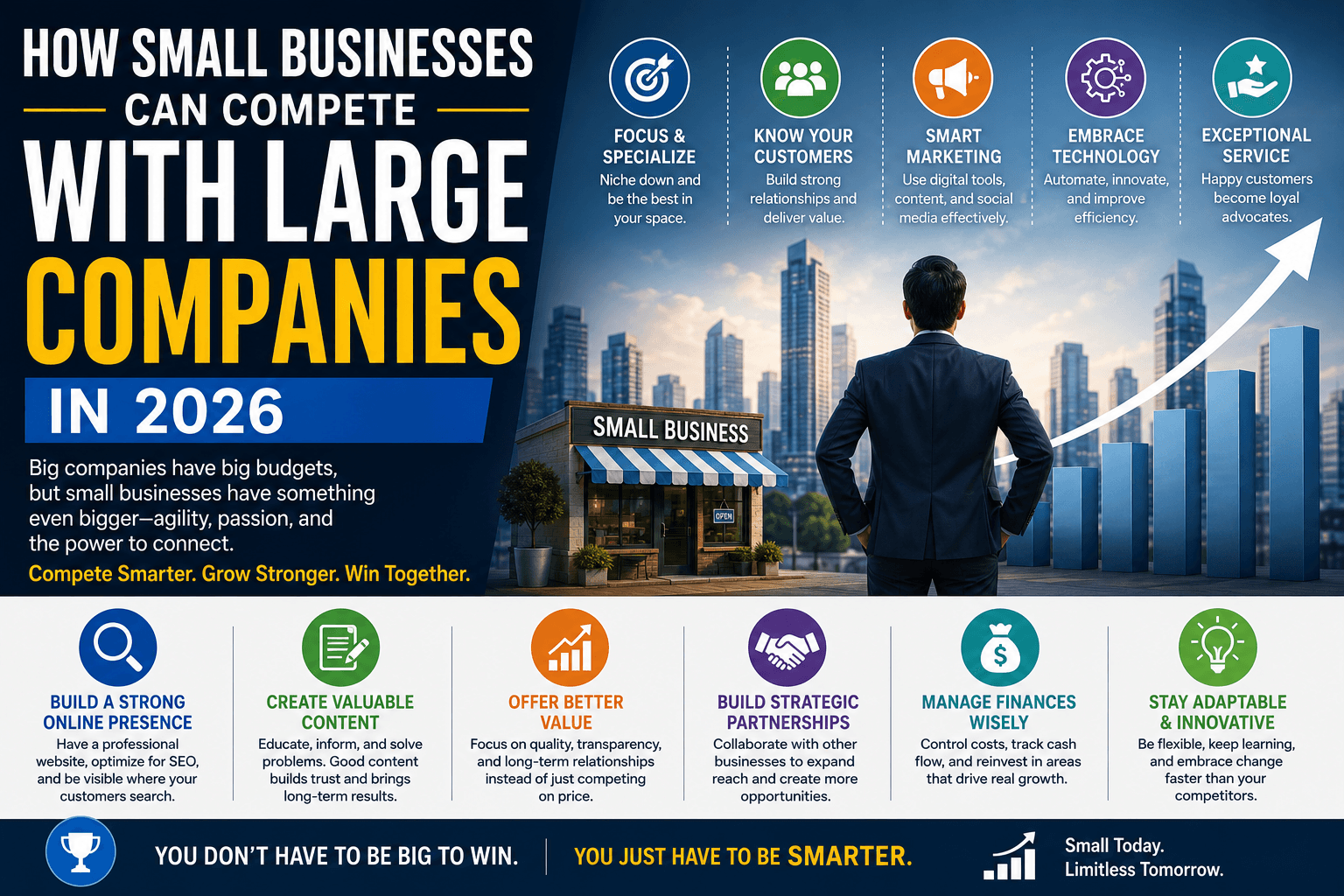
In today's highly competitive marketplace, small businesses are facing greater challenges than ever before. Large corporations often have bigger budgets, extensive marketing teams, established brand recognition, and access to advanced technologies. However, the rapid growth of digital transformation has created new opportunities that allow small businesses to compete more effectively without matching the financial resources of larger competitors.
Success in 2026 is no longer determined by the size of a company. Instead, it depends on innovation, customer relationships, adaptability, and the ability to deliver exceptional value. Small businesses often have the advantage of being more agile, making faster decisions, and providing personalized customer experiences that large organizations struggle to replicate.
This article explores practical strategies that help small businesses remain competitive, strengthen their market position, and achieve sustainable long-term growth.
Identify Your Unique Competitive Advantage
Every successful small business has something that makes it different. Instead of trying to compete directly with large corporations on price alone, entrepreneurs should focus on the unique value they provide.
Your competitive advantage may include:
Personalized customer service
Specialized industry expertise
Faster response times
Innovative products or services
Local market knowledge
Flexible business operations
Clearly communicating this value helps businesses build trust and attract loyal customers who appreciate quality over price.
Build a Professional Online Presence
A business website is often the first interaction customers have with a brand.
A professional online presence should include:
A responsive and mobile-friendly website
Fast loading speeds
Secure HTTPS browsing
Clear business information
Professional branding
Simple website navigation
Contact information and calls to action
An effective website not only improves credibility but also serves as a powerful marketing and lead-generation tool.
Invest in Search Engine Optimization (SEO)
Search Engine Optimization (SEO) remains one of the most cost-effective ways for small businesses to attract new customers.
An effective SEO strategy includes:
Publishing original blog content
Optimizing page titles and meta descriptions
Improving website speed
Using relevant keywords naturally
Building high-quality backlinks
Creating internal links
Optimizing for mobile devices
Unlike paid advertising, SEO continues generating organic traffic long after content is published, making it a valuable long-term investment.
Publish High-Quality Content
Content marketing helps businesses educate potential customers while establishing industry authority.
Useful content includes:
Educational blog posts
Industry news
Business guides
Frequently Asked Questions (FAQs)
Case studies
Customer success stories
Consistently publishing valuable content improves search rankings, builds trust, and encourages visitors to return to your website.
Quality content should focus on solving customer problems rather than simply promoting products.
Deliver Outstanding Customer Service
Customer service is one of the greatest advantages small businesses have over larger competitors.
Unlike corporations, small businesses can build genuine relationships with customers by offering:
Quick responses
Personalized recommendations
Honest communication
Reliable support
Follow-up after purchases
Excellent customer experiences encourage repeat business, positive reviews, and valuable word-of-mouth referrals.
Use Social Media to Build Relationships
Social media offers affordable opportunities to connect with customers and grow brand awareness.
Instead of trying to dominate every platform, focus on the channels where your target audience spends the most time.
Successful social media strategies include:
Sharing educational content
Posting business updates
Responding to customer comments
Encouraging community engagement
Publishing customer success stories
Authentic communication often performs better than overly promotional content.
Use Artificial Intelligence to Improve Productivity
Artificial Intelligence (AI) is no longer limited to large enterprises.
Today, small businesses use AI to:
Automate repetitive administrative tasks
Generate content ideas
Improve customer support
Analyze marketing campaigns
Personalize customer experiences
Forecast sales trends
AI should support employees rather than replace personal interactions, helping businesses improve efficiency while maintaining high-quality service.
Build Long-Term Customer Loyalty
Keeping existing customers is often more profitable than constantly acquiring new ones.
Businesses can strengthen customer loyalty by:
Offering consistent service quality
Creating loyalty programs
Sending personalized communications
Providing educational resources
Rewarding repeat customers
Resolving issues quickly
Satisfied customers often become long-term advocates who recommend businesses to others.
Strengthen Financial Management
Effective financial planning supports sustainable business growth.
Entrepreneurs should regularly review:
Cash flow
Revenue performance
Operating expenses
Profit margins
Marketing return on investment
Inventory management
Maintaining healthy finances enables businesses to invest confidently in future opportunities while remaining prepared for economic uncertainty.
Develop Strategic Partnerships
Strategic partnerships allow small businesses to grow without making significant financial investments.
Collaborating with complementary businesses can help:
Reach new audiences
Share expertise
Launch joint marketing campaigns
Expand service offerings
Improve credibility
Increase referrals
Partnerships create additional value for customers while supporting mutual business growth.
Continue Learning and Adapting
Markets, technologies, and customer expectations continue changing rapidly.
Business owners should invest in continuous learning through:
Industry research
Professional development
Leadership training
Digital marketing education
AI and technology adoption
Business networking
Entrepreneurs who continuously improve their knowledge are better equipped to identify opportunities and overcome challenges.
Prioritize Cybersecurity
Cybersecurity has become essential for businesses of every size.
Small businesses should implement:
Strong password policies
Multi-factor authentication
Regular software updates
Secure cloud storage
Employee cybersecurity training
Routine data backups
Protecting customer information strengthens trust and minimizes operational risks.
Think Beyond Short-Term Success
Long-term business growth requires strategic planning rather than chasing quick profits.
Successful entrepreneurs invest in:
Brand reputation
Employee development
Customer relationships
Innovation
Digital transformation
Operational efficiency
Companies that consistently improve their products, services, and customer experiences build stronger competitive advantages over time.
Frequently Asked Questions
Why can small businesses compete successfully with large companies?
Small businesses can compete by providing personalized customer service, responding quickly to market changes, specializing in niche markets, adopting modern technologies, and building strong relationships with customers.
What is the most effective marketing strategy for small businesses?
A combination of Search Engine Optimization (SEO), content marketing, social media marketing, email marketing, and local SEO provides long-term, cost-effective growth while increasing brand visibility and customer engagement.
How does SEO help small businesses grow?
SEO improves a website's visibility in search engine results, attracts qualified organic traffic, increases brand authority, generates leads, and reduces reliance on paid advertising.
How can artificial intelligence benefit small businesses?
Artificial intelligence helps automate repetitive tasks, improve customer support, analyze business data, personalize marketing campaigns, optimize workflows, and increase productivity without significantly increasing operational costs.
Why is customer service important for small businesses?
Outstanding customer service builds trust, encourages repeat business, generates positive reviews, and creates long-term customer loyalty, helping small businesses compete against larger competitors.
How can small businesses improve customer loyalty?
Businesses can improve loyalty by delivering consistent quality, providing personalized experiences, rewarding repeat customers, maintaining honest communication, and responding quickly to customer concerns.
What role does cybersecurity play in business success?
Cybersecurity protects customer information, prevents data breaches, reduces financial risks, and strengthens customer confidence, making it an essential part of modern business operations.
What are the biggest opportunities for small businesses in 2026?
Key opportunities include adopting artificial intelligence, investing in SEO, creating valuable content, embracing digital transformation, strengthening customer relationships, and using data-driven decision-making to identify growth opportunities.
Conclusion
Small businesses possess unique strengths that many large corporations cannot easily replicate. Agility, innovation, personalized customer service, and close customer relationships provide meaningful competitive advantages in today's rapidly changing marketplace.
By investing in digital marketing, search engine optimization, artificial intelligence, quality content, cybersecurity, financial management, and customer experience, small businesses can successfully compete with larger organizations while building sustainable long-term growth.
The future belongs to businesses that remain adaptable, customer-focused, and committed to continuous improvement. With the right strategy, small businesses can not only compete with larger companies but also become trusted leaders within their industries.