
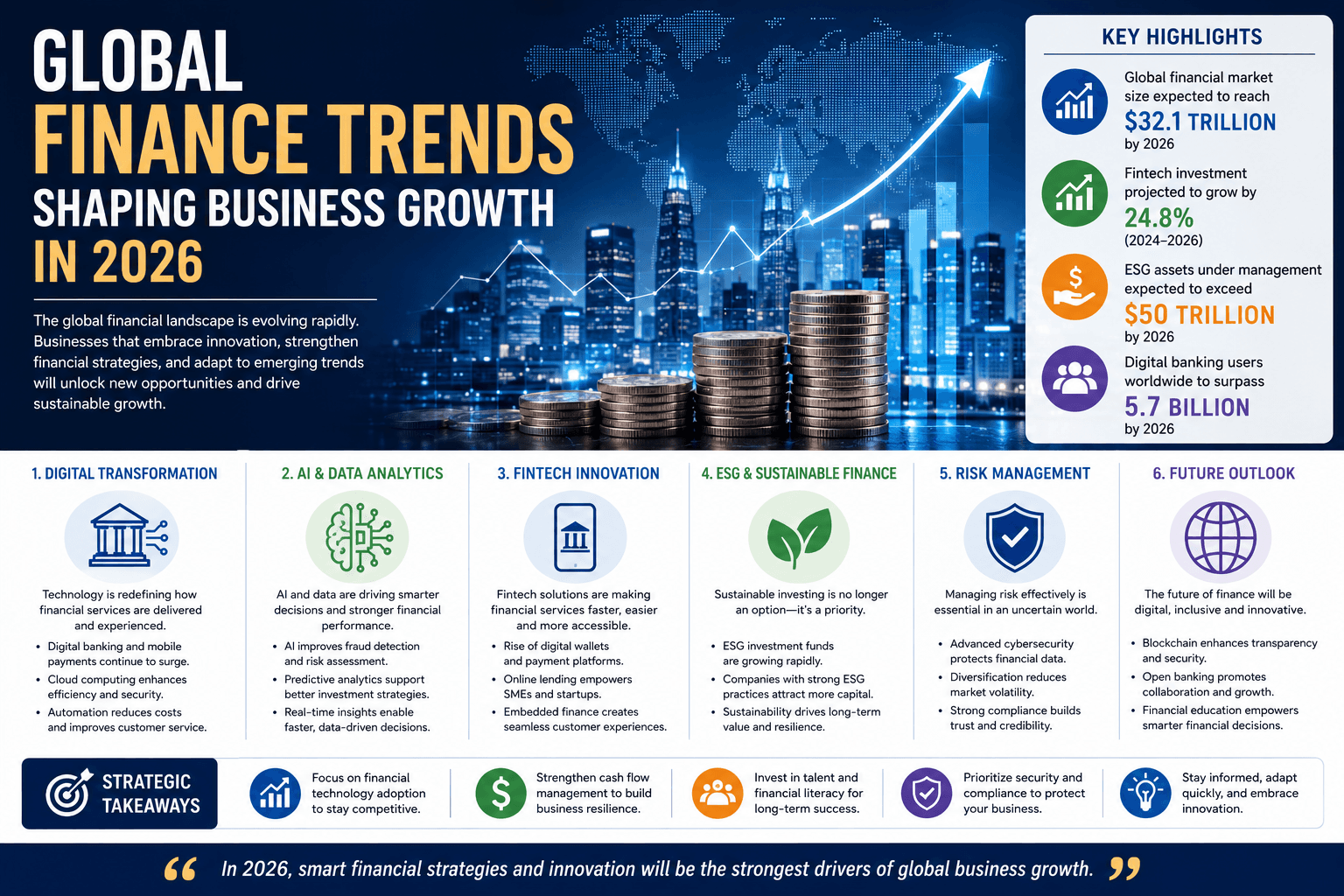

The global financial landscape is evolving rapidly as businesses adapt to changing economic conditions, technological innovation, and shifting consumer expectations. In 2026, finance has become more than simply managing money—it has become a strategic tool that enables organizations to drive growth, improve operational efficiency, and remain competitive in an increasingly digital economy. From artificial intelligence and digital banking to sustainable investing and financial technology, the finance sector is undergoing one of the most significant transformations in its history.
Economic uncertainty, inflation, interest rate changes, and geopolitical developments continue to influence financial markets worldwide. Businesses are responding by strengthening financial planning, improving cash flow management, diversifying investments, and adopting advanced financial technologies. Companies that successfully adapt to these changes are better positioned to achieve sustainable growth while minimizing financial risks.
Digital transformation is one of the biggest drivers of change within the finance industry. Financial institutions are investing heavily in cloud computing, artificial intelligence, blockchain technology, and automation to improve operational efficiency and customer experience. These technologies enable faster transactions, better fraud detection, real-time financial reporting, and more accurate business forecasting.
Artificial intelligence has become an essential part of modern financial services. Banks and investment firms use AI to analyze market trends, identify fraudulent transactions, assess credit risks, and automate customer support. Machine learning algorithms process millions of financial transactions every second, helping institutions make faster and more informed decisions while improving security.
Financial technology companies continue reshaping traditional banking services. Mobile banking applications, digital payment systems, online lending platforms, and electronic wallets have transformed how consumers and businesses manage money. Cashless transactions are becoming increasingly common, offering greater convenience while reducing transaction processing times.
Small and medium-sized businesses are benefiting from modern financial management software that automates accounting, invoicing, payroll, tax reporting, and budgeting. Cloud-based financial platforms provide real-time access to business performance, allowing entrepreneurs to make data-driven decisions and improve financial planning.
Investment strategies are also evolving as investors seek diversified portfolios and long-term value creation. In addition to traditional stocks and bonds, many institutional investors are exploring infrastructure projects, renewable energy, technology companies, healthcare innovation, and sustainable investment opportunities. Diversification remains an important strategy for managing market volatility while supporting long-term financial objectives.
Environmental, Social, and Governance (ESG) investing has gained significant momentum in recent years. Investors increasingly evaluate companies based on sustainability initiatives, corporate governance, environmental responsibility, and social impact alongside financial performance. Businesses demonstrating strong ESG practices often attract greater investor confidence and improved access to capital.
Cybersecurity has become one of the highest priorities within the financial sector. As digital transactions continue increasing, financial institutions invest heavily in advanced security technologies to protect customer information and prevent cybercrime. Multi-factor authentication, biometric verification, encryption, and AI-powered fraud detection systems strengthen digital financial security while maintaining customer trust.
Global financial markets remain interconnected, meaning economic developments in one region can quickly influence businesses worldwide. Interest rate decisions, inflation data, trade policies, and geopolitical events often impact investment strategies, exchange rates, and corporate financial planning. Businesses therefore monitor both domestic and international economic indicators when developing long-term growth strategies.
Blockchain technology is expanding beyond cryptocurrency into mainstream financial applications. Financial institutions are exploring blockchain for secure transactions, trade finance, cross-border payments, digital identity verification, and smart contracts. These innovations improve transparency, reduce administrative costs, and streamline financial operations across multiple industries.
Financial education is becoming increasingly important for entrepreneurs and business leaders. Understanding financial statements, investment strategies, budgeting, taxation, and risk management enables organizations to make informed decisions that support sustainable growth. Companies investing in financial literacy often improve profitability while reducing operational risks.
Automation continues transforming corporate finance departments. Routine tasks such as invoice processing, expense management, reconciliation, and compliance reporting are increasingly handled by intelligent software, allowing finance professionals to focus on strategic planning, business analysis, and long-term decision-making.
Looking ahead, experts expect continued investment in digital finance, artificial intelligence, sustainable investing, and financial innovation. Organizations that embrace technological advancement while maintaining sound financial management practices will likely remain competitive in an evolving global marketplace.
The future of finance will depend on balancing innovation with responsible governance, cybersecurity, regulatory compliance, and customer trust. Businesses capable of adapting to changing market conditions while maintaining financial resilience will be better positioned to capitalize on new opportunities and navigate economic uncertainty.
Conclusion
Finance is rapidly evolving through technological innovation, digital transformation, and changing investment priorities. Businesses that embrace financial technology, strengthen risk management, and invest in long-term strategic planning will be better equipped to succeed in the modern economy. As global markets continue evolving, financial resilience, innovation, and informed decision-making will remain essential drivers of sustainable business growth.