
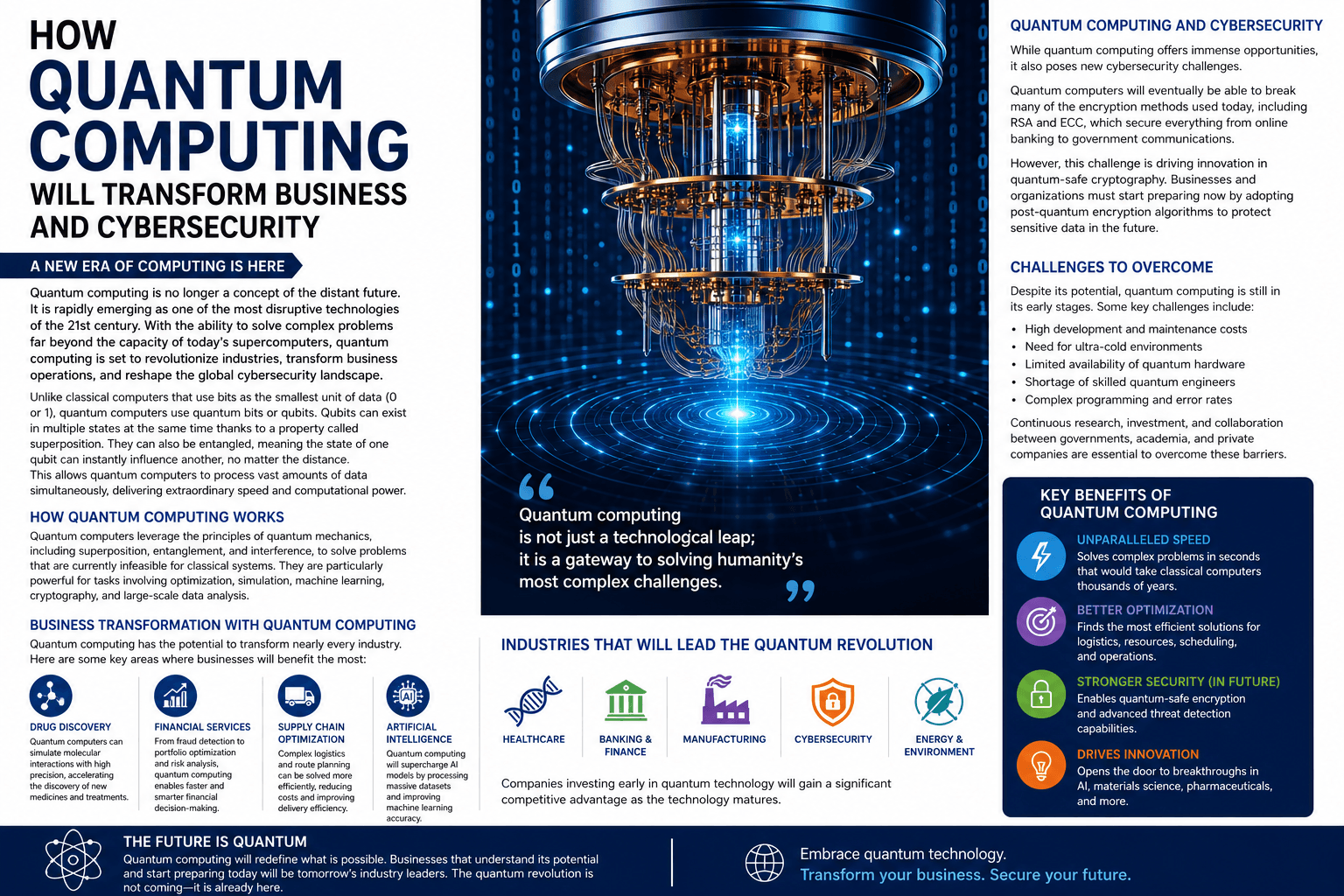

Quantum computing is emerging as one of the most revolutionary technologies of the 21st century. Although still in its early stages of commercial adoption, it has the potential to solve problems that would take today's most powerful supercomputers thousands or even millions of years to complete. As governments, technology companies, and research institutions continue investing billions of dollars in quantum research, businesses are preparing for a future where quantum computing could reshape industries, accelerate scientific discoveries, and redefine cybersecurity.
Unlike classical computers that process information using bits represented as either 0 or 1, quantum computers use quantum bits, or qubits. Through the principles of superposition and entanglement, qubits can exist in multiple states simultaneously, enabling quantum systems to process enormous amounts of information at unprecedented speeds. This unique capability makes quantum computing particularly valuable for solving highly complex mathematical, scientific, and optimization problems.
One of the industries expected to benefit most is financial services. Banks and investment firms process massive amounts of market data every second, requiring advanced analytics and forecasting models. Quantum computing could dramatically improve portfolio optimization, risk analysis, fraud detection, and high-frequency trading strategies. Financial institutions may also use quantum algorithms to simulate economic scenarios more accurately, allowing better investment decisions and improved market forecasting.
Healthcare is another sector poised for transformation. Drug discovery traditionally requires years of research and billions of dollars in investment. Quantum computers can simulate molecular interactions with remarkable precision, helping scientists identify promising compounds much faster than traditional computing methods. Researchers believe this technology could accelerate the development of treatments for cancer, Alzheimer's disease, rare genetic disorders, and future infectious diseases.
Artificial intelligence and machine learning may also experience significant advancements through quantum computing. Modern AI systems require extensive computational resources to train complex models. Quantum processors could reduce training times while improving optimization techniques, enabling businesses to develop smarter AI applications for healthcare, finance, manufacturing, customer service, and scientific research. The combination of quantum computing and artificial intelligence is expected to unlock new possibilities that are currently beyond the capabilities of classical computers.
Manufacturing companies are increasingly exploring quantum computing to optimize supply chains and production systems. Global supply networks involve countless variables including transportation costs, inventory management, supplier reliability, weather conditions, and consumer demand. Quantum algorithms could analyze these complex variables simultaneously, identifying the most efficient logistics strategies while reducing operational costs and improving delivery performance.
Energy companies are also investing in quantum research to improve efficiency and sustainability. Quantum simulations may help researchers design better battery technologies, discover advanced materials for renewable energy, optimize electrical grids, and improve climate modeling. These innovations could accelerate the global transition toward cleaner energy sources while supporting long-term environmental sustainability.
One of the most widely discussed aspects of quantum computing is its potential impact on cybersecurity. Today's digital security largely depends on encryption algorithms that are considered extremely difficult for classical computers to break. However, sufficiently advanced quantum computers could eventually solve certain mathematical problems much faster than traditional systems, potentially affecting some widely used encryption methods.
This possibility has prompted governments, cybersecurity companies, and technology organizations to develop post-quantum cryptography. These next-generation encryption standards are designed to remain secure even against future quantum attacks. Many organizations are already evaluating their cybersecurity infrastructure to prepare for the transition toward quantum-resistant security technologies.
Despite these concerns, quantum computing is expected to strengthen cybersecurity in many ways. Quantum communication technologies, including quantum key distribution, offer new methods for secure data transmission by using the principles of quantum mechanics. These systems can detect unauthorized attempts to intercept communications, providing enhanced protection for sensitive information exchanged between governments, financial institutions, healthcare organizations, and businesses.
Cloud computing providers are beginning to offer access to quantum computing platforms through cloud services, allowing businesses and researchers to experiment without investing in expensive quantum hardware. This approach enables organizations to develop algorithms, conduct research, and prepare future applications while quantum technology continues to mature.
Technology companies worldwide continue investing heavily in quantum research. Their efforts focus on improving qubit stability, reducing computational errors, increasing scalability, and developing practical commercial applications. Although significant technical challenges remain, steady progress suggests quantum computing will become increasingly valuable across multiple industries over the next decade.
Small and medium-sized businesses may also benefit from quantum innovation through cloud-based services. Rather than purchasing specialized quantum computers, companies will likely access quantum resources remotely, similar to today's cloud computing infrastructure. This model could democratize access to advanced computational capabilities, enabling organizations of all sizes to solve complex optimization problems and accelerate innovation.
Education and workforce development will play an important role in supporting the growth of quantum technologies. Universities around the world are expanding programs in quantum information science, engineering, computer science, mathematics, and physics to prepare future professionals for careers in this rapidly growing field. Businesses are also investing in employee training to build internal expertise and remain competitive in an evolving technology landscape.
Despite its enormous promise, quantum computing still faces several challenges. Building stable quantum systems requires extremely low temperatures and highly specialized equipment. Error correction, hardware scalability, manufacturing costs, and limited availability of skilled professionals remain significant obstacles that researchers continue working to overcome. However, ongoing investment and collaboration between governments, universities, and private companies are accelerating progress toward practical commercial applications.
The global market for quantum computing is expected to expand significantly over the coming years as technology matures and businesses identify new commercial opportunities. Industries including aerospace, automotive, pharmaceuticals, telecommunications, logistics, cybersecurity, finance, and artificial intelligence are expected to become early adopters of quantum-powered solutions.
Businesses that begin preparing today will be better positioned to capitalize on future quantum innovations. Organizations should monitor technological developments, evaluate cybersecurity readiness, invest in workforce education, and explore partnerships with technology providers specializing in quantum research.
Quantum computing represents more than simply faster computers—it introduces an entirely new approach to solving problems previously considered impossible. From accelerating scientific discoveries and improving business decision-making to transforming cybersecurity and artificial intelligence, quantum technology has the potential to reshape the global digital economy.
As research continues advancing and commercial adoption expands, quantum computing is expected to become one of the defining technologies of the next generation. Businesses that embrace innovation and prepare for this transformation will likely gain significant competitive advantages in an increasingly technology-driven world.
Conclusion
Quantum computing is moving steadily from research laboratories toward real-world business applications. Although widespread adoption may still take time, its potential to revolutionize industries, strengthen scientific research, optimize business operations, and reshape cybersecurity is becoming increasingly clear. Companies that invest in understanding quantum technology today will be better prepared for tomorrow's digital economy. As innovation continues, quantum computing is set to become a cornerstone of technological advancement and global business transformation.