
TCThe Cost of Cross-Border Trade: Navigating Supply Chain Disruptions in Regional Tech Sectors
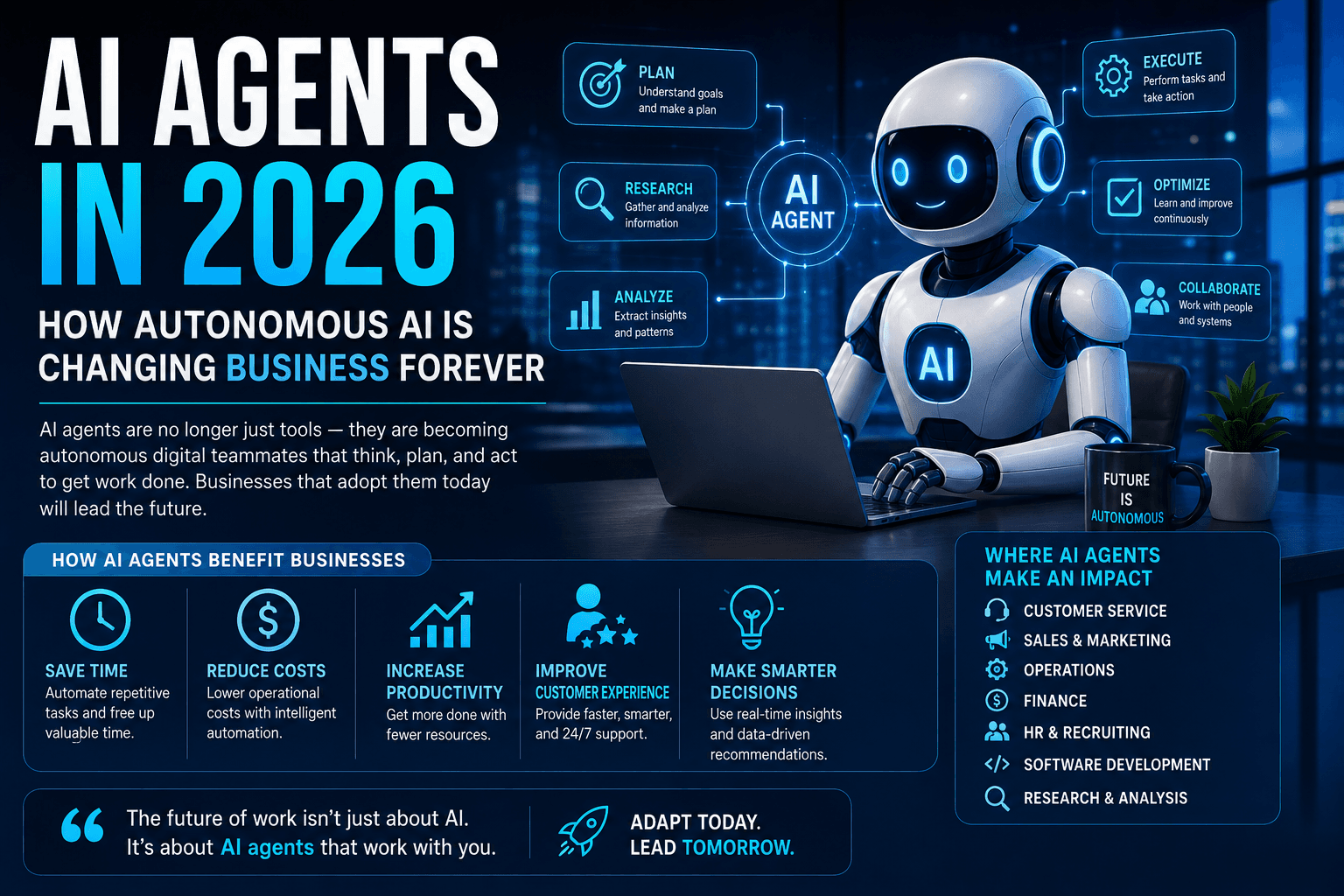
Artificial intelligence is moving into a new phase in 2026. Businesses are no longer using AI only to answer questions, generate content, or analyze information. A new generation of AI agents is capable of planning tasks, using digital tools, making decisions within defined boundaries, and completing multi-step workflows.
This shift toward autonomous AI is changing how companies think about productivity, customer service, software development, sales, and business operations.
For organizations of all sizes, the question is no longer simply whether AI can be useful. The bigger question is how businesses can safely integrate AI agents into everyday workflows while keeping humans in control.
What Are AI Agents?
AI agents are software systems designed to perform tasks and pursue specific goals with a degree of autonomy.
A traditional chatbot may answer a question such as, “What is our return policy?” An AI agent could potentially go further: understand a customer's problem, retrieve the relevant order information, check company policies, recommend an appropriate action, and prepare or initiate the next step according to its permissions.
The exact capabilities vary significantly between systems, but the general idea is that AI agents can handle sequences of actions rather than producing a single response.
Why AI Agents Are Growing in 2026
Several developments are making AI agents more practical for businesses.
Modern AI models can understand text, images, documents, and other forms of information. Businesses also have better access to APIs, cloud platforms, automation tools, and enterprise software integrations.
Together, these technologies allow AI systems to interact with business applications instead of operating in isolation.
Companies are therefore exploring agents for repetitive and structured workflows where speed and automation can create measurable value.
1. AI Agents Are Automating Business Workflows
One of the biggest opportunities is workflow automation.
Businesses often have processes involving multiple steps, such as collecting information, updating databases, sending notifications, preparing reports, or routing requests.
An AI agent can potentially coordinate several of these steps.
For example, a sales workflow could involve identifying a new lead, researching publicly available information, preparing a summary, updating a CRM, and creating a follow-up task.
Automating parts of these processes can reduce administrative work and allow employees to focus on higher-value activities.
2. Customer Service Is Becoming More Intelligent
Customer support is another major area for AI agents.
Basic chatbots can answer frequently asked questions, but agent-based systems can potentially manage more complex workflows by accessing approved business information and tools.
An AI agent might help customers track orders, troubleshoot common problems, find relevant information, or route complicated cases to human representatives.
The goal is not necessarily to eliminate human customer service. Instead, AI can handle routine interactions while human employees focus on sensitive, unusual, or high-value cases.
3. AI Agents Are Transforming Sales
Sales teams spend considerable time researching prospects, organizing information, updating CRM systems, and following up with potential customers.
AI agents can assist with many of these activities.
They may help summarize customer information, identify relevant opportunities, prepare personalized drafts, and organize follow-up tasks.
However, businesses should avoid relying entirely on automated outreach. Human judgment remains important when dealing with relationships, reputation, and complex customer needs.
4. AI Agents Can Support Employees
AI agents are also becoming useful as internal assistants.
Employees can use AI systems to find information, summarize documents, prepare reports, organize tasks, and support research.
For example, an employee could ask an internal AI system to locate relevant company policies and summarize the information needed for a particular situation.
This can reduce the time employees spend searching through large collections of documents.
5. Software Development Is Changing
AI agents are increasingly being explored for software development tasks.
Depending on the system and permissions, an AI coding agent may help understand a codebase, generate code, write tests, identify potential problems, or assist with debugging.
Developers still need to review AI-generated code carefully, particularly for security, reliability, and maintainability.
The likely impact is not simply fewer developers. Instead, developers may spend less time on repetitive coding tasks and more time on architecture, product decisions, testing, and complex problem-solving.
6. Small Businesses Can Benefit From AI Agents
AI agents are not limited to large corporations.
Small businesses can use AI-powered tools for tasks such as appointment management, customer support, lead organization, research, content workflows, and administrative work.
For a small team, even a few hours of saved work each week can make a meaningful difference.
The best starting point is usually a clearly defined workflow rather than attempting to automate the entire business at once.
7. AI Agents Are Creating New Business Opportunities
The growth of agentic AI is also creating new opportunities for entrepreneurs.
Businesses may need professionals who can design AI workflows, connect agents to existing software, monitor performance, create internal AI policies, and train employees.
This is creating demand for skills that combine AI knowledge with business process understanding.
Entrepreneurs can also build specialized AI solutions for particular industries and business problems.
8. Human Oversight Remains Essential
Greater autonomy does not mean businesses should give AI unlimited control.
AI systems can make mistakes, misunderstand instructions, use incorrect information, or produce unexpected results.
For important decisions, businesses should establish appropriate human oversight.
A useful approach is to classify tasks based on risk. Low-risk activities may be heavily automated, while financial, legal, security, employment, or customer-impacting decisions may require stronger review and approval.
9. AI Governance Is Becoming More Important
As AI agents gain access to business systems, governance becomes critical.
Companies need to determine:
What information can an AI agent access?
Which actions can it perform?
When is human approval required?
How are actions recorded?
How are errors handled?
How is sensitive information protected?
Clear policies can help businesses use AI more responsibly and reduce operational risks.
10. The Future Will Be Human + AI
The most realistic future of work is not necessarily humans versus AI.
Instead, businesses are likely to develop teams where people and AI systems work together.
AI agents can handle repetitive processes, information gathering, and routine workflows. Humans can provide creativity, leadership, empathy, judgment, and strategic thinking.
This combination could allow businesses to operate more efficiently while giving employees more time for meaningful work.
How Businesses Can Prepare for AI Agents
Businesses interested in adopting AI agents should start with a practical strategy.
Identify Repetitive Work
Look for workflows that consume significant employee time and follow predictable steps.
Start Small
Choose one well-defined process and measure the results before expanding the system.
Protect Sensitive Information
Set strict access controls and make sure AI systems only receive information they genuinely need.
Keep Humans in the Loop
Use human approval for high-impact decisions and actions.
Measure Results
Track productivity, costs, error rates, customer satisfaction, and other relevant metrics.
Train Employees
Employees should understand both the capabilities and limitations of AI agents.
What Does the Future of AI Agents Look Like?
AI agents are likely to become increasingly integrated into business software and digital workflows.
Instead of opening separate AI applications, employees may interact with intelligent agents directly inside CRM systems, productivity platforms, development environments, customer-service software, and other business tools.
The biggest opportunity may come from specialized agents designed around specific business processes rather than generic systems trying to do everything.
Companies that successfully combine AI automation with strong governance and human oversight could gain significant operational advantages.
Conclusion
AI agents are becoming one of the most important developments in business technology in 2026. They can potentially automate multi-step workflows, support employees, improve customer service, assist sales teams, and accelerate software development.
But successful adoption requires more than simply buying an AI tool. Businesses need clear goals, secure integrations, appropriate permissions, employee training, and strong human oversight.
The future of business is likely to be increasingly collaborative, with humans providing judgment and strategy while AI agents handle more routine digital work.
Organizations that learn how to use these systems responsibly today may be better prepared for the next stage of the AI-powered workplace.
Frequently Asked Questions
1. What are AI agents?
AI agents are software systems designed to pursue goals and perform multi-step tasks with some degree of autonomy.
2. How are AI agents different from chatbots?
Traditional chatbots often focus on answering questions, while AI agents can potentially plan and execute multiple actions using connected tools and systems.
3. Can small businesses use AI agents?
Yes. Small businesses can use AI agents for customer support, administration, lead management, research, scheduling, and other repetitive workflows.
4. Will AI agents replace employees?
AI agents may automate some tasks, but many roles still require human judgment, creativity, communication, leadership, and accountability.
5. Are AI agents safe for businesses?
They can be useful when properly designed and governed. Businesses should use access controls, monitoring, testing, and human oversight to reduce risks.
6. How can AI agents improve customer service?
They can help handle routine questions, retrieve information, support order-related tasks, and route complex issues to human representatives.
7. Can AI agents help with sales?
Yes. They can assist with research, lead organization, CRM updates, summaries, and follow-up workflows.
8. What skills are useful for working with AI agents?
Useful skills include AI literacy, workflow automation, data analysis, prompt design, software integration, cybersecurity awareness, and business process management.
9. How should a business start using AI agents?
Start with a clearly defined, low-risk workflow where automation can produce measurable benefits.
10. Why is AI governance important?
AI governance helps organizations control access, protect sensitive information, monitor AI actions, manage risks, and establish appropriate human oversight.