

Introduction
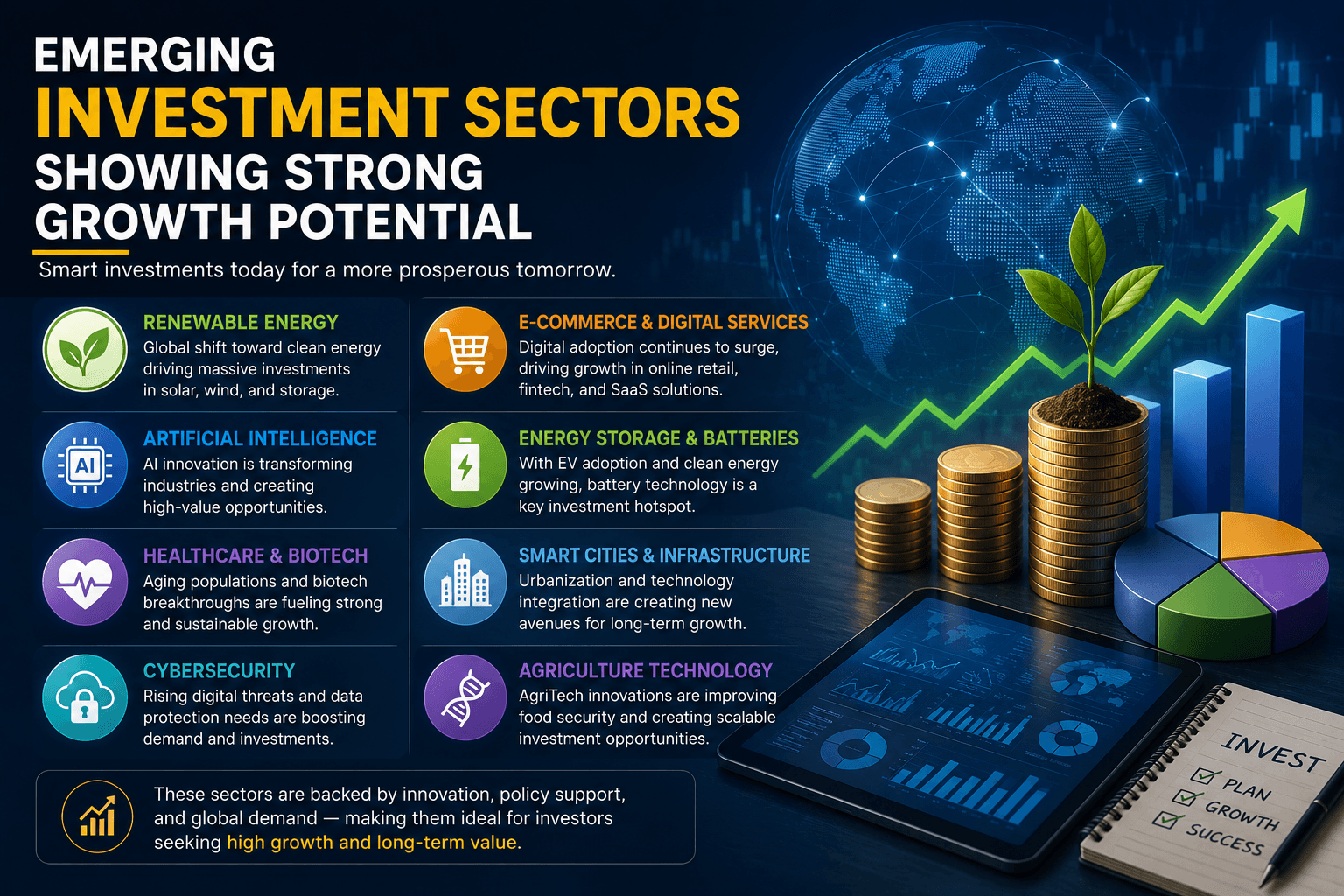
Global investment markets are experiencing one of the most significant transformations in modern economic history. Technological innovation, climate initiatives, demographic changes, and digital transformation are reshaping industries at an unprecedented pace, creating entirely new opportunities for investors. In 2026, traditional investment strategies focused solely on mature industries are gradually giving way to innovation-driven sectors that promise sustainable growth, scalability, and resilience against economic uncertainty.
Today's investors are looking beyond short-term market fluctuations and identifying industries positioned to benefit from long-term structural changes. Artificial intelligence, renewable energy, biotechnology, cybersecurity, cloud computing, advanced manufacturing, and digital finance are no longer considered emerging concepts—they are becoming the foundation of tomorrow's global economy.
Governments worldwide are increasing investments in clean energy, digital infrastructure, semiconductor manufacturing, and healthcare innovation, while private companies continue accelerating technological breakthroughs. At the same time, consumers are demanding smarter digital services, sustainable products, and personalized experiences, further driving growth across these sectors.
Understanding these emerging investment opportunities is essential for businesses, entrepreneurs, and investors seeking to build resilient portfolios and capitalize on the industries shaping the future. This article explores the fastest-growing investment sectors in 2026, why they matter, and how they are transforming the global economy.
Why Emerging Investment Sectors Matter
Emerging sectors are not simply new industries; they represent long-term economic shifts driven by innovation, changing consumer behavior, and evolving government policies. Businesses and investors who recognize these structural changes early are often better positioned to benefit from long-term growth and market leadership.
Unlike traditional sectors that may experience slower growth, emerging industries are fueled by continuous technological advancement and increasing global demand. Governments are providing incentives for renewable energy projects, AI research, semiconductor manufacturing, and digital infrastructure, while venture capital and institutional investors continue directing billions of dollars toward high-growth companies.
Diversifying investments across multiple emerging sectors can also reduce risk by balancing exposure to different industries. As economies become increasingly digital and interconnected, companies operating in innovative sectors are expected to play a larger role in global economic development.
For long-term investors, focusing on industries with strong fundamentals, scalable business models, and continuous innovation provides opportunities to participate in the next generation of economic growth.
1. Artificial Intelligence and Intelligent Automation
Artificial intelligence has become the most influential investment sector of 2026, transforming nearly every industry through automation, predictive analytics, and intelligent decision-making. AI is no longer limited to research laboratories or technology companies—it is now integrated into healthcare, finance, manufacturing, retail, logistics, education, and professional services.
Businesses are investing heavily in generative AI, autonomous AI agents, machine learning platforms, and enterprise AI solutions to improve productivity and reduce operational costs. AI-powered systems can automate repetitive tasks, analyze large datasets, generate content, optimize supply chains, and enhance customer experiences.
Another major growth area is AI infrastructure. The rapid expansion of AI applications has increased demand for high-performance semiconductors, graphics processing units (GPUs), cloud computing resources, and large-scale data centers. Companies that provide the technology supporting AI ecosystems continue to attract significant investment as organizations accelerate digital transformation initiatives.
Artificial intelligence is also enabling entirely new business models by allowing companies to deliver more personalized services, improve operational efficiency, and make data-driven decisions in real time. As AI capabilities continue to evolve, the technology is expected to become as essential to business operations as the internet and electricity, making it one of the strongest long-term investment opportunities.
2. Renewable Energy and Climate Technology
The global transition toward cleaner energy sources is creating one of the largest investment opportunities of the decade. Governments, corporations, and financial institutions are investing billions of dollars in renewable energy projects to reduce carbon emissions, improve energy security, and achieve sustainability goals.
Solar power, wind energy, battery storage systems, green hydrogen, and smart grid technologies are driving this transformation. Advances in energy storage are making renewable energy more reliable, while innovations in carbon capture and energy efficiency are helping industries reduce their environmental impact.
Electric vehicles and charging infrastructure are also contributing to the rapid expansion of the clean energy ecosystem. As transportation becomes increasingly electrified, demand for battery technology, renewable electricity generation, and sustainable supply chains continues to rise.
Climate technology extends beyond energy production. Businesses are investing in sustainable agriculture, waste management, water conservation, and circular economy solutions to meet environmental regulations and changing consumer expectations.
With governments introducing supportive policies and incentives for clean technology projects, renewable energy remains one of the most resilient and attractive sectors for long-term investment.
3. Biotechnology and Healthcare Innovation
Healthcare innovation is advancing rapidly as biotechnology combines artificial intelligence, genetics, robotics, and precision medicine to improve patient outcomes. Aging populations, rising healthcare demand, and continuous scientific breakthroughs are driving sustained investment across the biotechnology sector.
One of the most promising areas is precision medicine, where treatments are tailored to an individual's genetic profile. This approach improves treatment effectiveness while reducing side effects, transforming how diseases are diagnosed and managed.
Artificial intelligence is also accelerating drug discovery by analyzing massive datasets to identify potential treatments more quickly than traditional research methods. AI-powered diagnostics, medical imaging, and predictive healthcare systems are enabling earlier disease detection and more personalized care.
Gene-editing technologies, regenerative medicine, immunotherapy, and advanced medical devices are opening new possibilities for treating previously difficult or incurable conditions. At the same time, digital health platforms and telemedicine services continue expanding access to healthcare worldwide.
As healthcare systems increasingly adopt technology-driven solutions, biotechnology is expected to remain one of the fastest-growing investment sectors over the coming decade, offering significant opportunities for innovation and long-term value creation.
1. What are the fastest-growing investment sectors in 2026?
Some of the fastest-growing investment sectors in 2026 include artificial intelligence (AI), renewable energy, biotechnology, cybersecurity, semiconductor manufacturing, cloud computing, financial technology (FinTech), robotics, electric vehicles, and advanced digital infrastructure. These industries are benefiting from technological innovation, increasing global demand, and supportive government policies.
2. Why is artificial intelligence considered a top investment opportunity?
Artificial intelligence is transforming nearly every industry by improving productivity, automating business processes, enhancing customer experiences, and enabling data-driven decision-making. Continued investments in AI infrastructure, enterprise software, and intelligent automation make it one of the strongest long-term growth sectors.
3. Is renewable energy still a good long-term investment?
Yes. Renewable energy remains one of the most attractive long-term investment sectors due to the global transition toward cleaner energy sources, government incentives, advancements in battery technology, and increasing demand for sustainable infrastructure. Solar power, wind energy, green hydrogen, and energy storage continue to experience significant growth.
4. Why are semiconductor companies attracting more investment?
Semiconductors are essential for powering artificial intelligence, cloud computing, electric vehicles, smartphones, data centers, and advanced manufacturing systems. As demand for high-performance computing continues to grow, semiconductor companies play a critical role in supporting the global digital economy.
5. How does cybersecurity create investment opportunities?
The rise of cloud computing, remote work, and digital services has increased the need for advanced cybersecurity solutions. Businesses are investing heavily in AI-powered threat detection, zero-trust security, identity management, and cloud security platforms to protect sensitive information and comply with evolving regulations.
6. Which emerging sectors offer the strongest long-term growth potential?
Artificial intelligence, cloud computing, biotechnology, renewable energy, cybersecurity, robotics, digital finance, and advanced manufacturing are expected to remain among the strongest long-term investment sectors due to continuous innovation and expanding global demand.
7. What should investors consider before investing in emerging sectors?
Investors should evaluate long-term market trends, company fundamentals, industry competition, government regulations, technological innovation, financial performance, and potential risks. Diversifying investments across multiple emerging sectors can also help reduce overall portfolio risk.
8. How can businesses benefit from investing in emerging technologies?
Businesses that invest in emerging technologies can improve operational efficiency, reduce costs, strengthen cybersecurity, accelerate innovation, enhance customer experiences, and gain a competitive advantage. Early adoption of technologies such as AI, cloud computing, and automation can position organizations for sustainable growth in the evolving global economy.