
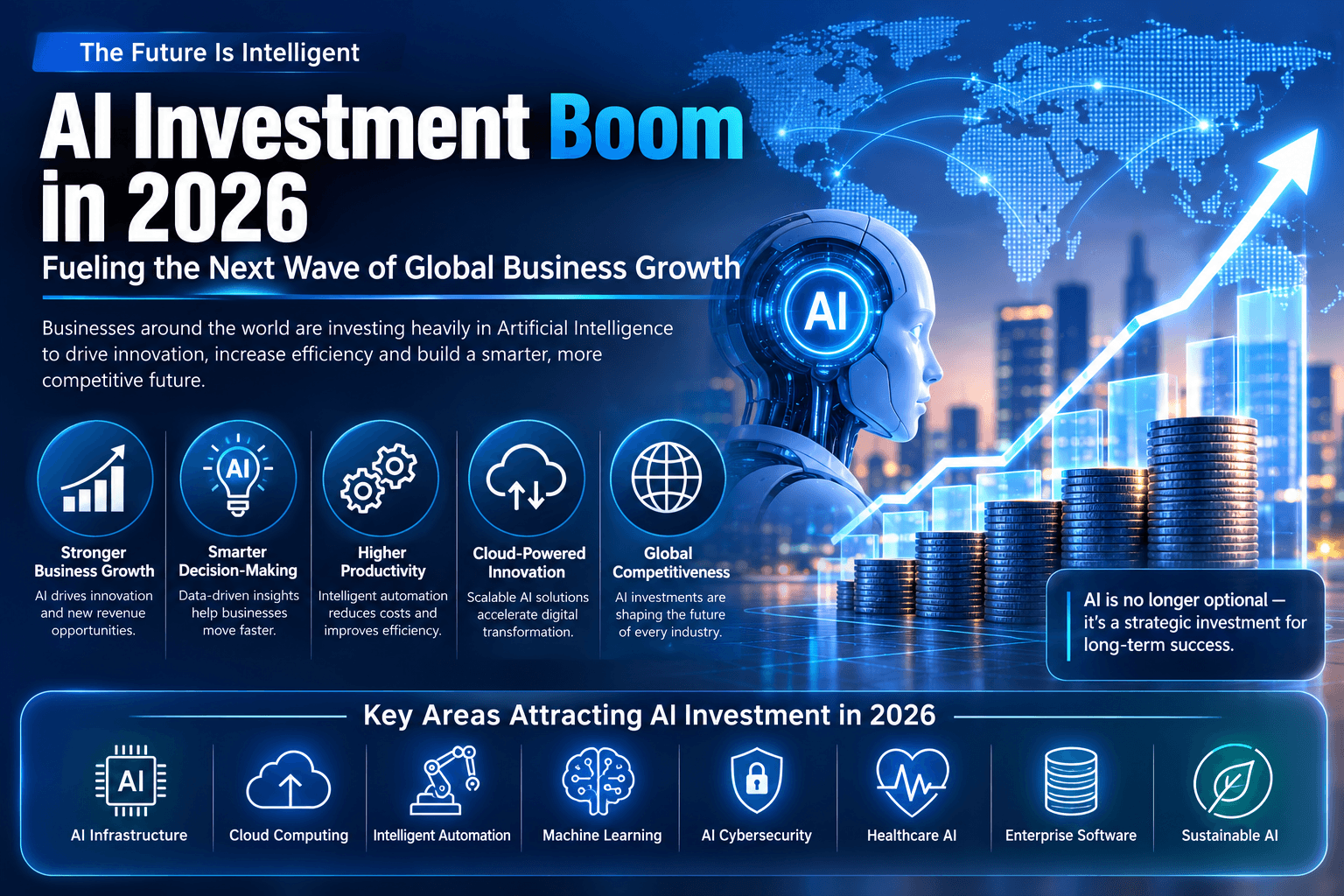

Artificial intelligence has become the most influential technology investment of the decade. In 2026, organizations across the world are allocating record-breaking budgets to AI technologies as they compete to improve productivity, reduce operational costs, and unlock new business opportunities. What began as an emerging technology has now evolved into a strategic necessity for companies of every size.
From multinational corporations to rapidly growing startups, AI investment is accelerating at an unprecedented pace. Businesses are no longer experimenting with isolated AI projects—they are integrating artificial intelligence into their long-term business strategies. Investments in AI software, cloud computing, intelligent automation, machine learning, and data infrastructure are reshaping industries and changing how organizations operate.
This global AI investment boom is driving innovation, transforming customer experiences, and redefining competitive advantage in the digital economy.
Understanding the AI Investment Boom
The AI investment boom refers to the significant increase in financial resources dedicated to developing, deploying, and scaling artificial intelligence technologies. Organizations are investing not only in AI software but also in infrastructure, skilled talent, cybersecurity, cloud platforms, and advanced analytics.
Unlike previous technology waves, AI impacts nearly every business function. Marketing, finance, customer service, operations, supply chain management, and human resources are all benefiting from intelligent automation and predictive insights.
As AI capabilities continue to improve, organizations recognize that early investment provides a significant competitive edge.
Why Businesses Are Increasing AI Investments
Several major factors are fueling AI spending worldwide in 2026.
Growing Demand for Automation
Businesses are under constant pressure to improve efficiency while controlling costs. AI-powered automation enables organizations to streamline repetitive tasks, reduce manual errors, and increase employee productivity.
Automation is now being used for:
Customer support
Invoice processing
Document analysis
Data entry
Financial reporting
Marketing campaigns
Sales forecasting
These improvements allow employees to focus on higher-value strategic work.
Competitive Market Pressure
Companies that successfully adopt AI gain faster decision-making capabilities, improved operational efficiency, and better customer experiences. As competitors continue investing in AI, businesses risk falling behind if they delay digital transformation initiatives.
AI investment has become a strategic requirement rather than an optional technology upgrade.
Rapid Growth of Generative AI
Generative AI continues to transform business operations through intelligent content creation, software development, customer support, research assistance, and enterprise knowledge management.
Organizations are investing heavily in generative AI platforms to improve creativity, accelerate workflows, and enhance employee productivity.
Enterprise AI Is Becoming Mainstream
Artificial intelligence is now integrated across multiple business departments.
Marketing
Marketing teams use AI for:
Personalized campaigns
Customer segmentation
Predictive analytics
SEO optimization
Content generation
Social media management
AI enables marketers to make data-driven decisions while delivering more relevant customer experiences.
Sales
Sales organizations leverage AI to:
Predict customer behavior
Score leads
Recommend products
Automate follow-ups
Improve forecasting
These capabilities increase conversion rates and revenue growth.
Human Resources
HR departments use AI for:
Resume screening
Recruitment
Employee engagement
Workforce planning
Performance analysis
Learning recommendations
AI simplifies hiring while improving workforce management.
Finance
Financial teams benefit from AI through:
Fraud detection
Risk analysis
Financial forecasting
Expense management
Compliance monitoring
Intelligent reporting
These applications improve accuracy while reducing operational risk.
Cloud Computing Supports AI Expansion
Cloud platforms remain one of the largest recipients of AI investment. Businesses increasingly rely on cloud-based AI services because they offer scalability, flexibility, and reduced infrastructure costs.
Cloud AI platforms provide:
Machine learning tools
Data storage
AI model deployment
Enterprise analytics
API integrations
Security management
This allows organizations to adopt AI without maintaining expensive on-premise systems.
AI Talent Is a Strategic Investment
Technology alone cannot deliver successful AI transformation. Companies are also investing in skilled professionals, including:
AI engineers
Machine learning specialists
Data scientists
Cloud architects
AI security experts
Business analysts
Organizations are expanding internal training programs to help employees work effectively with AI-powered systems.
Startups Continue Attracting AI Funding
Venture capital investment in AI startups remains exceptionally strong.
Investors are supporting companies developing:
Autonomous AI agents
Healthcare AI
Financial AI
Robotics
Cybersecurity solutions
Enterprise software
AI infrastructure
Intelligent analytics
Startup innovation continues driving the rapid evolution of AI technologies.
Industries Leading AI Investment
Healthcare
Healthcare organizations invest in AI for diagnostics, medical imaging, drug discovery, personalized treatment, and predictive healthcare.
Financial Services
Banks use AI for fraud prevention, algorithmic trading, customer support, and compliance monitoring.
Manufacturing
Manufacturers deploy AI to improve quality control, predictive maintenance, supply chain optimization, and industrial automation.
Retail
Retail businesses use AI for inventory forecasting, personalized shopping experiences, demand prediction, and customer analytics.
Logistics
Supply chain companies optimize warehouse operations, transportation planning, delivery routes, and inventory management through AI.
Benefits of AI Investment
Organizations investing in AI experience numerous advantages:
Increased productivity
Faster innovation
Lower operational costs
Better customer experiences
Improved decision-making
Enhanced cybersecurity
Greater scalability
Higher revenue potential
Stronger competitive advantage
More efficient business operations
These benefits continue encouraging enterprises to expand AI investment strategies.
Challenges Businesses Must Consider
Although AI offers significant opportunities, organizations also face several challenges.
High Implementation Costs
Building enterprise AI systems requires substantial investment in technology, infrastructure, and talent.
Data Privacy
Organizations must protect customer data while complying with privacy regulations.
Skills Gap
Demand for AI professionals continues exceeding supply.
Ethical AI
Businesses must ensure AI systems remain transparent, unbiased, and accountable.
Integration
Many organizations still operate legacy systems that require modernization before AI can be fully implemented.
The Future of AI Investment
AI investment is expected to continue growing over the next several years. Future spending will increasingly focus on:
Autonomous AI systems
AI-powered enterprise software
Intelligent robotics
Edge AI
AI cybersecurity
Sustainable AI infrastructure
Digital employees
AI governance
Predictive business intelligence
Human-AI collaboration
Organizations that invest strategically today will be better prepared for tomorrow's increasingly AI-driven economy.
Conclusion
The AI investment boom in 2026 is transforming the global business landscape by enabling organizations to innovate faster, improve efficiency, and deliver greater value to customers. Artificial intelligence is no longer viewed as a future technology but as a core business asset that supports sustainable growth and competitive advantage. As investment continues to expand across industries, businesses that embrace AI strategically will be well-positioned to lead the next wave of digital transformation. By combining advanced technology with skilled talent and responsible governance, organizations can unlock new opportunities, strengthen resilience, and achieve long-term success in an increasingly intelligent and data-driven world.
The AI investment boom in 2026 is transforming the global business landscape by enabling organizations to innovate faster, improve efficiency, and deliver greater value to customers. Artificial intelligence is no longer viewed as a future technology but as a core business asset that supports sustainable growth and competitive advantage. As investment continues to expand across industries, businesses that embrace AI strategically will be well-positioned to lead the next wave of digital transformation. By combining advanced technology with skilled talent and responsible governance, organizations can unlock new opportunities, strengthen resilience, and achieve long-term success in an increasingly intelligent and data-driven world.
Looking ahead, AI investment will continue to influence how companies develop products, engage customers, and optimize daily operations. Organizations that prioritize innovation, continuous learning, and scalable AI solutions will be better prepared to adapt to changing market conditions and emerging technologies. As governments, investors, and enterprises increase their commitment to artificial intelligence, collaboration between technology providers and businesses will become even more important. Companies that make informed AI investments today will not only improve operational performance but also build a strong foundation for future innovation, sustainable profitability, and long-term leadership in the rapidly evolving global digital economy.