
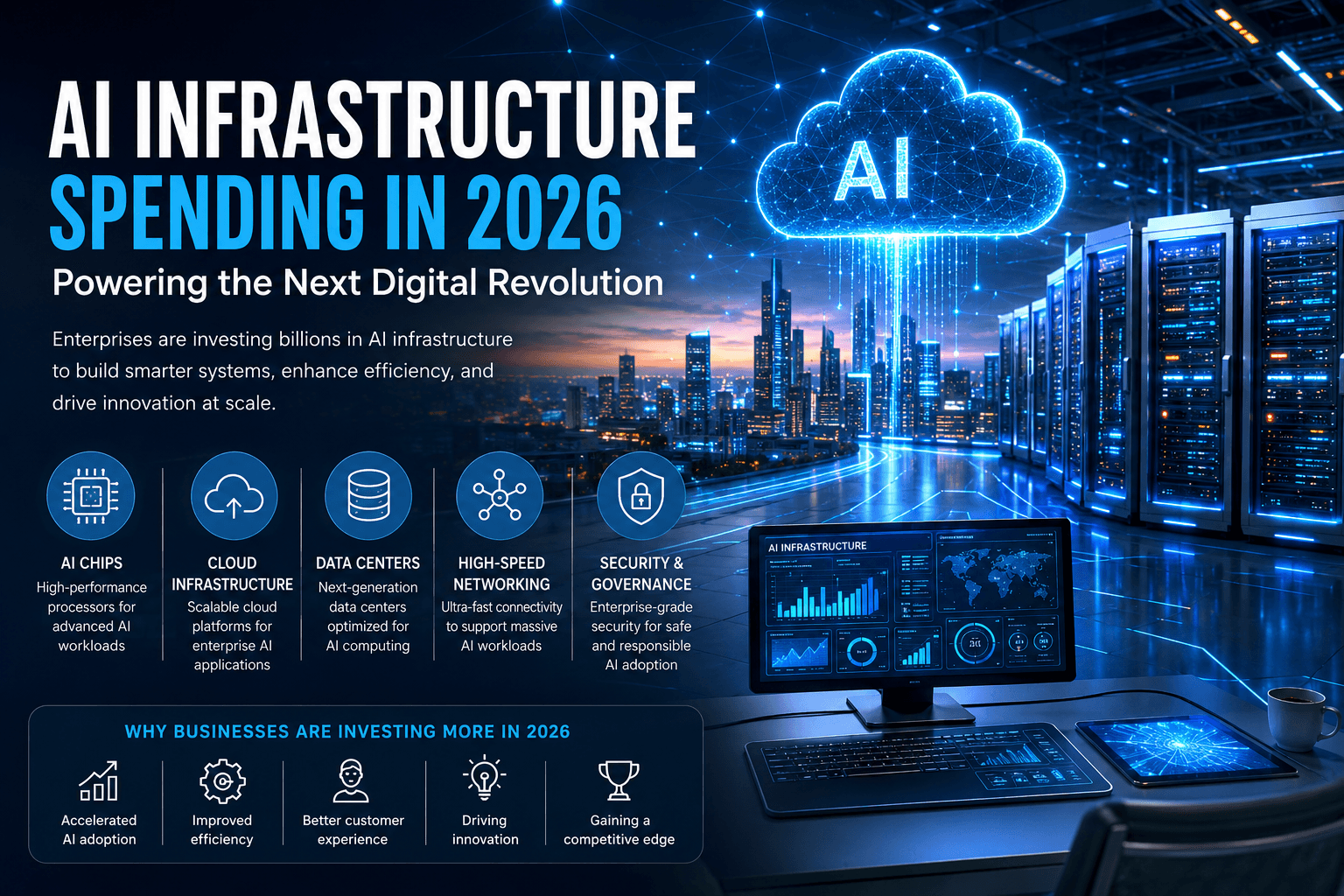

Artificial intelligence has moved beyond being an experimental technology to becoming the foundation of modern business operations. In 2026, enterprises across every industry are investing billions of dollars into AI infrastructure to support advanced applications, improve efficiency, and gain a competitive advantage. From cloud computing and data centers to specialized AI chips and networking technologies, infrastructure has become the backbone of intelligent business transformation.
Organizations are realizing that successful AI implementation depends not only on advanced software but also on powerful and scalable infrastructure. As AI models become larger and more sophisticated, the demand for high-performance computing resources continues to grow rapidly.
This unprecedented wave of investment is reshaping the technology landscape and creating new opportunities for businesses worldwide.
Understanding AI Infrastructure
AI infrastructure refers to the complete ecosystem of hardware, software, networking, storage, and cloud services required to build, train, deploy, and manage artificial intelligence applications.
Unlike traditional IT infrastructure, AI systems require significantly greater computing power because they process enormous datasets and execute complex mathematical calculations continuously.
A modern AI infrastructure typically includes:
High-performance AI processors
GPU and AI accelerator clusters
Cloud computing platforms
Enterprise data centers
High-speed networking
Massive storage systems
AI development platforms
Security and governance solutions
Together, these components create an environment capable of supporting enterprise-scale AI applications.
Why AI Infrastructure Spending Is Growing Rapidly
Several factors are driving organizations to increase their AI budgets in 2026.
Explosion of Generative AI
Generative AI has become part of daily business operations. Companies are deploying AI assistants, intelligent search engines, automated content generation tools, and customer service chatbots.
These applications require enormous computing resources that traditional IT environments cannot efficiently support.
Enterprise AI Adoption
Large organizations are integrating AI into nearly every department, including:
Marketing
Sales
Customer support
Human resources
Finance
Manufacturing
Healthcare
Supply chain management
Each department increases demand for scalable AI infrastructure.
Increasing Data Volumes
Businesses generate massive amounts of structured and unstructured data every day.
AI systems require continuous access to these datasets for:
Training
Fine-tuning
Predictions
Automation
Business intelligence
This requires advanced storage and high-speed networking.
Cloud Providers Continue Massive Expansion
Cloud computing remains the preferred option for many enterprises implementing AI.
Leading cloud providers continue expanding AI infrastructure by building larger data centers and introducing AI-optimized services that allow businesses to scale resources without investing in expensive on-premise hardware.
Hybrid cloud environments are also becoming increasingly common, allowing companies to combine public cloud flexibility with private infrastructure security.
AI Chips Are Becoming Strategic Assets
Traditional processors are no longer sufficient for modern AI workloads.
Organizations are increasingly investing in specialized AI chips designed specifically for machine learning and deep learning applications.
These processors offer:
Faster model training
Lower energy consumption
Improved scalability
Better parallel processing
Reduced operational costs
The rapid evolution of AI hardware has become one of the biggest drivers of infrastructure investment worldwide.
Data Centers Are Evolving for AI
Enterprise data centers are undergoing significant modernization.
Instead of supporting conventional business software alone, they are now optimized for intensive AI processing.
Modern AI data centers feature:
Advanced cooling systems
High-density GPU servers
Intelligent energy management
Automated monitoring
High-bandwidth networking
These upgrades improve performance while reducing operational costs.
Networking Has Become Critical
AI models transfer enormous amounts of data between processors.
High-speed networking has therefore become one of the most important components of AI infrastructure.
Organizations are deploying advanced networking technologies that reduce latency and improve communication between servers, enabling faster AI training and real-time inference.
Storage Requirements Continue to Increase
Modern AI systems depend on enormous datasets.
Enterprises require scalable storage capable of handling:
Training datasets
Video files
Images
Customer information
Business analytics
Research data
Cloud storage and distributed storage architectures are becoming essential components of enterprise AI environments.
Security Is Now a Core Infrastructure Priority
As AI adoption grows, cybersecurity becomes increasingly important.
Organizations are implementing advanced security measures including:
Identity management
Data encryption
Zero Trust architecture
AI monitoring
Threat detection
Compliance management
Protecting AI models and enterprise data has become a strategic business priority.
Sustainability Influences Infrastructure Investment
AI workloads consume substantial energy.
As sustainability goals become more important, organizations are investing in energy-efficient infrastructure that reduces environmental impact while maintaining performance.
Many companies are adopting:
Renewable-powered data centers
Liquid cooling systems
Efficient AI processors
Intelligent power management
Carbon reduction strategies
Green AI infrastructure is becoming an important competitive advantage.
Industries Benefiting Most
AI infrastructure investment is transforming multiple industries.
Healthcare
Hospitals use AI infrastructure for medical imaging, diagnostics, predictive analytics, drug discovery, and personalized medicine.
Financial Services
Banks utilize AI for fraud detection, credit analysis, algorithmic trading, compliance monitoring, and customer support.
Manufacturing
Factories deploy AI-powered robotics, predictive maintenance, quality inspection, and production optimization.
Retail
Retailers use AI infrastructure for recommendation engines, inventory forecasting, demand prediction, and personalized shopping experiences.
Logistics
Supply chain organizations optimize transportation routes, warehouse automation, inventory planning, and delivery scheduling using AI-powered infrastructure.
Benefits for Enterprises
Organizations investing in AI infrastructure gain numerous advantages:
Faster innovation
Improved operational efficiency
Better customer experiences
Enhanced cybersecurity
Lower operational costs
Scalable AI deployment
Increased productivity
Better business intelligence
Stronger competitive positioning
These benefits explain why enterprise AI spending continues to accelerate.
Challenges Businesses Must Address
Despite its advantages, AI infrastructure investment presents several challenges.
High Initial Costs
Building enterprise-grade AI infrastructure requires substantial capital investment.
Skills Shortage
Organizations need experienced AI engineers, cloud architects, cybersecurity professionals, and infrastructure specialists.
Data Management
Managing massive datasets while maintaining compliance remains a significant challenge.
Energy Consumption
Large AI workloads increase electricity usage, requiring efficient infrastructure planning.
Integration Complexity
Many organizations must integrate modern AI infrastructure with legacy IT systems.
The Future of AI Infrastructure
Over the next several years, AI infrastructure will become increasingly intelligent.
Future developments may include:
Autonomous infrastructure management
AI-powered resource optimization
Self-healing cloud environments
Edge AI expansion
Quantum computing integration
Advanced AI networking
More energy-efficient processors
Fully automated data centers
Businesses that invest early will be better prepared for the next generation of digital transformation.
Conclusion
AI infrastructure spending in 2026 represents far more than an increase in technology budgets. It reflects a fundamental shift in how businesses operate, innovate, and compete. Powerful computing resources, intelligent cloud platforms, specialized AI hardware, secure networking, and scalable storage have become essential components of enterprise success.
Organizations that build strong AI infrastructure today will be better positioned to adopt emerging technologies, improve operational efficiency, and deliver superior customer experiences in the years ahead. As artificial intelligence continues to evolve, infrastructure will remain the critical foundation powering the future of enterprise innovation.
AI infrastructure spending in 2026 represents far more than an increase in technology budgets. It reflects a fundamental shift in how businesses operate, innovate, and compete. Powerful computing resources, intelligent cloud platforms, specialized AI hardware, secure networking, and scalable storage have become essential components of enterprise success.
Organizations that build strong
today will be better positioned to adopt emerging technologies, improve operational efficiency, and deliver superior customer experiences in the years ahead. As artificial intelligence continues to evolve, infrastructure will remain the critical foundation powering the future of enterprise innovation.
Looking ahead, enterprises that prioritize scalable, secure, and sustainable AI infrastructure will be better equipped to respond to changing market demands and technological advancements. Strategic investments made today will enable faster innovation, stronger collaboration, and improved business resilience. Companies that embrace AI-ready infrastructure can unlock new revenue opportunities, accelerate digital transformation, and gain a lasting competitive advantage. As AI becomes embedded in every aspect of business, robust infrastructure will no longer be a luxury but a necessity for achieving long-term growth, operational excellence, and continued success in an increasingly AI-driven global economy.Conclusion
AI infrastructure spending in 2026 represents far more than an increase in technology budgets. It reflects a fundamental shift in how businesses operate, innovate, and compete. Powerful computing resources, intelligent cloud platforms, specialized AI hardware, secure networking, and scalable storage have become essential components of enterprise success.
Organizations that build strong AI infrastructure today will be better positioned to adopt emerging technologies, improve operational efficiency, and deliver superior customer experiences in the years ahead. As artificial intelligence continues to evolve, infrastructure will remain the critical foundation powering the future of enterprise innovation.
Looking ahead, enterprises that prioritize scalable, secure, and sustainable AI infrastructure will be better equipped to respond to changing market demands and technological advancements. Strategic investments made today will enable faster innovation, stronger collaboration, and improved business resilience. Companies that embrace AI-ready infrastructure can unlock new revenue opportunities, accelerate digital transformation, and gain a lasting competitive advantage. As AI becomes embedded in every aspect of business, robust infrastructure will no longer be a luxury but a necessity for achieving long-term growth, operational excellence, and continued success in an increasingly AI-driven global economy.