
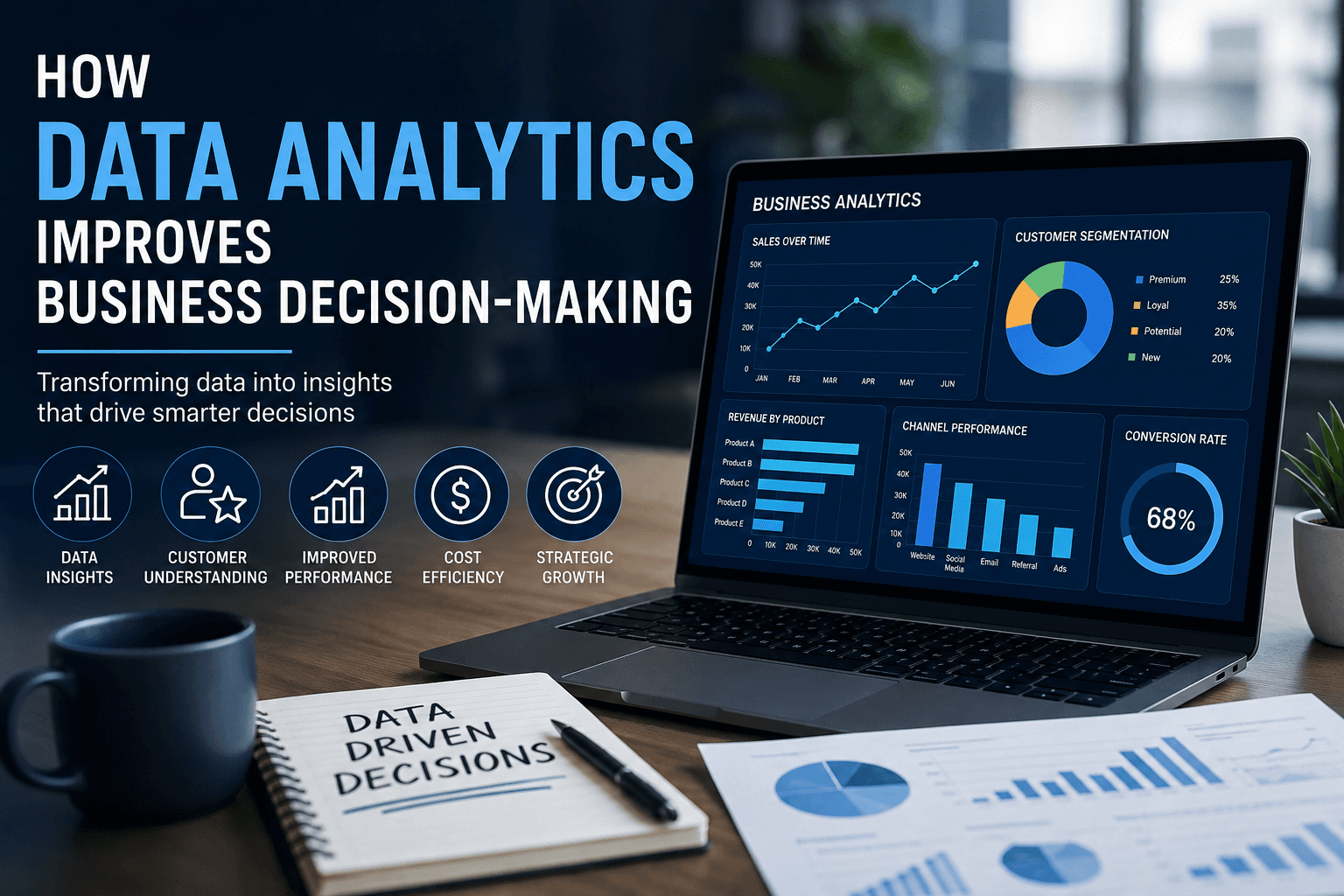

Introduction
In today's digital economy, businesses generate more data than ever before. Every customer interaction, online purchase, website visit, social media engagement, and financial transaction produces valuable information. However, data alone has little value unless organizations can analyze it and turn it into meaningful insights.
Data analytics has become one of the most powerful tools for modern businesses. Instead of relying on assumptions or intuition, companies now use real-time data to make informed decisions, improve efficiency, reduce costs, and identify new growth opportunities. Organizations that embrace data-driven decision-making are often more competitive, innovative, and better prepared to respond to changing market conditions.
Whether operating a small business or managing a global enterprise, leveraging data analytics can significantly improve strategic planning and operational performance.
What Is Data Analytics?
Data analytics is the process of collecting, organizing, analyzing, and interpreting data to uncover meaningful patterns, trends, and insights. Businesses use analytics to understand customer behavior, evaluate performance, predict future outcomes, and make better decisions.
Modern analytics platforms combine data from multiple sources, including websites, customer relationship management (CRM) systems, financial software, marketing platforms, and operational databases. By transforming raw information into actionable intelligence, organizations can make decisions based on facts rather than guesswork.
Why Data-Driven Decision-Making Matters
Successful businesses no longer depend solely on experience or intuition. While expertise remains valuable, decisions supported by reliable data are generally more accurate and measurable.
Data-driven decision-making helps businesses:
Reduce uncertainty
Improve operational efficiency
Understand customer needs
Identify market opportunities
Monitor business performance
Allocate resources effectively
Reduce financial risks
Organizations that consistently use analytics often respond faster to market changes and gain a competitive advantage.
Types of Data Analytics
Businesses typically use four major types of data analytics.
Descriptive Analytics
Descriptive analytics explains what has already happened by analyzing historical data. Examples include monthly sales reports, website traffic statistics, and customer purchase history.
Diagnostic Analytics
Diagnostic analytics investigates why specific events occurred. Businesses use it to identify factors behind declining sales, increased expenses, or customer churn.
Predictive Analytics
Predictive analytics uses historical patterns and machine learning models to forecast future outcomes. Companies apply predictive analytics for sales forecasting, inventory planning, and customer demand prediction.
Prescriptive Analytics
Prescriptive analytics recommends the best course of action based on available data. Advanced AI systems increasingly support businesses by suggesting optimized pricing, inventory levels, and operational strategies.
Key Benefits of Data Analytics
Better Strategic Planning
Executives use business intelligence dashboards and performance metrics to develop more effective long-term strategies.
Improved Operational Efficiency
Analytics identifies inefficient workflows, unnecessary expenses, and process bottlenecks, allowing organizations to improve productivity.
Smarter Financial Decisions
Finance teams analyze revenue trends, operating costs, profitability, and cash flow to make informed investment decisions.
Enhanced Risk Management
Businesses can detect unusual activities, identify potential risks, and prevent financial losses before problems escalate.
Increased Productivity
Managers monitor employee performance, project timelines, and operational efficiency to improve overall business performance.
Improving Customer Experience Through Data
Customer expectations continue to evolve. Businesses that understand customer preferences can provide more personalized experiences and stronger service.
Data analytics helps organizations:
Identify buying patterns
Personalize product recommendations
Improve customer support
Measure customer satisfaction
Reduce customer churn
Increase customer loyalty
For example, e-commerce businesses analyze browsing behavior to recommend products that customers are most likely to purchase. Service-based businesses use customer feedback to improve response times and service quality.
Data Analytics in Marketing
Marketing teams rely heavily on analytics to understand campaign performance and customer engagement.
Businesses measure:
Website traffic
Conversion rates
Email performance
Social media engagement
Customer acquisition costs
Return on marketing investment (ROI)
These insights help marketers optimize advertising budgets, improve content strategies, and target the right audiences more effectively.
The Role of Business Intelligence Tools
Business intelligence (BI) tools transform complex datasets into easy-to-understand dashboards and visual reports. Instead of manually reviewing spreadsheets, decision-makers can quickly identify trends and monitor key performance indicators (KPIs).
Popular BI solutions support faster reporting, better collaboration, and more informed decision-making across departments.
The Role of Artificial Intelligence in Data Analytics
Artificial intelligence (AI) has transformed data analytics by enabling businesses to process massive amounts of information quickly and accurately. AI-powered tools can identify hidden patterns, automate repetitive tasks, detect anomalies, and generate predictive insights. By combining AI with data analytics, organizations can make faster decisions, improve customer experiences, and gain a competitive advantage.
How Data Analytics Supports Business Growth
Data analytics helps businesses identify new market opportunities, understand customer preferences, optimize pricing strategies, and improve operational efficiency. By continuously monitoring business performance, organizations can make informed decisions that support sustainable growth and long-term profitability.
Data Analytics and Risk Management
Every business faces risks, including financial uncertainty, cybersecurity threats, and market fluctuations. Data analytics enables companies to identify potential risks early by monitoring trends, detecting unusual activities, and analyzing historical data. This proactive approach allows organizations to reduce losses and strengthen business resilience.
Building a Data-Driven Business Culture
Successful data analytics initiatives require more than technology. Organizations should encourage employees to use data in daily decision-making, invest in analytics training, and promote collaboration between departments. A strong data-driven culture improves transparency, accountability, and overall business performance.
Common Mistakes to Avoid
Businesses often fail to achieve the full benefits of data analytics due to common mistakes such as relying on poor-quality data, ignoring data privacy regulations, focusing on too many metrics, or failing to act on insights. Establishing clear objectives and maintaining accurate data are essential for successful analytics implementation.
Choosing the Right Data Analytics Tools
Selecting the right analytics platform depends on business size, budget, and objectives. Organizations should look for tools that offer real-time reporting, customizable dashboards, easy integration with existing systems, strong security features, and scalability to support future growth.
The Future of Data Analytics
The future of data analytics will be shaped by artificial intelligence, machine learning, automation, cloud computing, and real-time business intelligence. These technologies will help organizations make faster, more accurate decisions while improving efficiency and customer satisfaction.
Final Thoughts
Data analytics is no longer optional for businesses that want to remain competitive. Organizations that invest in data-driven strategies can improve decision-making, enhance customer experiences, reduce operational risks, and uncover new opportunities for growth. As technology continues to evolve, businesses that embrace analytics will be better positioned for long-term success.
Conclusion
Data analytics has become a fundamental component of modern business success. Organizations that collect, analyze, and apply data effectively can make smarter decisions, improve operational efficiency, strengthen customer relationships, and identify new growth opportunities.
As digital transformation continues to accelerate, data-driven decision-making will become even more important. Businesses that invest in analytics technologies, skilled professionals, and a culture of data literacy will be better positioned to compete in an increasingly data-centric world.
Rather than relying on assumptions, successful organizations use evidence-based insights to navigate challenges, seize opportunities, and build sustainable long-term growth.
FAQs – How Data Analytics Improves Business Decision-Making
1. What is data analytics in business?
Data analytics is the process of collecting and analyzing data to help businesses make informed decisions and improve performance.
2. Why is data analytics important for businesses?
It helps organizations identify trends, improve efficiency, reduce costs, and make data-driven decisions.
3. How does data analytics improve decision-making?
By providing accurate insights, businesses can make strategic decisions based on facts rather than assumptions.
4. What are the four types of data analytics?
The four types are descriptive, diagnostic, predictive, and prescriptive analytics.
5. How does predictive analytics benefit businesses?
Predictive analytics forecasts future trends, helping businesses plan inventory, sales, and customer demand more effectively.
6. Which industries benefit from data analytics?
Industries such as healthcare, finance, retail, manufacturing, logistics, education, and marketing all benefit from data analytics.
7. What tools are commonly used for data analytics?
Popular tools include Microsoft Power BI, Tableau, Google Analytics, Excel, SQL, and Python-based analytics platforms.
8. Can small businesses use data analytics?
Yes. Small businesses can use affordable analytics tools to track customer behavior, monitor sales, and improve marketing performance.
9. How does data analytics improve customer experience?
It helps businesses understand customer preferences, personalize services, and deliver better products and support.
10. What challenges do businesses face when implementing data analytics?
Common challenges include poor data quality, lack of skilled professionals, data privacy concerns, and integrating data from multiple sources.
11. How often should businesses analyze their data?
Businesses should monitor key metrics regularly, with many organizations reviewing data daily, weekly, or monthly depending on their goals.
12. What is the future of data analytics in business?
The future includes AI-powered analytics, real-time dashboards, predictive modeling, automation, and advanced business intelligence solutions.