Modern supply chains are more complex than ever before. Global trade, changing customer expectations, labor shortages, fluctuating demand, and unexpected disruptions have made traditional supply chain management increasingly difficult. In 2026, businesses are turning to predictive artificial intelligence (AI) to overcome these challenges and build smarter, more resilient operations.
Predictive AI uses machine learning, historical data, and real-time information to forecast future events before they happen. Instead of reacting to delays, inventory shortages, or supplier issues, organizations can anticipate problems and take proactive action. This shift from reactive management to predictive decision-making is helping companies reduce costs, improve efficiency, and strengthen customer satisfaction.
This article explores how predictive AI is transforming supply chain management, the technologies behind it, key business benefits, implementation challenges, and future trends shaping the logistics industry.
What Is Predictive AI?
Predictive AI refers to artificial intelligence systems that analyze historical patterns and current data to forecast future outcomes. In supply chains, these systems process information from inventory records, supplier performance, transportation networks, weather reports, economic indicators, and customer purchasing behavior.
Unlike traditional reporting tools, predictive AI continuously learns from new data, allowing businesses to make more accurate decisions over time. The result is faster planning, fewer disruptions, and improved operational performance.
Smarter Demand Forecasting
Demand forecasting is one of the most valuable applications of predictive AI. Businesses often struggle with inaccurate forecasts that lead to excess inventory or stock shortages.
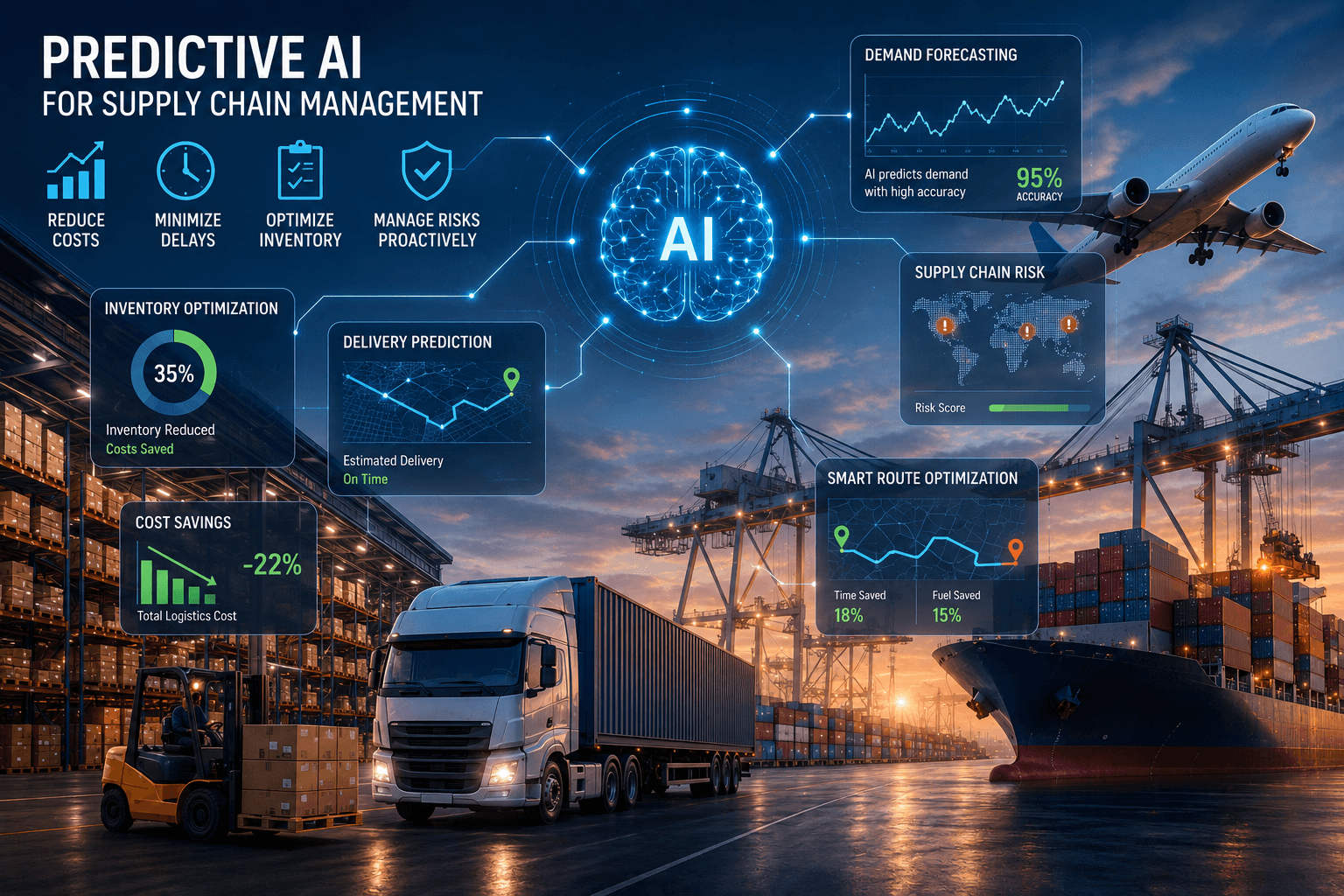
Predictive AI combines multiple data sources, including sales history, seasonal demand, promotions, market trends, and customer behavior. By analyzing these variables together, AI generates highly accurate demand forecasts that help businesses maintain optimal inventory levels.
Accurate forecasting reduces waste, improves product availability, and supports better production planning.
Inventory Optimization
Maintaining the right inventory balance is critical for profitability. Excess stock increases storage costs, while insufficient inventory results in lost sales and dissatisfied customers.
Predictive AI continuously monitors inventory movement and predicts future stock requirements. Instead of relying on fixed reorder points, AI recommends dynamic replenishment strategies based on demand forecasts, supplier lead times, and market conditions.
This intelligent inventory management improves cash flow while ensuring products remain available when customers need them.
Preventing Supply Chain Delays
Shipping delays can affect production schedules, customer satisfaction, and company profitability.
Predictive AI identifies potential delays before they happen by monitoring transportation routes, weather conditions, port congestion, traffic, customs processing, and carrier performance.
Businesses receive early warnings, allowing them to reroute shipments, adjust schedules, or secure alternative suppliers before disruptions impact operations.
Supplier Risk Management
Reliable suppliers are essential for efficient supply chain operations. However, supplier performance can change due to financial issues, production problems, geopolitical events, or transportation disruptions.
Predictive AI evaluates supplier reliability using historical delivery performance, product quality, pricing trends, and operational consistency. Risk scores help procurement teams identify vulnerable suppliers and diversify sourcing strategies.
This proactive approach strengthens supply chain resilience and reduces dependence on high-risk vendors.
Warehouse Intelligence
Warehouses generate large volumes of operational data every day. Predictive AI analyzes warehouse activities to improve efficiency and reduce operational costs.
Applications include:
Predicting storage requirements
Optimizing warehouse layouts
Improving picking routes
Forecasting labor demand
Identifying equipment maintenance needs
Combined with robotics and computer vision, predictive AI enables warehouses to process orders faster with fewer errors.
Transportation Optimization
Transportation represents one of the largest operating expenses for logistics companies.
Predictive AI improves transportation by analyzing:
Fuel prices
Traffic conditions
Driver schedules
Vehicle availability
Weather forecasts
Delivery priorities
AI recommends optimal delivery routes while predicting arrival times more accurately. Businesses reduce fuel consumption, improve fleet utilization, and increase on-time deliveries.
Predictive Maintenance
Unexpected equipment failures can stop production and delay shipments.
Predictive AI continuously analyzes sensor data from vehicles, warehouse equipment, and manufacturing machinery to detect early signs of wear or malfunction.
Instead of waiting for equipment to fail, maintenance teams perform repairs before breakdowns occur.
Benefits include:
Reduced downtime
Lower maintenance costs
Longer equipment lifespan
Higher productivity
Cost Reduction Through AI
One of the biggest reasons companies invest in predictive AI is cost reduction.
Predictive AI lowers expenses by:
Reducing inventory waste
Preventing emergency shipments
Improving warehouse productivity
Optimizing transportation routes
Minimizing equipment downtime
Increasing procurement efficiency
Even small improvements across multiple operations can generate substantial long-term savings.
Better Customer Experience
Customers expect accurate delivery dates and consistent product availability.
Predictive AI improves customer satisfaction by:
Providing realistic delivery estimates
Reducing shipping delays
Preventing stock shortages
Improving order accuracy
Offering proactive shipment notifications
Satisfied customers are more likely to remain loyal and recommend the business to others.
Sustainability Benefits
Sustainability has become a strategic priority across global supply chains.
Predictive AI contributes by:
Reducing fuel consumption
Preventing excess manufacturing
Minimizing inventory waste
Lowering warehouse energy usage
Optimizing transportation networks
These improvements help businesses reduce carbon emissions while maintaining operational efficiency.
Real-Time Decision Making
Traditional supply chain decisions often rely on reports generated hours or days after events occur.
Predictive AI processes live operational data and delivers instant recommendations.
Managers can quickly respond to disruptions, adjust inventory levels, reroute shipments, and allocate resources more effectively.
Real-time intelligence increases organizational agility in rapidly changing markets.
Challenges of Implementing Predictive AI
Although predictive AI offers significant advantages, implementation requires careful planning.
Data Quality
Accurate predictions depend on clean, reliable, and consistent business data.
Integration
Older ERP and logistics systems may require upgrades before AI solutions can be fully integrated.
Employee Adoption
Organizations should train employees to understand AI insights and incorporate predictive recommendations into daily operations.
Cybersecurity
AI systems rely on connected digital infrastructure, making cybersecurity essential for protecting operational data.
Future Trends
Predictive AI will continue evolving through several emerging technologies.
Generative AI
Generative AI will summarize operational reports, create procurement recommendations, and assist supply chain managers with faster decision-making.
Digital Twins
Virtual supply chain models will simulate disruptions before they occur, allowing organizations to test different operational strategies without affecting real-world operations.
Autonomous Logistics
Self-driving trucks, autonomous warehouse robots, and drone deliveries will increasingly rely on predictive AI for navigation and operational planning.
AI Agents
Intelligent AI agents will independently manage procurement, supplier communications, shipment tracking, and inventory replenishment with minimal human intervention.
Best Practices for Businesses
Organizations adopting predictive AI should:
Start with demand forecasting and inventory optimization.
Invest in high-quality centralized data.
Integrate AI with ERP, warehouse, and logistics platforms.
Monitor key performance indicators regularly.
Continuously retrain AI models using updated operational data.
Encourage collaboration between AI systems and human decision-makers.
A phased implementation strategy helps businesses maximize return on investment while minimizing disruption.
Conclusion
Predictive AI is redefining supply chain management by enabling businesses to anticipate challenges instead of simply reacting to them. Through accurate demand forecasting, intelligent inventory optimization, supplier risk analysis, transportation planning, and predictive maintenance, AI helps organizations reduce costs, improve operational efficiency, and deliver better customer experiences.
As technologies such as generative AI, digital twins, autonomous logistics, and intelligent AI agents continue to mature, predictive AI will become an essential component of every modern supply chain. Companies that embrace predictive intelligence today will be better equipped to navigate future disruptions, achieve sustainable growth, and maintain a competitive advantage in an increasingly complex global marketplace.
Frequently Asked Questions (FAQs)
1. What is predictive AI in supply chain management?
Predictive AI uses machine learning and data analytics to forecast demand, identify risks, optimize inventory, and improve supply chain decisions before problems occur.
2. How does predictive AI reduce operational costs?
It minimizes inventory waste, optimizes transportation routes, prevents equipment failures, and improves warehouse efficiency, leading to significant cost savings.
3. Which industries benefit most from predictive AI?
Retail, manufacturing, healthcare, automotive, e-commerce, food and beverage, and logistics companies all benefit from predictive AI solutions.
4. Can predictive AI prevent supply chain disruptions?
While it cannot eliminate all disruptions, predictive AI identifies potential risks early and recommends proactive actions to minimize their impact.
5. Is predictive AI suitable for small businesses?
Yes. Many cloud-based AI platforms offer scalable and affordable predictive analytics solutions for small and medium-sized businesses.
6. What data does predictive AI analyze?
It analyzes sales history, inventory levels, supplier performance, transportation data, weather forecasts, customer behavior, and market trends.
7. How does predictive AI support sustainability?
It reduces waste, lowers fuel consumption, optimizes logistics, improves inventory planning, and helps businesses reduce their environmental impact.
8. What is the future of predictive AI in supply chains?
Future developments include AI agents, digital twins, autonomous logistics, and more advanced predictive analytics that will further automate and optimize global supply chain operations.