
In today’s fast-moving global economy, businesses are under constant pressure to reduce operational costs, improve efficiency, and deliver better customer experiences. Supply chain disruptions, rising transportation expenses, labor shortages, unpredictable demand, and increasing customer expectations have made traditional supply chain management increasingly difficult.
As a result, businesses are turning toward smart supply chains powered by artificial intelligence (AI), automation, the Internet of Things (IoT), robotics, cloud computing, and advanced analytics.
In 2026, supply chain automation is no longer simply a competitive advantage for large corporations. It is becoming an important business strategy for organizations of all sizes seeking to improve profitability, resilience, and long-term growth.
Smart supply chains enable companies to monitor operations in real time, predict potential disruptions, automate repetitive processes, optimize transportation, and make faster data-driven decisions.
What Is a Smart Supply Chain?
A smart supply chain uses connected digital technologies to monitor, manage, and optimize different stages of the supply chain.
These technologies can connect:
Suppliers
Manufacturers
Warehouses
Transportation providers
Retailers
Customers
AI algorithms, IoT sensors, cloud platforms, robotics, and predictive analytics work together to provide businesses with greater visibility across their operations.
Unlike traditional supply chains that depend heavily on manual processes and historical information, smart supply chains continuously collect data and use it to identify problems, predict demand, and optimize workflows.
This allows businesses to move from reactive supply chain management toward a more proactive and intelligent model.
How Automation Reduces Supply Chain Costs
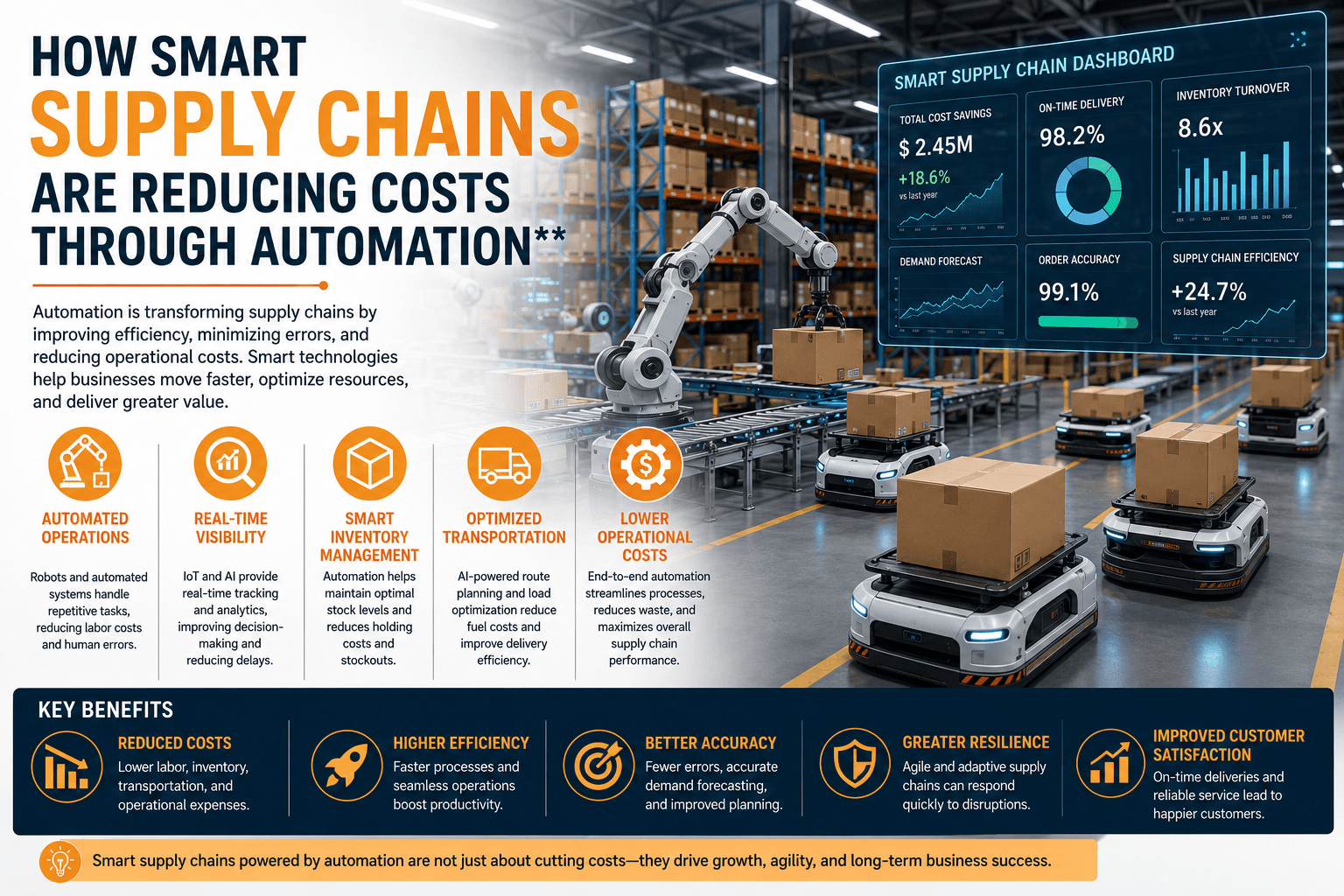
One of the biggest reasons companies are investing in supply chain automation is cost reduction.
Many supply chain activities involve repetitive tasks such as inventory tracking, order processing, warehouse management, shipment scheduling, and data entry. Automating these processes reduces the need for manual intervention and allows employees to focus on higher-value activities.
Automated systems can operate continuously while improving speed and consistency.
Businesses can benefit from:
Lower labor costs
Fewer human errors
Faster order processing
Reduced operational delays
Higher employee productivity
More consistent workflows
By eliminating unnecessary manual processes, companies can improve their margins while maintaining service quality.
AI Is Making Inventory Management Smarter
Inventory management has a direct impact on profitability. Too much inventory increases storage and holding costs, while too little inventory can result in shortages and lost sales.
AI-powered inventory management systems analyze historical sales, seasonal trends, customer behavior, supplier performance, and market conditions to forecast future demand.
Businesses can use these insights to:
Predict inventory requirements
Reduce overstocking
Prevent stock shortages
Optimize warehouse space
Improve purchasing decisions
Respond to demand changes faster
Real-time inventory visibility also gives businesses a clearer understanding of what products are available, where they are located, and when additional stock may be required.
Optimizing Transportation and Logistics
Transportation is one of the largest expenses for many businesses. Fuel costs, delivery delays, traffic congestion, inefficient routes, and underutilized vehicles can significantly increase supply chain expenses.
AI-powered logistics platforms can analyze multiple factors simultaneously to determine efficient transportation strategies.
These systems can consider:
Traffic conditions
Weather
Fuel consumption
Delivery schedules
Vehicle availability
Shipment volumes
Customer locations
AI-powered route optimization can help businesses reduce unnecessary mileage, improve delivery times, lower fuel consumption, and increase vehicle utilization.
This makes intelligent logistics an important component of modern supply chain strategy.
Predictive Maintenance Prevents Expensive Downtime
Warehouses and manufacturing facilities depend on equipment such as conveyor systems, forklifts, robots, packaging machines, and production machinery.
Unexpected equipment failures can interrupt operations and create expensive delays.
IoT sensors can continuously monitor equipment performance, temperature, vibration, energy consumption, and other operational indicators.
AI-powered predictive maintenance systems analyze this information to identify potential problems before equipment fails.
Instead of waiting for machinery to break down, businesses can schedule maintenance when it is actually needed.
This can help organizations:
Reduce unexpected downtime
Lower emergency repair costs
Extend equipment lifespans
Improve workplace efficiency
Maintain consistent production
Real-Time Supply Chain Visibility
Visibility has become one of the most valuable features of smart supply chains.
Traditional supply chains may rely on disconnected systems, making it difficult for managers to understand what is happening across the entire network.
Connected technologies provide real-time information about:
Inventory levels
Shipment locations
Supplier performance
Warehouse activity
Production schedules
Delivery progress
When a shipment is delayed or inventory begins running low, managers can identify the problem quickly and take corrective action.
Greater visibility reduces uncertainty and allows businesses to respond more effectively to unexpected disruptions.
AI Improves Supply Chain Decision-Making
Modern supply chains generate enormous amounts of data. Without advanced analytical tools, turning this information into useful decisions can be difficult.
AI transforms operational data into actionable insights by identifying patterns, forecasting demand, detecting risks, and recommending potential solutions.
Business leaders can use AI insights to make decisions involving:
Procurement
Inventory allocation
Production planning
Supplier selection
Transportation
Pricing
Demand forecasting
Instead of relying exclusively on historical reports, organizations can use real-time intelligence to make faster and more informed decisions.
Improving Customer Satisfaction
Supply chain performance directly affects customer experience.
Customers increasingly expect accurate product availability, fast delivery, transparent tracking, and reliable fulfillment.
Smart supply chain technologies improve these areas by automating order processing, improving inventory accuracy, and providing real-time shipment information.
Customers can receive updates about:
Order confirmation
Product availability
Shipment status
Estimated delivery times
Delivery completion
Better supply chain performance can lead to fewer errors, faster deliveries, stronger customer satisfaction, and increased customer loyalty.
Smart Supply Chains Support Sustainability
Supply chain automation can also support environmental goals.
AI-powered logistics systems can optimize routes and reduce unnecessary transportation. Intelligent inventory systems can minimize waste caused by overstocking and expired products.
Smart warehouses can also use energy-monitoring technologies to identify inefficient equipment and reduce unnecessary energy consumption.
Businesses can therefore pursue both operational efficiency and sustainability by adopting intelligent supply chain technologies.
The Role of Robotics and IoT
Robotics and IoT are becoming increasingly important components of smart supply chains.
Warehouse robots can assist with picking, packing, sorting, and transportation of products. IoT devices can provide continuous information about inventory, equipment, vehicles, and shipments.
When these technologies are connected to AI platforms, businesses can create highly automated supply chain environments.
The combination of AI, IoT, robotics, cloud computing, and analytics is creating a more connected and responsive supply chain ecosystem.
Challenges of Supply Chain Automation
Although smart supply chains provide significant benefits, implementation also creates challenges.
Businesses must consider:
Initial technology costs
Cybersecurity risks
Data privacy
Integration with legacy systems
Employee training
Technology maintenance
Vendor selection
Companies should develop a clear technology strategy before automating their operations.
Successful implementation requires more than purchasing software or robots. Businesses must ensure that employees understand the new systems and that different technologies can communicate effectively.
The Future of Smart Supply Chains
The next generation of supply chains will become increasingly intelligent and autonomous.
Emerging technologies such as generative AI, digital twins, autonomous robots, blockchain, advanced IoT networks, and autonomous transportation could further transform supply chain management.
Future systems may be capable of detecting disruptions, predicting demand changes, identifying alternative suppliers, and automatically adjusting logistics strategies with limited human intervention.
Businesses that invest in these technologies today can build more flexible and resilient operations for the future.
Conclusion
Smart supply chains are becoming an essential part of modern business strategy in 2026. By combining AI, automation, IoT, robotics, cloud computing, and advanced analytics, companies can reduce operational costs while improving efficiency, visibility, resilience, and customer satisfaction.
From automated warehouses to AI-powered demand forecasting and intelligent transportation systems, supply chain technology is changing how businesses operate.
Organizations that strategically adopt supply chain automation can improve profitability, respond faster to market changes, and create more sustainable operations. As global competition increases, smart supply chains will increasingly become a foundation for long-term business growth.
Frequently Asked Questions
1. What is a smart supply chain?
A smart supply chain is a digitally connected supply chain that uses AI, automation, IoT, robotics, cloud computing, and analytics to monitor and optimize operations in real time.
2. Why are businesses adopting smart supply chains in 2026?
Businesses are adopting smart supply chains to reduce costs, improve efficiency, manage disruptions, respond to changing demand, and deliver faster and more reliable customer service.
3. How does AI improve supply chain management?
AI analyzes large amounts of operational data to forecast demand, identify risks, optimize inventory, improve transportation routes, and support faster business decisions.
4. Can supply chain automation reduce business costs?
Yes. Automation can reduce labor requirements for repetitive tasks, minimize errors, improve productivity, reduce waste, and optimize transportation and inventory management.
5. How does AI improve inventory management?
AI analyzes sales history, seasonal patterns, customer demand, supplier performance, and market trends to predict how much inventory a business may need.
6. What is predictive maintenance in supply chains?
Predictive maintenance uses IoT sensors and AI analytics to identify signs of equipment problems before machinery fails, helping businesses reduce downtime and repair costs.
7. How does automation improve warehouse operations?
Warehouse automation can speed up picking, packing, sorting, inventory tracking, and product movement while reducing repetitive manual work and operational errors.
8. What role does IoT play in smart supply chains?
IoT devices collect real-time information from equipment, vehicles, warehouses, inventory, and shipments, giving businesses greater visibility into their supply chain operations.
9. How can smart supply chains improve delivery times?
AI-powered logistics systems can optimize routes, consolidate shipments, monitor traffic, and adjust delivery plans to help businesses complete deliveries more efficiently.
10. Can small businesses use smart supply chain technology?
Yes. Cloud-based software, AI-powered inventory platforms, logistics tools, and automation services allow small and medium-sized businesses to adopt smart supply chain technologies without building large technology infrastructures.
11. How does supply chain automation improve customer satisfaction?
Automation improves order accuracy, inventory visibility, delivery tracking, and fulfillment speed, helping customers receive products more reliably and with fewer delays.
12. What industries benefit from smart supply chains?
Manufacturing, retail, e-commerce, logistics, healthcare, food distribution, automotive, electronics, pharmaceuticals, and many other industries can benefit from smart supply chain technologies.
13. How does AI help businesses manage supply chain disruptions?
AI can identify potential risks, analyze alternative suppliers, forecast shortages, monitor transportation conditions, and recommend alternative strategies when disruptions occur.
14. What is real-time supply chain visibility?
Real-time visibility means businesses can monitor inventory, shipments, suppliers, warehouses, and other supply chain activities using continuously updated digital information.
15. How do smart supply chains support sustainability?
They can reduce fuel consumption through optimized routes, minimize inventory waste, improve energy efficiency, and help businesses make more sustainable operational decisions.
16. What are the biggest challenges of supply chain automation?
Major challenges include implementation costs, cybersecurity, data integration, employee training, compatibility with older systems, and selecting appropriate technology providers.
17. What technologies are used in smart supply chains?
Common technologies include artificial intelligence, machine learning, IoT sensors, robotics, cloud computing, predictive analytics, digital twins, automation software, and advanced data platforms.
18. Will supply chains become fully autonomous?
Some supply chain processes may become highly autonomous, but human oversight will remain important for strategic decisions, complex disruptions, governance, and relationship management.
19. How can businesses prepare for the future of supply chain automation?
Businesses should identify repetitive processes, improve data quality, invest in scalable technology, strengthen cybersecurity, train employees, and develop a long-term supply chain automation strategy.
20. Why are smart supply chains important for future business growth?
Smart supply chains help businesses control costs, improve operational efficiency, respond faster to disruptions, increase customer satisfaction, and build more resilient operations, making them an important foundation for long-term growth.