I1iPhone 18 in 2026: Latest Features, Price Expectations & Release Updates
Introduction
Technology is evolving faster than ever in 2026. Artificial intelligence, robotics, cybersecurity, cloud computing, smart devices, and next-generation connectivity are changing the way people work, communicate, shop, study, and run businesses.
Some technologies that once seemed futuristic are now becoming part of everyday digital life. At the same time, businesses are investing heavily in automation and intelligent software to improve productivity and create new digital experiences.
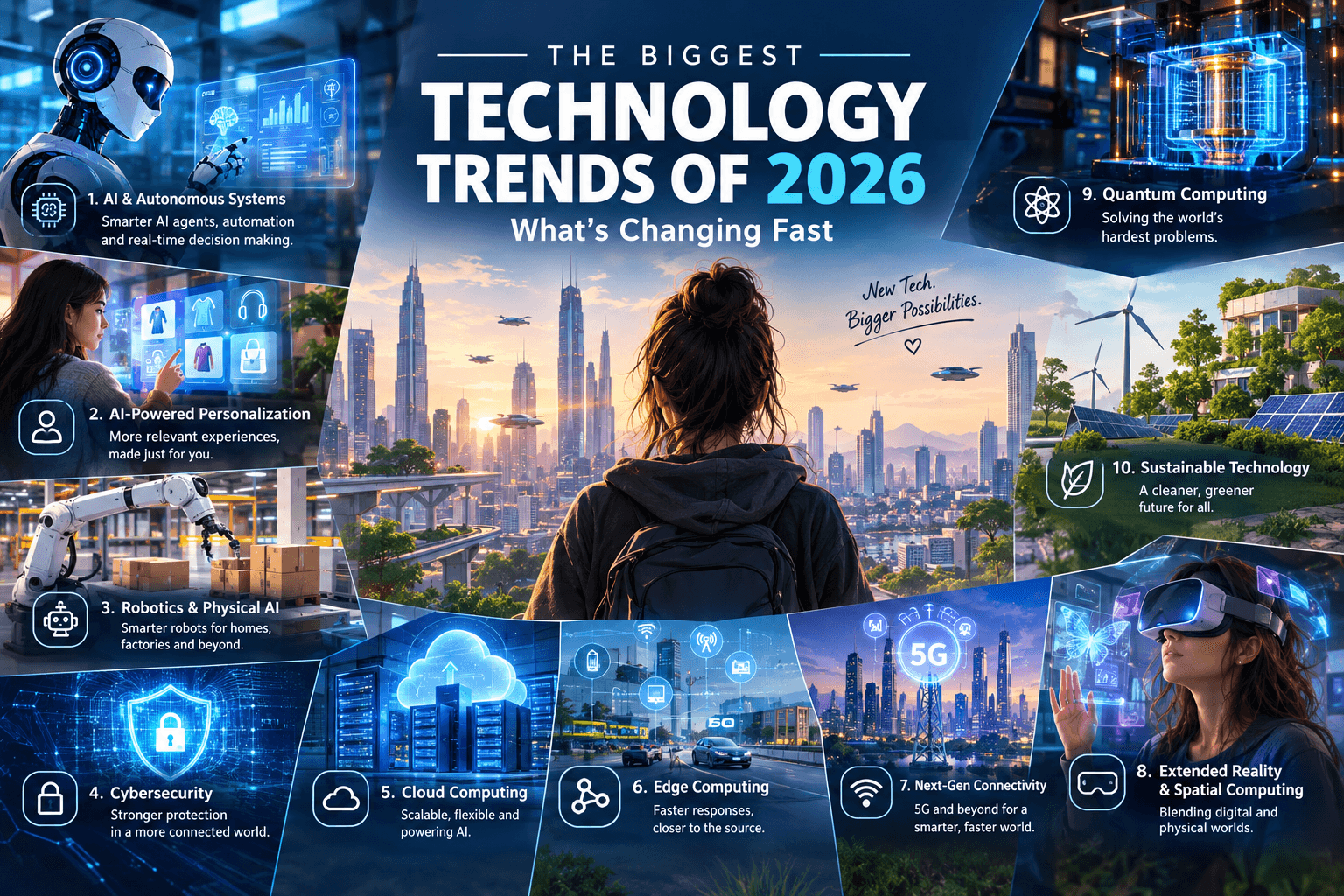
Here are some of the biggest technology trends shaping 2026.
1. Artificial Intelligence Is Becoming More Autonomous
AI has moved beyond simple chatbots and content-generation tools. In 2026, AI systems are increasingly being designed to complete multi-step tasks, analyze information, use software tools, and support business workflows.
AI agents can potentially assist with:
Research
Customer support
Software development
Marketing
Data analysis
Administrative work
Business operations
This shift is making AI a more integrated part of digital workplaces.
2. AI-Powered Personalization
Personalization is becoming increasingly sophisticated.
Websites, applications, shopping platforms, and entertainment services can use AI to understand user behavior and provide more relevant recommendations.
Examples include personalized shopping suggestions, customized learning experiences, targeted content, and intelligent digital assistants.
The growth of personalization also increases the importance of privacy and responsible data management.
3. Robotics and Physical AI
Robotics is another major technology area receiving attention in 2026.
Modern robots are becoming more capable of understanding their surroundings and performing complex physical tasks. Advances in computer vision, sensors, machine learning, and AI are helping robots operate in environments such as warehouses, factories, hospitals, and homes.
Humanoid robots are also attracting significant interest as companies explore potential applications in physical work and assistance.
4. Cybersecurity Is Becoming More Advanced
As technology becomes more connected, cybersecurity is becoming increasingly important.
Organizations are using AI and automation to identify suspicious activity, detect potential threats, and respond to security incidents.
At the same time, attackers are also using advanced technologies to create more sophisticated scams and cyberattacks.
This creates a continuous need for stronger security systems, employee awareness, authentication, and data protection.
5. Cloud Computing Continues to Expand
Cloud technology remains an essential part of modern digital infrastructure.
Businesses use cloud platforms to store information, run applications, manage data, and scale computing resources.
AI is also increasing demand for powerful cloud infrastructure because advanced AI models require significant computing resources.
Hybrid and multi-cloud strategies allow organizations to combine different computing environments based on their requirements.
6. Edge Computing
Edge computing moves some data processing closer to where information is generated instead of sending everything to distant data centers.
This can be useful for applications that require fast responses, including:
Smart factories
Connected vehicles
Healthcare technologies
Security systems
Industrial automation
Internet of Things devices
Reducing the distance data needs to travel can help improve responsiveness for certain applications.
7. Next-Generation Connectivity
Fast and reliable connectivity continues to support the growth of connected technologies.
5G networks are expanding, while research and development toward future generations of wireless technology continues.
Better connectivity can support applications involving smart cities, connected vehicles, industrial systems, immersive experiences, and large numbers of connected devices.
8. Extended Reality and Spatial Computing
Virtual reality, augmented reality, and mixed reality are becoming increasingly connected with spatial computing.
These technologies can create interactive digital environments for entertainment, education, training, design, healthcare, and business.
Instead of simply viewing information on a traditional screen, users can increasingly interact with digital objects in three-dimensional spaces.
9. Quantum Computing Research
Quantum computing remains an emerging field rather than a mainstream replacement for conventional computers.
Researchers and technology companies are exploring how quantum systems could eventually help address certain highly complex computational problems.
Potential applications include areas such as optimization, scientific research, materials science, and cryptography.
However, significant technical challenges remain before large-scale practical applications become widespread.
10. Sustainable Technology
Technology companies are also focusing on energy efficiency and sustainability.
Data centers, AI infrastructure, electric transportation, renewable energy systems, smart buildings, and energy-management technologies are all areas where technological innovation can influence resource consumption.
As demand for computing increases, improving the efficiency of digital infrastructure is becoming increasingly important.
How These Trends Affect Everyday Life
Technology trends are not limited to laboratories or large corporations. They increasingly influence everyday activities.
People may encounter AI when searching for information, using smartphones, shopping online, communicating with businesses, studying, or creating content.
Smart devices can automate household activities, while digital services can provide increasingly personalized experiences.
The workplace is also changing as employees gain access to AI assistants, automation tools, cloud platforms, and collaborative software.
Technology and the Future of Work
The future workplace is likely to involve a combination of people and intelligent technologies.
Automation can handle repetitive tasks, while employees can focus on activities requiring communication, creativity, problem-solving, judgment, and specialized expertise.
This makes digital literacy increasingly valuable.
Workers may benefit from learning how to use AI tools, protect digital information, analyze data, and adapt to new software and technologies.
Challenges of Rapid Technological Growth
Rapid innovation also creates challenges.
Privacy
Connected services often rely on large amounts of data, making responsible data management essential.
Cybersecurity
More connected systems can create additional opportunities for cyberattacks.
Digital Skills
People need opportunities to develop the skills required to use new technologies effectively.
Cost and Access
Advanced technologies may initially be expensive, creating differences in access between organizations and communities.
Responsible AI
AI systems need appropriate oversight to reduce errors, misuse, and unintended consequences.
Conclusion
The biggest technology trends of 2026 include autonomous AI, robotics, cybersecurity, cloud computing, edge computing, advanced connectivity, spatial computing, quantum research, and sustainable technology.
These technologies are developing at different speeds, and their real-world impact will vary by industry and application. Together, however, they are contributing to a rapidly changing digital environment.
For individuals and businesses, understanding these developments can help them adapt to new tools, opportunities, and challenges in the years ahead.
FAQs
1. What is the biggest technology trend in 2026?
Artificial intelligence is one of the most significant technology trends, particularly the development of AI systems capable of handling increasingly complex tasks.
2. What are the top technology trends of 2026?
Major trends include AI agents, robotics, cybersecurity, cloud computing, edge computing, advanced connectivity, spatial computing, quantum computing research, and sustainable technology.
3. How is AI changing technology?
AI is being integrated into software, business processes, search, customer service, content creation, data analysis, and many other digital applications.
4. What are AI agents?
AI agents are systems designed to complete multi-step tasks and workflows with varying levels of human supervision.
5. Is robotics growing in 2026?
Robotics continues to develop across manufacturing, logistics, healthcare, research, and other industries.
6. Why is cybersecurity important?
As more devices, applications, and services become connected, protecting systems and data becomes increasingly important.
7. What is edge computing?
Edge computing processes some data closer to the device or location where it is generated, which can reduce delays for certain applications.
8. What is spatial computing?
Spatial computing combines digital information with physical environments, often using technologies such as augmented, virtual, or mixed reality.
9. Is quantum computing widely used?
Quantum computing remains an emerging technology, with researchers continuing to investigate practical applications and technical challenges.
10. How is cloud computing changing?
Cloud platforms continue to evolve as businesses require scalable computing, storage, networking, and AI infrastructure.
11. What is sustainable technology?
Sustainable technology includes innovations designed to improve energy efficiency, reduce resource consumption, or support cleaner systems.
12. How does technology affect jobs?
Technology can automate some tasks while changing job responsibilities and creating demand for new technical and digital skills.
13. What skills are useful in the technology-driven workplace?
AI literacy, cybersecurity awareness, data skills, communication, critical thinking, creativity, and adaptability can all be valuable.
14. Will AI replace all technology jobs?
There is no basis for assuming that all technology jobs will disappear. The effects are likely to differ across occupations and tasks.
15. Why is cloud computing important for AI?
Advanced AI systems require substantial computing resources, and cloud platforms can provide scalable infrastructure for training and running AI applications.
16. What is 5G used for?
5G can support high-speed connectivity and applications involving mobile devices, connected systems, industrial technology, and Internet of Things devices.
17. What is the Internet of Things?
The Internet of Things refers to physical devices connected to networks that can collect, exchange, or process data.
18. How can technology improve education?
AI tutors, digital learning platforms, interactive tools, and personalized educational software can support different learning experiences.
19. What are the risks of rapidly developing technology?
Potential concerns include privacy, cybersecurity, unequal access, misinformation, misuse, and difficulties adapting to rapid technological change.
20. What will technology look like in the future?
Technology is likely to become more intelligent, connected, automated, personalized, and integrated into everyday environments.