How Intelligent Automation Is Transforming Finance and Accounting Operations
L
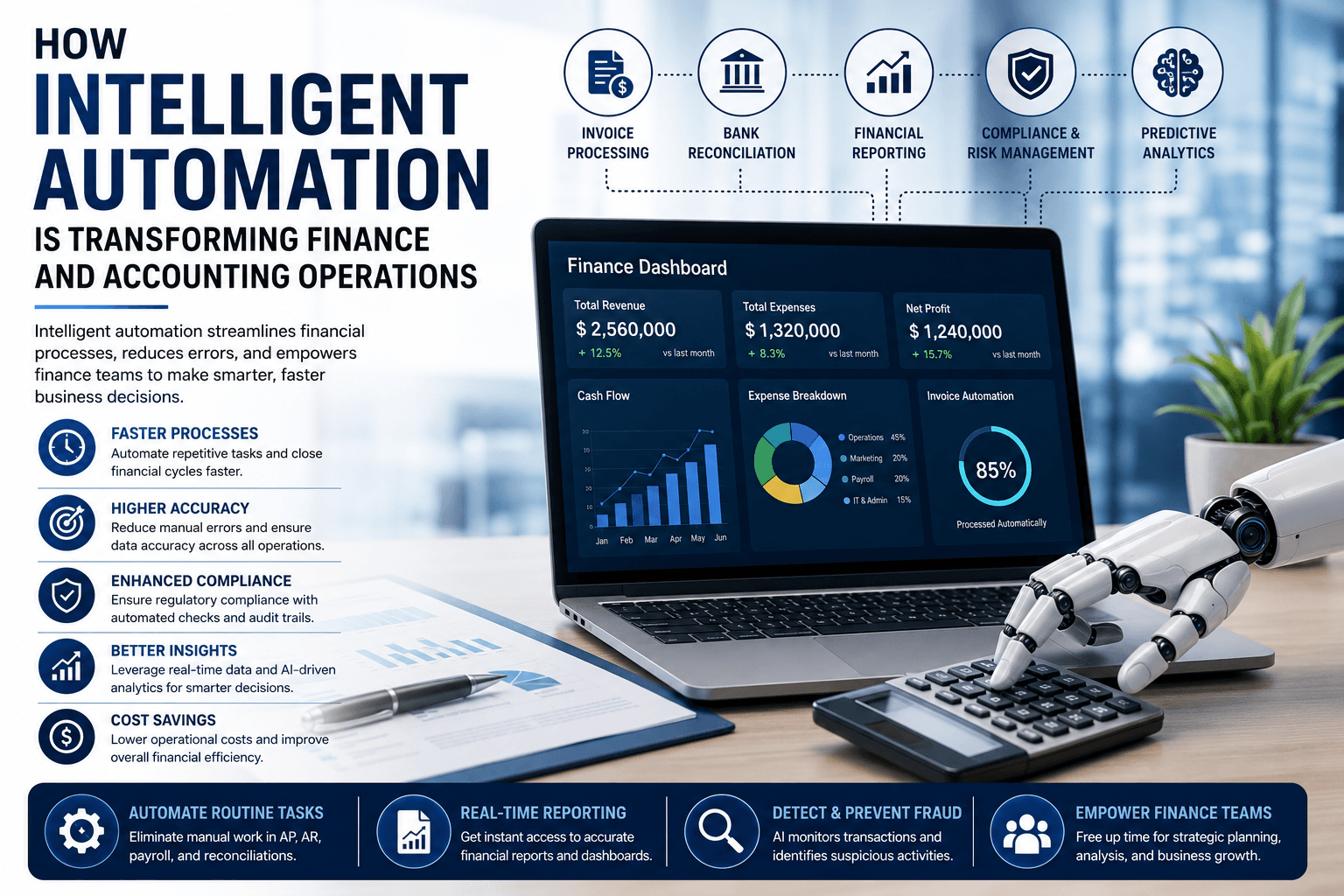
The finance and accounting industry is experiencing a major transformation as businesses embrace intelligent automation to improve efficiency, accuracy, and decision-making. Traditional financial processes often involve repetitive manual tasks, complex data entry, and time-consuming reporting, which can slow business operations and increase the risk of errors.
In 2026, intelligent automation—powered by artificial intelligence (AI), robotic process automation (RPA), machine learning, and advanced analytics—is helping finance teams streamline operations, reduce costs, and focus on strategic initiatives. Organizations of all sizes are investing in intelligent automation to modernize financial management and stay competitive in an increasingly digital economy.
## What Is Intelligent Automation?
Intelligent automation combines AI technologies with automation tools to perform business tasks that previously required human effort. Unlike basic automation, intelligent automation can analyze data, recognize patterns, make recommendations, and continuously improve through machine learning.
In finance and accounting, these systems can process invoices, reconcile accounts, generate reports, detect fraud, forecast cash flow, and support financial planning with minimal human intervention.
## Automating Routine Financial Tasks
One of the greatest advantages of intelligent automation is its ability to handle repetitive financial processes quickly and accurately. Tasks such as invoice processing, expense management, payroll calculations, bank reconciliations, and accounts payable can be completed automatically.
By reducing manual work, finance professionals can dedicate more time to financial analysis, business strategy, and decision-making.
## Improving Accuracy and Compliance
Manual accounting processes often lead to data entry mistakes and compliance risks. Intelligent automation minimizes human error by validating financial data, identifying inconsistencies, and ensuring transactions follow company policies and regulatory requirements.
Automated audit trails also simplify compliance with financial reporting standards and tax regulations.
## Faster Financial Reporting
Businesses rely on timely financial reports to make informed decisions. Intelligent automation gathers data from multiple systems, processes it in real time, and generates accurate reports much faster than traditional methods.
Finance leaders gain instant access to dashboards, performance metrics, and key financial indicators that support strategic planning.
## Enhancing Fraud Detection
AI-powered automation continuously monitors financial transactions to identify unusual activities, suspicious payment patterns, and potential fraud.
Machine learning algorithms improve over time by recognizing new fraud techniques, helping businesses strengthen financial security while reducing financial losses.
## Better Financial Forecasting
Predictive analytics enables finance teams to forecast revenue, expenses, cash flow, and market trends with greater accuracy.
By analyzing historical data alongside current business conditions, intelligent automation provides insights that help organizations make proactive financial decisions and prepare for future challenges.
## Supporting Employee Productivity
Rather than replacing finance professionals, intelligent automation enhances their productivity by eliminating repetitive administrative tasks.
Employees can focus on budgeting, financial planning, investment analysis, and advising business leaders on growth opportunities, creating greater value for the organization.
## Business Benefits
Organizations adopting intelligent automation in finance and accounting experience several significant advantages:
* Faster financial processes
* Lower operational costs
* Higher data accuracy
* Improved regulatory compliance
* Enhanced fraud detection
* Better financial forecasting
* Increased employee productivity
* Faster business decision-making
These benefits help organizations build more agile, efficient, and resilient finance operations.
## Challenges to Consider
Successful implementation requires high-quality financial data, secure system integration, employee training, and effective change management.
Organizations should also maintain human oversight for complex financial decisions while ensuring AI systems remain transparent and compliant with regulatory requirements.
## The Future of Intelligent Finance
The future of finance will increasingly rely on AI-driven automation, autonomous financial assistants, predictive analytics, and real-time decision support.
Generative AI will help finance professionals prepare reports, summarize financial performance, answer business questions, and provide strategic recommendations, allowing finance departments to become proactive business partners rather than administrative functions.
## Conclusion
Intelligent automation is revolutionizing finance and accounting by improving efficiency, reducing manual work, enhancing compliance, and providing deeper financial insights. Businesses that embrace AI-powered automation can streamline operations, strengthen financial control, and respond more quickly to changing market conditions.
As digital transformation accelerates, intelligent automation will become an essential component of modern financial management. Organizations that invest in these technologies today will be better positioned to drive sustainable growth, im
prove profitability, and remain competitive in the evolving business landscape.
| Category | Details |
|---|---|
| Topic | Automotive |
| Author | Lora |
| Published | 04/07/2026 |
| Read Time | Not set |
L