Introduction
Hybrid work has become the standard for many organizations worldwide. Employees now split their time between the office and remote locations, giving businesses greater flexibility while helping workers achieve a better work-life balance.
However, managing distributed teams presents new challenges, including communication gaps, project coordination, productivity tracking, and cybersecurity. In 2026, artificial intelligence (AI) is helping organizations overcome these obstacles by providing smarter collaboration, automation, and decision-making tools.
From AI meeting assistants to intelligent project management platforms, businesses are using AI to improve teamwork, reduce repetitive tasks, and increase overall productivity.
Why Hybrid Work Is Here to Stay
Businesses have realized that hybrid work offers several long-term benefits:
Greater employee flexibility
Lower office operating costs
Access to global talent
Higher job satisfaction
Improved employee retention
Better business continuity
As organizations continue adopting hybrid work models, AI is becoming an essential part of maintaining efficiency and collaboration.
How AI Is Transforming Remote Work
Artificial intelligence helps remote teams work smarter by automating repetitive tasks and improving communication.
Modern AI tools can:
Summarize meetings automatically
Schedule appointments
Organize documents
Translate conversations in real time
Generate reports
Prioritize tasks
Assist with writing and coding
Analyze productivity trends
This allows employees to spend more time on meaningful work instead of administrative tasks.
Essential AI Tools for Hybrid Teams
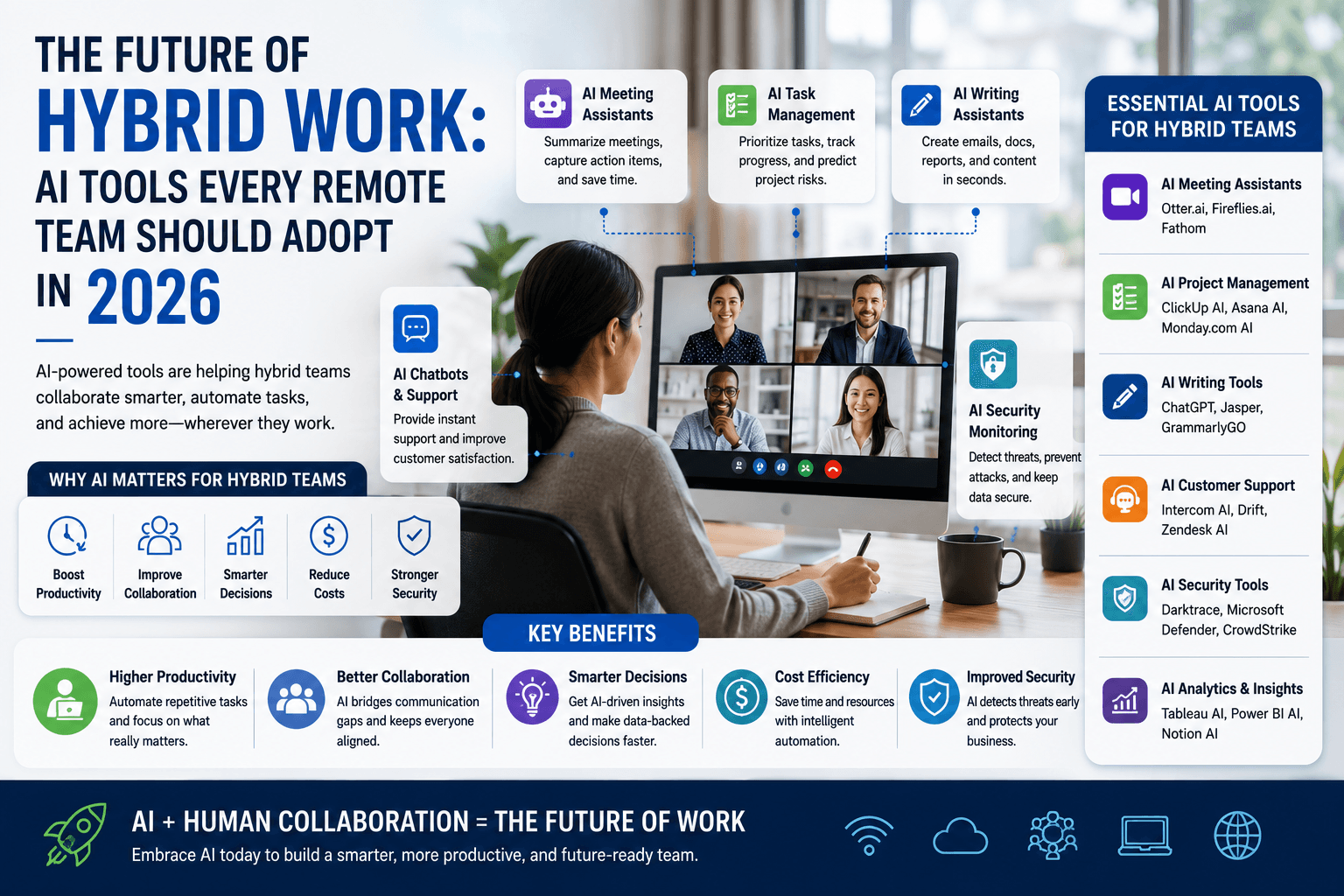
AI Meeting Assistants
AI-powered meeting assistants can:
Record meetings
Generate transcripts
Summarize discussions
Identify action items
Assign follow-up tasks
Employees no longer need to take detailed notes manually.
AI Project Management
Modern AI project management platforms help teams:
Prioritize work
Predict project delays
Allocate resources efficiently
Track progress automatically
Recommend workflow improvements
Project managers receive intelligent recommendations instead of relying only on manual updates.
AI Writing Assistants
Content creation is faster with AI.
Teams use AI to draft:
Emails
Reports
Marketing content
Documentation
Presentations
Knowledge base articles
AI reduces writing time while improving consistency.
AI Customer Support
Remote customer service teams use AI chatbots and virtual assistants to:
Answer common questions
Route customer inquiries
Provide instant support
Reduce response times
This improves customer satisfaction while lowering operational costs.
AI Cybersecurity Monitoring
Hybrid work increases cybersecurity risks.
AI security tools monitor:
Unusual login activity
Malware threats
Phishing attempts
Network anomalies
Unauthorized access
Real-time threat detection protects sensitive business information.
Benefits for Businesses
Organizations adopting AI-powered hybrid work tools experience several advantages.
Higher Productivity
Automation reduces repetitive administrative work.
Better Collaboration
AI improves communication across distributed teams.
Faster Decision-Making
Managers receive real-time insights and predictive analytics.
Lower Costs
Businesses reduce travel, office, and administrative expenses.
Improved Employee Experience
Employees spend more time on creative and strategic work.
Enhanced Customer Service
AI enables faster, more personalized support.
Industries Leading AI Adoption
AI-powered hybrid work solutions are becoming common in:
Information technology
Marketing agencies
Financial services
Healthcare administration
Education
Consulting
Customer support
Software development
These industries rely heavily on digital collaboration and knowledge sharing.
Challenges Businesses Should Consider
Despite the benefits, organizations must prepare for several challenges.
Data Privacy
AI tools often process sensitive company information.
Businesses should implement strong privacy controls.
Employee Training
Staff need guidance on using AI effectively and responsibly.
Integration
New AI tools should work smoothly with existing software systems.
Human Oversight
AI should support employees—not replace critical human decision-making.
Best Practices for AI-Powered Hybrid Work
Businesses should:
Develop clear AI usage policies
Choose secure AI platforms
Train employees regularly
Automate repetitive tasks first
Measure productivity improvements
Maintain human oversight
Continuously evaluate AI performance
These practices help organizations maximize AI's value while reducing risks.
The Future of Hybrid Work
The next generation of AI will make remote collaboration even more intelligent.
Future innovations may include:
Fully autonomous meeting assistants
AI digital coworkers
Real-time multilingual collaboration
Predictive workload balancing
Personalized productivity coaching
AI-generated business insights
Hybrid work will become more efficient, flexible, and data-driven than ever before.
Conclusion
Hybrid work is no longer a temporary solution—it is a permanent part of modern business. Artificial intelligence is making distributed teams more productive by automating repetitive tasks, improving communication, enhancing collaboration, and strengthening cybersecurity.
Organizations that invest in AI-powered hybrid work tools today will be better prepared to attract talent, improve operational efficiency, and remain competitive in the digital economy. The future workplace is not defined by location—it is powered by intelligent technology.
Frequently Asked Questions (FAQs)
What is hybrid work?
Hybrid work combines remote work and office-based work, allowing employees to work from different locations while staying connected through digital tools.
How does AI improve hybrid work?
AI automates administrative tasks, summarizes meetings, improves project management, enhances communication, and strengthens cybersecurity.
Which businesses benefit most from AI-powered hybrid work?
Technology companies, financial institutions, healthcare providers, marketing agencies, educational organizations, and customer support teams benefit significantly.
Will AI replace remote workers?
No. AI is designed to enhance employee productivity by automating repetitive tasks, allowing workers to focus on strategic, creative, and high-value activities.
FAQs: The Future of Hybrid Work: AI Tools Every Remote Team Should Adopt in 2026
1. How is AI transforming hybrid and remote work in 2026?
AI is transforming hybrid work by automating repetitive tasks, improving communication, organizing information, and helping employees collaborate across different locations and time zones. AI-powered meeting assistants can summarize discussions and identify action items, while intelligent project-management tools can prioritize tasks and detect potential delays. AI can also help employees search internal knowledge, draft documents, analyze data, and automate routine workflows. As a result, remote teams can spend less time on administrative work and more time on strategic and creative activities.
2. Which AI tools should every remote team consider adopting in 2026?
Remote teams should consider AI tools across several areas rather than relying on a single platform. Useful categories include AI meeting assistants, intelligent project-management software, AI writing and communication tools, automated workflow platforms, knowledge-management assistants, customer-support AI, cybersecurity tools, and analytics platforms. The best combination depends on the team's size, industry, budget, and existing technology stack. Companies should prioritize tools that solve measurable problems instead of adopting AI simply because it is trending.
3. How can AI improve virtual meetings for hybrid teams?
AI can make virtual meetings more productive by automatically transcribing conversations, generating summaries, identifying decisions, and assigning follow-up tasks. Team members who cannot attend a meeting can review an AI-generated summary instead of watching an entire recording. Some AI meeting tools can also help identify recurring topics, unanswered questions, and important commitments. This reduces the administrative burden associated with meetings and creates a searchable record of important discussions, which is particularly valuable for distributed teams working across multiple time zones.
4. Can AI help remote employees communicate more effectively?
Yes. AI can improve communication by helping employees write clearer emails, messages, reports, presentations, and project updates. Translation and language-assistance capabilities can also make international collaboration easier. AI can summarize lengthy conversations and extract the most important information from large message threads, reducing information overload. However, organizations should use AI as an assistant rather than allowing it to replace human communication entirely. Important decisions, sensitive conversations, and relationship-building still require genuine human interaction.
5. How can AI-powered project management benefit distributed teams?
AI-powered project-management platforms can analyze tasks, deadlines, workloads, and project dependencies to help teams organize work more efficiently. AI can suggest priorities, summarize project progress, identify overdue tasks, and highlight potential bottlenecks. For managers, this creates better visibility into projects without requiring constant status meetings. For employees, intelligent task recommendations can make it easier to understand what needs attention next. This can be especially useful when team members work asynchronously and managers cannot rely on physical visibility to understand progress.
6. Is AI useful for asynchronous work in remote organizations?
AI is particularly valuable for asynchronous work because it helps employees access information without requiring everyone to be online simultaneously. Meeting summaries, searchable company knowledge bases, automated reports, task updates, and AI assistants can allow employees to find answers independently. This reduces the need for unnecessary meetings and makes collaboration less dependent on overlapping working hours. In 2026, organizations that combine AI with strong asynchronous processes can potentially give employees greater flexibility while maintaining productivity and accountability.
7. How can remote companies use AI without creating employee surveillance concerns?
Companies should establish clear policies explaining what AI systems collect, why the information is collected, and how it will be used. AI should primarily support productivity and collaboration rather than becoming a tool for excessive employee monitoring. Organizations should avoid evaluating employees solely through automated activity metrics because online activity does not necessarily represent meaningful work. Transparency, data minimization, access controls, and employee involvement in policy development are important for maintaining trust. AI adoption works best when employees understand its purpose and feel that the technology is supporting rather than policing them.
8. What cybersecurity AI tools should hybrid teams use in 2026?
Hybrid organizations should consider AI-powered cybersecurity solutions that can detect unusual login behavior, identify suspicious messages, analyze network activity, and respond to potential threats more quickly. AI can help security teams process large volumes of alerts and identify patterns that might otherwise be missed. Remote employees also need strong identity management, multi-factor authentication, endpoint protection, secure collaboration platforms, and employee security training. AI should complement these controls rather than replace them, because sophisticated cyber threats still require human oversight and well-designed security processes.
9. How much can companies save by adopting AI for remote work?
The financial impact varies significantly depending on the organization, the tools selected, and how effectively they are integrated into existing workflows. AI can potentially reduce costs by automating repetitive administrative tasks, shortening meeting times, improving customer-service efficiency, reducing manual data processing, and helping employees complete routine work faster. However, purchasing multiple AI subscriptions without eliminating redundant processes can increase expenses. Companies should therefore measure productivity gains, time saved, error reduction, and operational improvements before expanding AI investments across the organization.
10. What will the future of AI-powered hybrid work look like?
The future of hybrid work will likely involve AI becoming an integrated layer across communication, collaboration, project management, cybersecurity, knowledge management, and business operations. Instead of employees opening separate applications for every task, AI assistants may increasingly connect information and workflows across multiple systems. Employees could ask an AI assistant for a project update, retrieve relevant documents, identify outstanding tasks, and prepare a summary without manually searching several platforms. The organizations most likely to benefit will be those that combine AI adoption with clear workflows, strong data governance, employee training, and a culture that balances technological efficiency with human collaboration.