Artificial intelligence is moving beyond simple chatbots and content generators. One of the most important technology trends is the rise of AI agents—software systems designed to pursue goals, make decisions within defined limits, and perform multi-step tasks with varying degrees of autonomy.
In 2026, businesses are exploring AI agents for customer support, research, sales operations, software development, data analysis, and other workflows. While these systems can improve productivity, they also introduce new challenges involving reliability, security, governance, and human oversight.
This article explains what AI agents are, how they work, and how they may change the future of business.
What Are AI Agents?
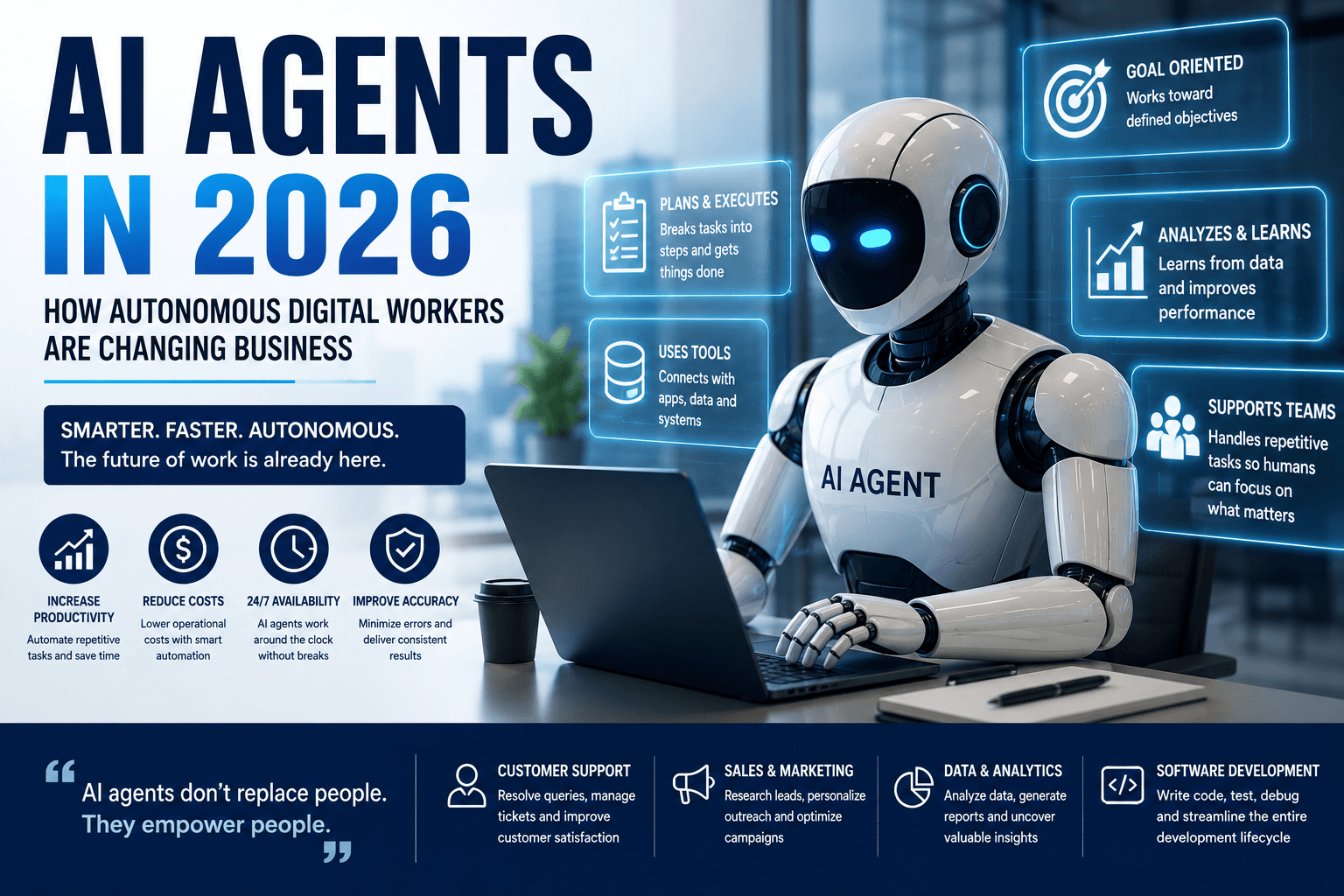
An AI agent is a software system that can receive a goal, process information, decide on actions, use available tools, and carry out steps toward completing a task.
Unlike a traditional chatbot that mainly responds to individual prompts, an AI agent may be designed to handle a longer workflow.
For example, an AI agent could potentially:
Receive a business request.
Search approved information sources.
Analyze relevant data.
Prepare a draft response or report.
Request approval when necessary.
Complete permitted actions.
The exact level of autonomy depends on how the system is designed and what permissions it receives.
How Do AI Agents Work?
AI agents typically combine several components.
Goal and Instructions
The agent receives a task or objective, along with rules that define what it is allowed to do.
Reasoning and Planning
The system analyzes the task and determines possible steps.
Memory and Context
Some AI agent systems can retain relevant information or access approved context to support longer workflows.
Tools and Integrations
AI agents may use tools such as:
Search systems
Databases
Business software
Email systems
Calendars
Customer relationship management platforms
Internal knowledge bases
Actions
The agent can perform permitted actions based on its instructions and available tools.
Feedback and Monitoring
Human oversight and system monitoring can help identify errors and improve performance.
AI Agents vs Traditional Chatbots
Traditional chatbots usually respond to individual questions.
AI agents can be designed to perform more complex, multi-step workflows.
Traditional Chatbot | AI Agent |
|---|---|
Responds to prompts | Works toward a defined goal |
Usually handles single interactions | Can manage multiple steps |
Limited actions | May use approved tools |
Often requires repeated instructions | Can follow structured workflows |
Primarily conversational | Can be action-oriented |
The difference is not always absolute, as modern AI systems can combine conversational and agent-like capabilities.
How Businesses Are Using AI Agents
AI agents can support many different business functions.
Customer Support
AI agents may help:
Answer common questions
Search knowledge bases
Route complex issues
Prepare customer responses
Update support records
Human employees may still handle sensitive or complex cases.
Sales and Marketing
AI agents can potentially assist with:
Lead research
Customer segmentation
Campaign analysis
Follow-up preparation
Market research
Businesses should carefully control how agents access customer information and communicate externally.
Data Analysis
AI agents can help analyze large amounts of information and generate summaries.
For example, an agent could:
Review sales data
Identify trends
Create reports
Highlight unusual changes
Important decisions should still be reviewed by qualified professionals.
Software Development
AI agents are increasingly being used to assist developers with:
Writing code
Reviewing code
Finding bugs
Creating documentation
Testing software
Human developers remain responsible for reviewing critical code and ensuring security.
Human Resources
Potential uses include:
Organizing job applications
Answering common employee questions
Preparing documents
Managing routine administrative tasks
Organizations should be especially careful when AI systems are involved in decisions that affect people.
Benefits of AI Agents for Businesses
Increased Productivity
AI agents can automate repetitive parts of complex workflows, allowing employees to focus on higher-value tasks.
Faster Operations
Agents can process information and complete approved tasks quickly.
Continuous Availability
Some AI systems can operate outside normal business hours, depending on their design and infrastructure.
Scalable Support
Businesses may use AI agents to handle increasing volumes of routine requests.
Better Workflow Automation
AI agents can connect multiple steps that previously required manual work.
Risks and Challenges
AI agents also introduce significant challenges.
Reliability Problems
AI systems can make mistakes, misunderstand instructions, or produce inaccurate information.
An agent should not be trusted with important decisions without appropriate safeguards.
Security Risks
Giving an AI agent access to business systems can create security concerns.
Organizations should carefully control:
Permissions
Data access
Tool access
External actions
The principle of least privilege is important: an agent should have only the access it genuinely needs.
Privacy Concerns
Businesses must consider how customer, employee, and company data is handled.
Sensitive information should be protected according to applicable laws and organizational policies.
Lack of Transparency
Complex AI systems can make it difficult to understand why a particular action was taken.
Logging and monitoring can help organizations investigate problems.
Over-Automation
Not every task should be automated.
Human judgment remains essential for:
High-stakes decisions
Ethical questions
Sensitive customer situations
Legal matters
Strategic decisions
How to Implement AI Agents Safely
Businesses should avoid giving AI agents unlimited access to important systems.
A safer implementation process may include the following steps.
Step 1: Start with a Specific Use Case
Choose a well-defined problem.
For example:
Automatically organize customer support requests.
This is easier to measure and control than:
Automate the entire customer service department.
Step 2: Define Clear Permissions
Specify what the agent can and cannot do.
For example, an agent might be allowed to:
Read support tickets
Search a knowledge base
Draft responses
But require human approval before:
Issuing refunds
Changing customer accounts
Sending sensitive information
Step 3: Test Before Deployment
Test the agent using realistic scenarios.
Include unusual and difficult cases, not just simple examples.
Step 4: Keep Humans in the Loop
Human approval should be required for high-risk or important actions.
Step 5: Monitor Performance
Track:
Errors
Failed tasks
Unexpected actions
Security events
User feedback
Step 6: Improve Continuously
Update instructions, permissions, and workflows based on real-world results.
The Future of AI Agents
AI agents are likely to become more capable and more deeply integrated into business software.
Future systems may handle increasingly complex workflows involving multiple tools and data sources.
However, greater capability also means greater responsibility.
Businesses will need strong systems for:
AI governance
Security
Human oversight
Privacy protection
Performance monitoring
The most successful organizations may be those that combine AI automation with human expertise rather than attempting to automate every decision.
AI Agents and the Future of Work
AI agents are likely to change how people work.
Some routine tasks may become increasingly automated, while employees may spend more time on:
Strategy
Creativity
Relationship building
Complex problem-solving
Decision-making
This may also increase demand for skills related to:
AI management
Data literacy
AI security
Workflow design
Critical thinking
The future may involve humans and AI systems working together rather than AI simply replacing people.
Best Practices for Businesses Using AI Agents
To use AI agents responsibly:
Start with small, clearly defined tasks.
Limit system permissions.
Protect sensitive information.
Keep humans involved in important decisions.
Monitor agent activity.
Test for errors and unusual situations.
Maintain clear governance policies.
Regularly review system performance.
Train employees to work effectively with AI.
Focus on practical business value.
Final Thoughts
AI agents represent a significant step in the evolution of business automation. Unlike simple chatbots, they can potentially manage multi-step tasks, interact with tools, and work toward specific goals.
In 2026, their biggest value may come from helping businesses automate repetitive workflows while allowing employees to focus on work that requires human judgment and creativity.
However, AI agents should not be treated as completely independent employees. They require careful design, limited permissions, monitoring, and human oversight.
The future of AI agents is likely to be defined not only by what they can do, but also by how safely and responsibly organizations choose to use them.
Frequently Asked Questions
1. What is an AI agent?
An AI agent is a software system designed to work toward a goal by processing information, making decisions within defined limits, and using available tools.
2. How are AI agents different from chatbots?
Chatbots primarily respond to conversations, while AI agents can be designed to manage multi-step workflows and perform approved actions.
3. Can AI agents replace employees?
AI agents can automate some tasks, but human skills such as judgment, creativity, leadership, and relationship building remain important.
4. What can AI agents do for businesses?
They can support customer service, research, sales, data analysis, software development, and other workflows.
5. Are AI agents safe?
Their safety depends on their design, permissions, security controls, monitoring, and human oversight.
6. What are the biggest risks of AI agents?
Major risks include errors, security vulnerabilities, privacy concerns, and excessive automation.
7. Do AI agents need human supervision?
Human oversight is especially important for high-risk decisions and sensitive actions.
8. How can a small business use AI agents?
A small business can start with simple use cases such as organizing customer inquiries, preparing reports, or researching information.
9. What skills are needed to work with AI agents?
Useful skills include AI literacy, critical thinking, workflow design, data literacy, and understanding how to monitor AI systems.
10. What is the future of AI agents?
AI agents are likely to become more capable and integrated into business systems, with increasing emphasis on governance, security, and responsible human oversight.