
TFThe Future of Smart Homes in 2026: AI, Automation & Connected Living
Investors have long debated whether dividend stocks or growth stocks offer the better path to building wealth. In 2026, this question remains more relevant than ever as changing interest rates, technological innovation, and evolving global markets create new opportunities for investors.
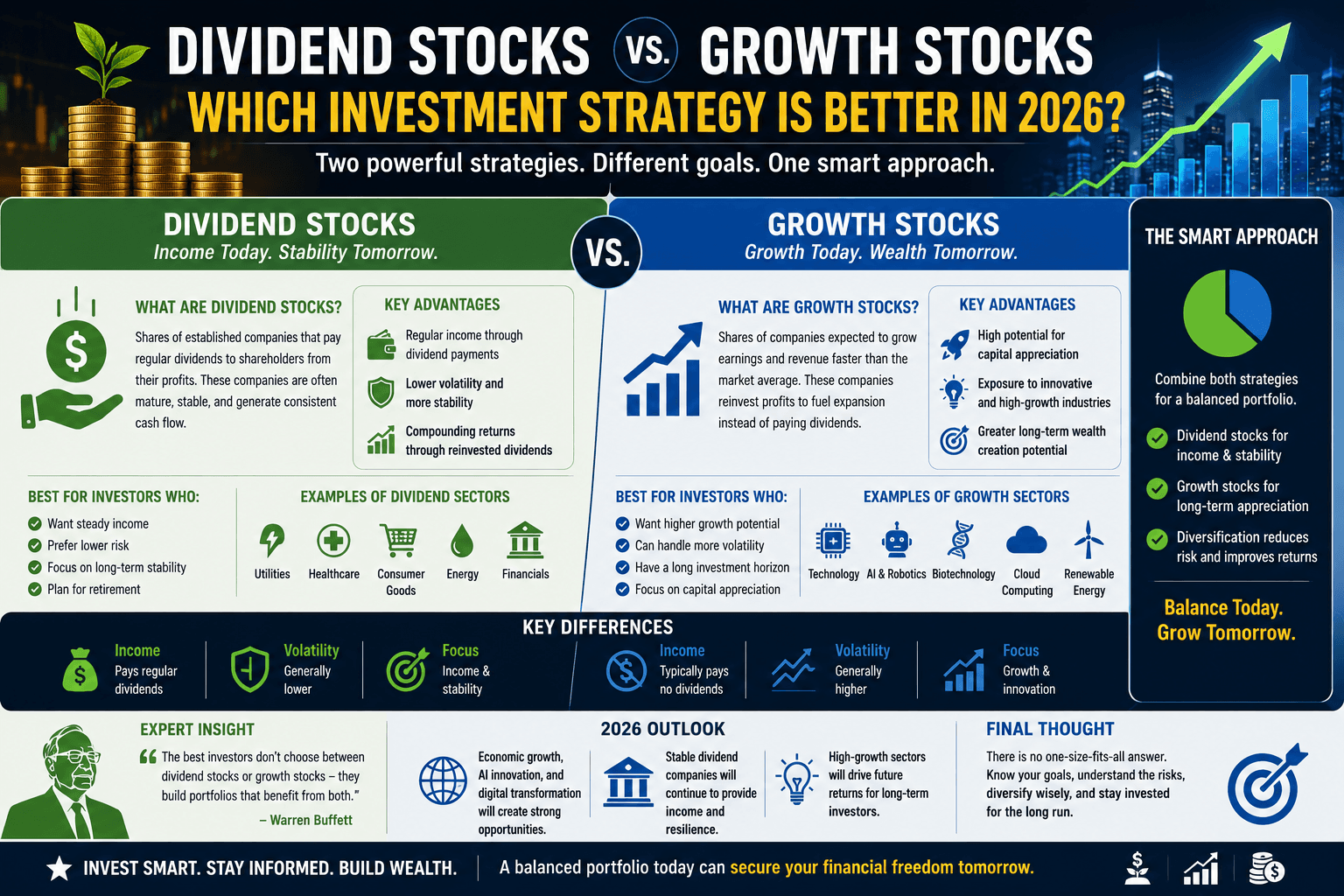
Both investment strategies have unique advantages. Dividend stocks provide regular income and stability, while growth stocks focus on capital appreciation through expanding businesses. Choosing between them depends on your financial goals, risk tolerance, and investment timeline.
Rather than viewing these strategies as competitors, many financial professionals recommend understanding how each fits into a diversified investment portfolio.
What Are Dividend Stocks?
Dividend stocks are shares of companies that regularly distribute a portion of their profits to shareholders.
These businesses are often mature, financially stable, and generate consistent cash flow. Instead of reinvesting all earnings into expansion, they return part of their profits through quarterly or annual dividend payments.
Common industries known for dividend-paying companies include:
Banking
Utilities
Consumer goods
Healthcare
Telecommunications
Energy
Dividend investing appeals to investors seeking reliable income and long-term financial stability.
Advantages of Dividend Stocks
Dividend stocks offer several important benefits.
Reliable Income
One of the biggest advantages is the opportunity to receive regular dividend payments.
This income can be used for living expenses, reinvested to purchase additional shares, or saved for future financial goals.
Lower Volatility
Dividend-paying companies often have established business models and stable earnings.
As a result, they may experience less price volatility than rapidly growing companies.
Compounding Returns
Reinvesting dividends allows investors to purchase additional shares over time.
This creates compound growth, helping portfolios expand through both capital appreciation and dividend income.
What Are Growth Stocks?
Growth stocks belong to companies expected to increase revenue and earnings faster than the overall market.
Instead of paying dividends, these businesses typically reinvest profits into expansion, research, product development, and innovation.
Popular growth sectors include:
Artificial Intelligence
Cloud Computing
Cybersecurity
Software
Biotechnology
Semiconductor Manufacturing
Investors purchase growth stocks expecting future increases in company value.
Benefits of Growth Stocks
Growth investing offers several potential advantages.
Higher Capital Appreciation
Successful growth companies may experience significant increases in share prices over time.
Long-term investors often benefit from substantial capital gains if businesses continue expanding successfully.
Innovation
Growth companies frequently lead technological innovation.
Businesses developing AI solutions, healthcare technologies, renewable energy, and financial technology often operate in rapidly expanding industries.
Long-Term Wealth Creation
Many of the world's largest companies began as growth businesses focused on innovation rather than paying dividends.
Investors willing to hold quality growth companies over many years may benefit from long-term appreciation.
Risks of Dividend Stocks
Although dividend investing is generally considered more conservative, risks remain.
Potential challenges include:
Slower capital growth
Dividend reductions during economic downturns
Limited expansion opportunities
Interest rate sensitivity
Investors should evaluate company fundamentals before relying on dividend income.
Risks of Growth Stocks
Growth investing also carries important risks.
These include:
Higher price volatility
Expensive valuations
Greater sensitivity to economic conditions
Earnings uncertainty
Rapidly growing businesses often experience larger share price fluctuations than mature dividend-paying companies.
Which Strategy Performs Better?
There is no universal answer.
Market conditions often determine which investment style outperforms.
During periods of economic expansion, growth stocks may deliver stronger returns.
During uncertain or volatile markets, dividend-paying companies often provide greater stability.
Experienced investors understand that both strategies have valuable roles within diversified portfolios.
Can You Own Both?
Absolutely.
Many successful investors combine dividend stocks and growth stocks to balance income and capital appreciation.
For example:
Dividend stocks provide steady cash flow.
Growth stocks offer higher long-term upside.
Together, they improve diversification and reduce dependence on one investment style.
This balanced approach allows investors to benefit from multiple market conditions.
Building a Balanced Portfolio
A diversified investment portfolio may include:
Dividend-paying blue-chip companies
High-growth technology stocks
Exchange-Traded Funds (ETFs)
Healthcare companies
Financial services
Renewable energy businesses
International equities
Diversification remains one of the most effective methods for managing investment risk.
Long-Term Investment Principles
Regardless of strategy, successful investors often follow similar principles.
These include:
Investing consistently
Diversifying across sectors
Reinvesting profits
Researching companies carefully
Avoiding emotional decisions
Maintaining long-term goals
Patience often becomes one of the greatest advantages in wealth creation.
Future Outlook
Both dividend and growth investing are expected to remain important throughout 2026.
Artificial intelligence, digital transformation, renewable energy, financial technology, and healthcare innovation continue creating opportunities for growth investors.
At the same time, stable dividend-paying companies continue attracting investors seeking dependable income and lower portfolio volatility.
Rather than choosing one approach exclusively, many investors may benefit from combining both strategies.
Conclusion
The debate between dividend stocks and growth stocks does not have a single correct answer. Each strategy offers unique advantages depending on an investor's financial objectives, risk tolerance, and investment horizon.
Dividend stocks provide reliable income, stability, and compound growth through reinvestment, while growth stocks offer greater capital appreciation and exposure to rapidly expanding industries.
A well-diversified portfolio that combines both investment styles can help investors balance risk, generate income, and build long-term wealth in an evolving financial landscape.
As markets continue changing in 2026, disciplined investing, continuous learning, and diversification remain the foundations of successful financial planning.